Loading...
Digital Logic Design
What is System & types of different systems.

A system is a collection of different components that are connected or organized together to perform a specific task or function.
Each component of the system works together and depends on other components to achieve a common objective.

Example: Computer System

A computer is a good example of a system because it consists of several interconnected components that work together to process data.

ComponentFunction
CPU (Central Processing Unit)Processes instructions and performs calculations
MemoryStores data and programs temporarily
MonitorDisplays output information
KeyboardAllows users to input data
MouseControls cursor and interacts with programs
PrinterProduces printed output

All these components are connected and work together to perform tasks such as data processing, information display, and user interaction. Therefore, a computer can be considered a system.
Types of Systems
Systems can be broadly classified into two main categories based on how they process and represent data.

  1. Analog System
  2. Digital System

System হলো এমন একটি গঠন যেখানে বিভিন্ন component বা অংশ একসাথে সংযুক্ত হয়ে একটি নির্দিষ্ট কাজ সম্পন্ন করে।
System-এর প্রতিটি component একে অপরের সাথে সম্পর্কিত এবং একসাথে কাজ করে একটি নির্দিষ্ট লক্ষ্য অর্জন করে।

Example: Computer System

একটি computer একটি system-এর ভালো উদাহরণ কারণ এতে অনেকগুলো component একসাথে কাজ করে।

ComponentFunction
CPU (Central Processing Unit)Instruction process করে এবং calculation সম্পন্ন করে
MemoryData এবং program সাময়িকভাবে সংরক্ষণ করে
MonitorOutput information প্রদর্শন করে
KeyboardUser থেকে input নেওয়ার জন্য ব্যবহৃত হয়
MouseCursor control এবং program interact করার জন্য ব্যবহৃত হয়
PrinterPrinted output তৈরি করে

এই সব component একসাথে সংযুক্ত হয়ে বিভিন্ন কাজ সম্পন্ন করে। তাই computer-কে একটি system বলা হয়।
System-এর ধরন
System-কে সাধারণত data process করার পদ্ধতির উপর ভিত্তি করে দুইটি প্রধান ভাগে ভাগ করা যায়।

  1. Analog System
  2. Digital System
Analog System and its Characteristics

An Analog System is a system that processes information using continuous-time signals called analog signals. These signals vary smoothly over time and are usually represented by a sinusoidal waveform. In an analog system, the signal amplitude changes continuously and can take any value within a given range.

Analog systems transmit signals in their original or raw form, which reduces the need for conversion or translation. Because of this property, analog systems are often used to represent natural physical quantities.

Analog signals are commonly used to represent real-world phenomena such as sound, temperature, pressure, and light intensity.

Characteristics of Analog Systems

  • Uses Continuous Signals: Analog systems use continuous electrical signals such as voltage or sound waves to represent information.
  • Real-World Representation: Analog systems are suitable for representing natural phenomena like sound, temperature, and light because these quantities change continuously.
  • Smooth Signal Variation: The output signal changes smoothly without sudden jumps between values.
  • Higher Circuit Complexity: Analog systems often require complex electronic circuits to process and transmit signals accurately.

Examples of Analog Systems

DeviceFunction
Analog ThermometerMeasures temperature using continuous expansion of liquid.
Analog ClockDisplays time using continuously moving hands.
MicrophoneConverts sound waves into continuous electrical signals.

Analog System হলো এমন একটি system যেখানে তথ্য continuous signal বা analog signal ব্যবহার করে প্রক্রিয়াকরণ করা হয়। এই signal সাধারণত sinusoidal waveform আকারে থাকে এবং সময়ের সাথে সাথে এর amplitude ধারাবাহিকভাবে পরিবর্তিত হয়।

Analog system-এ signal সাধারণত তার raw form-এ transmit করা হয়, ফলে signal convert করার জন্য অতিরিক্ত সময় লাগে না। এই কারণে analog system প্রাকৃতিক physical quantity প্রকাশ করার জন্য উপযোগী।

Analog signal সাধারণত sound, temperature, light intensity, pressure ইত্যাদি real-world signal প্রকাশ করতে ব্যবহৃত হয়।

Analog System-এর বৈশিষ্ট্য

  • Continuous Signal ব্যবহার: Analog system-এ information continuous electrical signal যেমন voltage বা sound wave-এর মাধ্যমে প্রকাশ করা হয়।
  • Real-World Signal Representation: Sound, temperature এবং light-এর মতো natural phenomenon প্রকাশ করতে analog system উপযোগী।
  • Smooth Signal Change: Signal ধীরে ধীরে পরিবর্তিত হয় এবং কোনো sudden jump থাকে না।
  • Circuit Complexity: Analog system-এ signal process এবং transmit করার জন্য তুলনামূলকভাবে complex electronic circuit প্রয়োজন হয়।

Analog System-এর উদাহরণ

DeviceFunction
Analog ThermometerLiquid expansion ব্যবহার করে temperature মাপা হয়।
Analog ClockClock hand-এর মাধ্যমে সময় দেখায়।
MicrophoneSound wave-কে continuous electrical signal-এ রূপান্তর করে।
Analog Signal in Analog System
Digital System and its Characteristics

A Digital System is a system that processes information using digital signals. Unlike analog systems, digital systems use signals that have a finite number of discrete values. These signals are usually represented using binary numbers (0 and 1).

Digital systems operate using digital logic and electronic circuits to process and store information. Because of their accuracy and efficiency, digital systems are widely used in modern electronic devices such as computers, calculators, mobile phones, and telecommunication systems.

Characteristics of Digital Systems

  • Uses Binary Code: Digital systems represent information using binary digits (0 and 1).
  • High Accuracy: Information in digital systems is represented precisely, which reduces errors compared to analog systems.
  • Fast Processing: Digital systems can process large amounts of data quickly and efficiently.
  • Noise Immunity: Digital signals are less affected by noise or interference during transmission.
  • Scalability: Digital systems can easily be expanded by adding memory or integrating new components.
  • Efficient Storage: Data is stored efficiently in digital memory using binary representation.

Examples of Digital Systems

DeviceFunction
ComputerProcesses and stores digital data.
CalculatorPerforms arithmetic calculations using digital logic.
Digital TelephoneTransmits voice in digital form.
Digital ClockDisplays time in numeric digital format.

Digital System হলো এমন একটি system যেখানে information digital signal ব্যবহার করে process করা হয়। Digital system-এ signal-এর মান সীমিত এবং সাধারণত binary value (0 এবং 1) দ্বারা প্রকাশ করা হয়।

Digital system digital logic এবং electronic circuit ব্যবহার করে data process, transmit এবং store করে। এই ধরনের system আধুনিক electronic device-এ ব্যাপকভাবে ব্যবহৃত হয়, যেমন computer, calculator, mobile phone, digital telephone ইত্যাদি।

Digital System-এর বৈশিষ্ট্য

  • Binary Code ব্যবহার: Digital system-এ information 0 এবং 1-এর combination দ্বারা প্রকাশ করা হয়।
  • উচ্চ নির্ভুলতা: Digital system-এ data নির্দিষ্টভাবে উপস্থাপন করা হয়, ফলে error কম হয়।
  • দ্রুত Processing: Digital system অল্প সময়ে অনেক data দ্রুত process করতে পারে।
  • Noise Immunity: Digital signal noise বা interference দ্বারা কম প্রভাবিত হয়।
  • Scalability: Memory বা নতুন component যোগ করে system সহজে expand করা যায়।
  • Efficient Storage: Binary form ব্যবহার করে data memory-তে দক্ষতার সাথে সংরক্ষণ করা যায়।

Digital System-এর উদাহরণ

DeviceFunction
ComputerDigital data process এবং store করে।
CalculatorDigital logic ব্যবহার করে গাণিতিক হিসাব করে।
Digital TelephoneVoice signal digital form-এ transmit করে।
Digital Clockসংখ্যা আকারে সময় প্রদর্শন করে।
Digital signal used in Digital Systems
Analog System vs Digital System

What is Signal ? Write Propertise and types of signal.(Digital and Analog Signal)

A signal is a physical quantity that carries or transmits information from one point to another. In electronic and communication systems, signals are used to represent data or information so that it can be processed, transmitted, or received.

Signals can exist in different forms such as voltage, current, electromagnetic waves, and optical signals. These signals travel through communication channels like wires, air (electromagnetic waves), or optical fibers.

Signals are considered the backbone of electronic communication and processing systems because they allow information to be transferred between devices.

Properties of a Signal

A signal is characterized by several important properties in electronics.

  • Magnitude: Magnitude refers to the strength or maximum value of a signal. It represents the intensity of the signal.
  • Frequency: Frequency is the number of oscillations or cycles of a signal that occur in one second. It is measured in Hertz (Hz).
  • Time Period: The time taken by a signal to complete one full cycle or oscillation is called the time period.

Signal হলো এমন একটি physical quantity যা এক স্থান থেকে অন্য স্থানে information বা data বহন করে। Electronic এবং communication system-এ signal ব্যবহার করা হয় information transmit এবং process করার জন্য।

Signal বিভিন্ন আকারে হতে পারে যেমন voltage, current, electromagnetic wave এবং optical signal। এই signal বিভিন্ন communication channel যেমন wires, air (electromagnetic waves) এবং optical fiber এর মাধ্যমে প্রেরণ করা হয়।

Signal মূলত electronic communication system-এর মৌলিক ভিত্তি, কারণ এর মাধ্যমে device গুলোর মধ্যে information আদান-প্রদান করা সম্ভব হয়।

Signal-এর বৈশিষ্ট্য (Properties of Signal)

Electronics-এ একটি signal সাধারণত কয়েকটি গুরুত্বপূর্ণ বৈশিষ্ট্যের মাধ্যমে নির্ধারিত হয়।

  • Magnitude: Signal-এর সর্বোচ্চ মান বা শক্তিকে magnitude বলা হয়। এটি signal-এর intensity নির্দেশ করে।
  • Frequency: প্রতি সেকেন্ডে signal কতবার oscillation করে তাকে frequency বলা হয়। এটি Hertz (Hz) এককে পরিমাপ করা হয়।
  • Time Period: একটি সম্পূর্ণ oscillation সম্পন্ন করতে যে সময় লাগে তাকে time period বলা হয়।
Types of signal.(Digital and Analog Signal)

Types of Signals
In electronics and communication systems, signals are mainly classified into two types.

TypeDescription
Analog SignalA signal that varies continuously over time and can take any value within a given range.
Digital SignalA signal that has discrete values and usually represents information in binary form (0 and 1).

Signal-এর ধরন (Types of Signal)

Electronics এবং communication system-এ প্রধানত দুই ধরনের signal ব্যবহৃত হয়।

TypeDescription
Analog Signalসময়ের সাথে ধারাবাহিকভাবে পরিবর্তিত হয় এবং যেকোনো মান গ্রহণ করতে পারে।
Digital SignalDiscrete মান ব্যবহার করে এবং সাধারণত binary (0 এবং 1) দ্বারা information প্রকাশ করে।
Analog Signal and its propertise

An analog signal is a type of electronic signal that has continuous values within a given range. Analog signals vary smoothly with time and are expressed as continuous functions of time. These signals are usually represented by continuously varying voltage or current waveforms.

Analog signals are widely used to represent natural physical quantities. Some common examples of analog signals include human voice, speed, pressure, and temperature.

An important characteristic of an analog signal is that it has a definite value at every instant of time. This value is known as the instantaneous value of the signal.

Analog signals have smooth waveforms because they are continuous in both amplitude and time. This means there are no interruptions or gaps in the signal representation.

Properties of Analog Signal

  • Continuous Nature: Analog signals are continuous in both amplitude and time.
  • Instantaneous Value: At any moment of time, the signal has a specific value or magnitude.
  • Infinite Resolution: Analog signals can take any value within a given range, giving them theoretically infinite resolution.
  • Real-World Representation: Analog signals are best suited for representing real-world phenomena such as sound, temperature, and light.
  • Smooth Waveform: Analog signals are represented by smooth and continuously varying waveforms.

Analog signal হলো এমন একটি electronic signal যার মান একটি নির্দিষ্ট সীমার মধ্যে ধারাবাহিকভাবে পরিবর্তিত হয়। Analog signal সময়ের সাথে সাথে smoothভাবে পরিবর্তিত হয় এবং এটি continuous function of time দ্বারা প্রকাশ করা হয়। সাধারণত analog signal-কে continuously varying voltage বা current waveform দ্বারা প্রকাশ করা হয়।

Analog signal সাধারণত real-world physical quantity প্রকাশ করতে ব্যবহৃত হয়। যেমন মানব কণ্ঠস্বর (voice), speed, pressure, temperature ইত্যাদি analog signal-এর উদাহরণ।

Analog signal-এর একটি গুরুত্বপূর্ণ বৈশিষ্ট্য হলো যেকোনো সময়ে এর একটি নির্দিষ্ট মান থাকে, যাকে instantaneous value বলা হয়।

Analog signal amplitude এবং time উভয় ক্ষেত্রেই continuous হওয়ায় এর waveform খুব smooth হয় এবং সময়ের সাথে কোনো interruption বা break থাকে না।

Analog Signal-এর বৈশিষ্ট্য

  • Continuous Signal: Analog signal amplitude এবং time উভয় ক্ষেত্রেই ধারাবাহিকভাবে পরিবর্তিত হয়।
  • Instantaneous Value: যেকোনো মুহূর্তে signal-এর একটি নির্দিষ্ট magnitude থাকে।
  • Infinite Resolution: Analog signal একটি নির্দিষ্ট সীমার মধ্যে অসংখ্য মান গ্রহণ করতে পারে।
  • Real-World Representation: Sound, temperature এবং light-এর মতো natural phenomenon প্রকাশ করতে analog signal উপযোগী।
  • Smooth Waveform: Analog signal সাধারণত smooth এবং continuously varying waveform দ্বারা প্রকাশ করা হয়।
Analog Signal in Analog System
Digital Signal and its propertise

A digital signal is a type of electronic signal that represents information using a finite set of discrete values. Unlike analog signals, digital signals do not vary continuously with time. Instead, they change in steps and are represented as discontinuous functions of time.

Digital signals are also known as binary signals because they use two states: 0 and 1.
Here, binary 0 represents the low or OFF state, and binary 1 represents the high or ON state of the signal.

Digital signals are widely used in modern electronic systems such as computers, digital communication systems, calculators, and digital storage devices.

Properties of Digital Signal

  • Discrete Values: Digital signals have discrete or discontinuous values in both amplitude and time.
  • No Intermediate Values: Digital signals do not have values defined between two distinct instants of time.
  • Binary Representation: Information is represented using binary digits (0 and 1) by sampling signal values at specific time intervals.
  • Binary Data Sequence: Digital signals represent information as a sequence of binary bits.
  • Finite Resolution: Digital signals have limited resolution because they can only take specific discrete values.
  • Logical Operations: Digital signals can perform logical operations such as AND, OR, and NOT in digital circuits.
  • Efficient Storage and Transmission: Digital signals are more reliable and efficient for data storage and communication.

Digital signal হলো এমন একটি electronic signal যা information প্রকাশ করার জন্য সীমিত সংখ্যক discrete value ব্যবহার করে। Analog signal-এর মতো এটি ধারাবাহিকভাবে পরিবর্তিত হয় না, বরং ধাপে ধাপে পরিবর্তিত হয় এবং discontinuous function of time হিসেবে প্রকাশ করা হয়।

Digital signal-কে অনেক সময় binary signal বলা হয় কারণ এতে দুটি মান ব্যবহার করা হয়: 0 এবং 1
এখানে binary 0 দ্বারা low বা OFF state বোঝায় এবং binary 1 দ্বারা high বা ON state বোঝায়।

Digital signal আধুনিক electronic system যেমন computer, digital communication system, calculator এবং digital storage device-এ ব্যাপকভাবে ব্যবহৃত হয়।

Digital Signal-এর বৈশিষ্ট্য

  • Discrete Value: Digital signal amplitude এবং time উভয় ক্ষেত্রেই discrete বা discontinuous মান ধারণ করে।
  • No Intermediate Value: দুটি নির্দিষ্ট সময়ের মধ্যে কোনো মধ্যবর্তী মান থাকে না।
  • Binary Representation: নির্দিষ্ট সময়ে signal sample করে information binary (0 এবং 1) দ্বারা প্রকাশ করা হয়।
  • Binary Data Sequence: Digital signal binary bit-এর ধারাবাহিক sequence দ্বারা information প্রকাশ করে।
  • Finite Resolution: Digital signal শুধুমাত্র নির্দিষ্ট কিছু মান গ্রহণ করতে পারে।
  • Logical Operation: Digital circuit-এ AND, OR, NOT-এর মতো logical operation করা যায়।
  • Efficient Storage and Transmission: Data storage এবং transmission-এর ক্ষেত্রে digital signal বেশি নির্ভরযোগ্য।
Digital signal used in Digital Systems
Analog Signal VS Digital Signal

Difference Between Analog Signal and Digital Signal

  • Nature of Signal: An analog signal is continuous in nature and varies smoothly with time, whereas a digital signal has discrete values and changes in steps.
  • Representation: Analog signals represent information using a continuous range of values, while digital signals represent information using binary values 0 and 1.
  • Waveform: Analog signals are usually represented by smooth sine waveforms, whereas digital signals are represented by square waves.
  • Noise Effect: Analog signals are more likely to be affected by noise and interference, while digital signals are less affected by noise.
  • Accuracy: Analog signals have lower accuracy due to signal distortion, whereas digital signals provide higher accuracy because information is represented in discrete form.
  • Storage and Transmission: Analog signals are less efficient for storage and transmission, while digital signals are more reliable and efficient for storing and transmitting data.
  • Examples: Examples of analog signals include human voice, temperature, and pressure, while examples of digital signals include computer data, digital communication signals, and binary data.

Analog Signal এবং Digital Signal-এর পার্থক্য

  • Signal-এর প্রকৃতি: Analog signal ধারাবাহিকভাবে পরিবর্তিত হয়, কিন্তু digital signal নির্দিষ্ট discrete মানে পরিবর্তিত হয়।
  • Representation: Analog signal information continuous value দ্বারা প্রকাশ করে, অন্যদিকে digital signal information binary 0 এবং 1 দ্বারা প্রকাশ করে।
  • Waveform: Analog signal সাধারণত sine wave আকারে প্রকাশ করা হয়, আর digital signal square wave আকারে প্রকাশ করা হয়।
  • Noise-এর প্রভাব: Analog signal সহজে noise বা interference দ্বারা প্রভাবিত হয়, কিন্তু digital signal তুলনামূলকভাবে কম প্রভাবিত হয়।
  • Accuracy: Analog signal-এ distortion হওয়ার সম্ভাবনা বেশি, কিন্তু digital signal বেশি accurate কারণ এটি discrete value ব্যবহার করে।
  • Storage এবং Transmission: Analog signal data storage এবং transmission-এর ক্ষেত্রে কম কার্যকর, কিন্তু digital signal বেশি নির্ভরযোগ্য এবং কার্যকর।
  • Example: Analog signal-এর উদাহরণ হলো human voice, temperature, pressure এবং digital signal-এর উদাহরণ হলো computer data, digital communication signal
Number System and Its Types

A Number System is a method used to represent numbers and numerical values. It provides a unique way to express numbers in arithmetic and mathematical structures. Different number systems are used in mathematics, electronics, and computer systems to represent and process data.

The four commonly used number systems are:
Decimal Number System, Binary Number System, Octal Number System, and Hexadecimal Number System.

1. Decimal Number System

The Decimal Number System is the most commonly used number system in everyday life. It has a base value of 10 and uses ten digits from 0 to 9.

In the decimal system, the value of a digit depends on its place value, which is based on powers of 10. Starting from the right side, the places are units, tens, hundreds, thousands, and so on.

Example:
12265

(1 × 10⁴) + (2 × 10³) + (2 × 10²) + (6 × 10¹) + (5 × 10⁰)
= 10000 + 2000 + 200 + 60 + 5
= 12265

2. Binary Number System

The Binary Number System has a base value of 2. It uses only two digits: 0 and 1. The numbers formed using these two digits are called binary numbers.

Binary numbers are widely used in computers and digital electronic systems because electronic devices operate using two states: ON (1) and OFF (0).

Examples:
14₁₀ = 1110₂
19₁₀ = 10011₂
50₁₀ = 110010₂

3. Octal Number System

The Octal Number System has a base value of 8. It uses eight digits from 0 to 7 to represent numbers.

Octal numbers can be converted to decimal numbers by multiplying each digit with powers of 8 and then adding the results.

Examples:
(81)₁₀ = (121)₈
(125)₁₀ = (175)₈

Octal numbers are sometimes used in computing systems and digital electronics.

4. Hexadecimal Number System

The Hexadecimal Number System has a base value of 16. It uses sixteen symbols to represent numbers.

Digits from 0 to 9 are the same as the decimal system, while the numbers from 10 to 15 are represented using letters:

A = 10
B = 11
C = 12
D = 13
E = 14
F = 15

Hexadecimal numbers are commonly used in computer memory addressing and programming.

Examples:
(185)₁₀ = (B9)₁₆
(5440)₁₀ = (1540)₁₆
(4265)₁₀ = (10A9)₁₆

Number System এবং এর ধরন

Number System হলো একটি পদ্ধতি যার মাধ্যমে সংখ্যা প্রকাশ করা হয়। এটি গণিত এবং কম্পিউটার সিস্টেমে সংখ্যা উপস্থাপনের একটি নির্দিষ্ট উপায় প্রদান করে। বিভিন্ন ধরনের number system ব্যবহার করে সংখ্যা প্রকাশ এবং গণনা করা হয়।

সাধারণভাবে চার ধরনের number system ব্যবহৃত হয়:
Decimal Number System, Binary Number System, Octal Number System এবং Hexadecimal Number System।

১. Decimal Number System

Decimal Number System দৈনন্দিন জীবনে সবচেয়ে বেশি ব্যবহৃত number system। এর base হলো 10 এবং এতে 0 থেকে 9 পর্যন্ত মোট দশটি digit ব্যবহৃত হয়।

Decimal system-এ প্রতিটি digit-এর মান তার place value-এর উপর নির্ভর করে এবং এই place value গুলো 10-এর power দ্বারা নির্ধারিত হয়।

Example:
12265

(1 × 10⁴) + (2 × 10³) + (2 × 10²) + (6 × 10¹) + (5 × 10⁰)
= 10000 + 2000 + 200 + 60 + 5
= 12265

২. Binary Number System

Binary Number System-এর base হলো 2। এতে মাত্র দুটি digit ব্যবহৃত হয়: 0 এবং 1

Binary number system কম্পিউটার এবং digital electronic device-এ ব্যবহৃত হয় কারণ এগুলো দুটি অবস্থা ব্যবহার করে কাজ করে: ON (1) এবং OFF (0)

Example:
14₁₀ = 1110₂
19₁₀ = 10011₂
50₁₀ = 110010₂

৩. Octal Number System

Octal Number System-এর base হলো 8 এবং এতে 0 থেকে 7 পর্যন্ত মোট আটটি digit ব্যবহৃত হয়।

Octal number decimal-এ convert করার জন্য প্রতিটি digit-কে 8-এর power দ্বারা গুণ করে যোগ করতে হয়।

Example:
(81)₁₀ = (121)₈
(125)₁₀ = (175)₈

৪. Hexadecimal Number System

Hexadecimal Number System-এর base হলো 16। এতে ১৬টি symbol ব্যবহার করা হয়।

0–9 পর্যন্ত digit decimal-এর মতোই থাকে এবং 10–15 পর্যন্ত মানকে letter দ্বারা প্রকাশ করা হয়।

A = 10
B = 11
C = 12
D = 13
E = 14
F = 15

Hexadecimal number সাধারণত computer memory addressing এবং programming-এ ব্যবহৃত হয়।

Example:
(185)₁₀ = (B9)₁₆
(5440)₁₀ = (1540)₁₆
(4265)₁₀ = (10A9)₁₆

Number Conversion Decimal to Binary:(10.25)10

(10.25)10
= (10)10 + (0.25)10

(10)10
10 ÷ 2 = 5 remainder 0
5 ÷ 2 = 2 remainder 1
2 ÷ 2 = 1 remainder 0
1 ÷ 2 = 0 remainder 1
= (1010)2

(0.25)10
0.25 × 2 = 0.50 → 0
0.50 × 2 = 1.00 → 1
= (0.01)2

∴ (10.25)10 = (1010.01)2

Number Conversion Decimal to Binary:(4215)10

(4215)10
4215 ÷ 2 = 2107 remainder 1
2107 ÷ 2 = 1053 remainder 1
1053 ÷ 2 = 526 remainder 1
526 ÷ 2 = 263 remainder 0
263 ÷ 2 = 131 remainder 1
131 ÷ 2 = 65 remainder 1
65 ÷ 2 = 32 remainder 1
32 ÷ 2 = 16 remainder 0
16 ÷ 2 = 8 remainder 0
8 ÷ 2 = 4 remainder 0
4 ÷ 2 = 2 remainder 0
2 ÷ 2 = 1 remainder 0
1 ÷ 2 = 0 remainder 1

∴ (4215)10 = (1000001110111)2

Number Conversion Decimal to Binary:(43.375)10

(43.375)10
= (43)10 + (0.375)10

(43)10
43 ÷ 2 = 21 remainder 1
21 ÷ 2 = 10 remainder 1
10 ÷ 2 = 5 remainder 0
5 ÷ 2 = 2 remainder 1
2 ÷ 2 = 1 remainder 0
1 ÷ 2 = 0 remainder 1
= (101011)2

(0.375)10
0.375 × 2 = 0.75 → 0
0.75 × 2 = 1.50 → 1
0.50 × 2 = 1.00 → 1
= (0.011)2

∴ (43.375)10 = (101011.011)2

Number Conversion Decimal to Binary:(33.78)10

(33.78)10
= (33)10 + (0.78)10

(33)10
33 ÷ 2 = 16 remainder 1
16 ÷ 2 = 8 remainder 0
8 ÷ 2 = 4 remainder 0
4 ÷ 2 = 2 remainder 0
2 ÷ 2 = 1 remainder 0
1 ÷ 2 = 0 remainder 1
= (100001)2

(0.78)10
0.78 × 2 = 1.56 → 1
0.56 × 2 = 1.12 → 1
0.12 × 2 = 0.24 → 0
0.24 × 2 = 0.48 → 0
0.48 × 2 = 0.96 → 0
0.96 × 2 = 1.92 → 1
0.92 × 2 = 1.84 → 1
0.84 × 2 = 1.68 → 1
0.68 × 2 = 1.36 → 1
0.36 × 2 = 0.72 → 0
0.72 × 2 = 1.44 → 1

∴ (33.78)10 = (100001.11000111101…)2

Number Conversion Decimal to Octal:(4215)10

Decimal to Octal: (4215)10
4215 ÷ 8 = 526 remainder 7
526 ÷ 8 = 65 remainder 6
65 ÷ 8 = 8 remainder 1
8 ÷ 8 = 1 remainder 0
1 ÷ 8 = 0 remainder 1

∴ (4215)10 = (10167)8

Number Conversion Decimal to Octal:(2980.685)10

Decimal to Octal: (2980.685)10

(2980)10
2980 ÷ 8 = 372 remainder 4
372 ÷ 8 = 46 remainder 4
46 ÷ 8 = 5 remainder 6
5 ÷ 8 = 0 remainder 5
= (5644)8

(0.685)10
0.685 × 8 = 5.48 → 5
0.48 × 8 = 3.84 → 3
0.84 × 8 = 6.72 → 6
0.72 × 8 = 5.76 → 5
0.76 × 8 = 6.08 → 6
0.08 × 8 = 0.64 → 0
0.64 × 8 = 5.12 → 5

∴ (2980.685)10 = (5644.5365605…)8

Number Conversion Decimal to Hexadecimal:(4215)10

Decimal to Hexadecimal: (4215)10
4215 ÷ 16 = 263 remainder 7
263 ÷ 16 = 16 remainder 7
16 ÷ 16 = 1 remainder 0
1 ÷ 16 = 0 remainder 1

∴ (4215)10 = (1077)16

Number Conversion Decimal to Hexadecimal:(3917.640625)10

Decimal to Hexadecimal: (3917.640625)10

(3917)10
3917 ÷ 16 = 244 remainder 13 (D)
244 ÷ 16 = 15 remainder 4
15 ÷ 16 = 0 remainder 15 (F)
= (F4D)16

(0.640625)10
0.640625 × 16 = 10.25 → A
0.25 × 16 = 4.0 → 4
= (0.A4)16

∴ (3917.640625)10 = (F4D.A4)16

Number Conversion Binary to Decimal:(1101.101)2

Binary to Decimal: (1101.101)2
= 1×23 + 1×22 + 0×21 + 1×20 + 1×2-1 + 0×2-2 + 1×2-3
= 8 + 4 + 0 + 1 + 0.5 + 0 + 0.125
= (13.625)10

Number Conversion Binary to Decimal:(11010110.00101)2

Binary to Decimal: (11010110.00101)2
= 1×27 + 1×26 + 0×25 + 1×24 + 0×23 + 1×22 + 1×21 + 0×20 + 0×2-1 + 0×2-2 + 1×2-3 + 0×2-4 + 1×2-5
= 128 + 64 + 0 + 16 + 0 + 4 + 2 + 0 + 0 + 0 + 0.125 + 0 + 0.03125
= (214.15625)10

Number Conversion Binary to Octal:(11010110)2
Binary to Octal: (11010110)2
= 011 010 110
=  3   2   6
= (326)8
Number Conversion Binary to Octal:(10010101011)2
Binary to Octal: (10010101011)2
= 010 010 101 011
=  2   2   5   3
= (2253)8
Number Conversion Binary to Octal:(1010.010101)2
Binary to Octal: (1010.010101)2
= 001 010.010 101
=  1   2 . 2   5
= (12.25)8
Number Conversion Binary to Octal:(.10011111)2
Binary to Octal: (.10011111)2
= 000.100 111 110
=  0 . 4   7   6
= (0.476)8
Number Conversion Binary to Hexadecimal:(11100110100010)2
Binary to Hexadecimal: (11100110100010)2
= 0011 1001 1010 0010
=  3    9    A    2
= (39A2)16
Number Conversion Binary to Hexadecimal:(11011.1010111101)2
Binary to Hexadecimal: (11011.1010111101)2
= 0001 1011.1010 1111 0100
=  1    B  . A     F   4 (add trailing 0 to make full nibble)
= (1B.AF4)16
Number Conversion Hexadecimal to Decimal:(2A5.75)16

Hexadecimal to Decimal: (2A5.75)16 = 2 × 162 + A × 161 + 5 × 160 + 7 × 16-1 + 5 × 16-2 = 2 × 256 + 10 × 16 + 5 × 1 + 7 × 0.0625 + 5 × 0.00390625 = 512 + 160 + 5 + 0.4375 + 0.01953125 = (677.45703125)10

Hexadecimal to Decimal (Binary Shortcut – Integer Part Table):

Binary: 1     0    1     0   1    0    0     1    0   1
Power:  29    28   27    26   25   24   23    22    21  20
Value:  512   0   128   0    32   0    0    4     0   1

Add the values where binary digit = 1:
512 + 128 + 32 + 4 + 1 = 677

∴ Integer part (1010100101)2 = 67710
Number Conversion Hexadecimal to Binary:(2A5.75)16
Hexadecimal to Binary: (2A5.75)16
= 2 → 0010
  A → 1010
  5 → 0101
  .7 → 0111
  5 → 0101
= 0010 1010 0101.0111 0101
= (1010100101.01110101)2
Number Conversion Hexadecimal to Octal:(2A5.75)16
Hexadecimal to Octal: (2A5.75)16

Step 1: Convert each hex digit to 4-bit binary:
2 → 0010
A → 1010
5 → 0101
.7 → 0111
5 → 0101

Binary: 001010100101.01110101

Step 2: Group binary digits in sets of 3 for octal:
Integer: 001 010 100 101 → 1 2 4 5
Fraction: 011 101 010 1 → 3 5 2 (add trailing 0 to make full triplet)

∴ (2A5.75)16 = (1245.352)8
Number Conversion Octal to Decimal:(431.2)8
Octal to Decimal (Method 1 – Direct Calculation):
Octal to Decimal: (431.2)8
= 4 × 82 + 3 × 81 + 1 × 80 + 2 × 8-1
= 4 × 64 + 3 × 8 + 1 × 1 + 2 × 0.125
= 256 + 24 + 1 + 0.25
= (281.25)10

Octal to Decimal (Method 2 – Shortcut via Binary):
Step 1: Convert each octal digit to 3-bit binary:
4 → 100
3 → 011
1 → 001
.2 → 010

Binary: 100011001.010

Step 2: Binary to Decimal using powers of 2:

Integer part table:
Binary: 1    0     0    0     1    1    0    0    1
Power:  28   27    26   25    24    23    22    21   20
Value:  256   0    0    0    16    8    0    0    1

Add values where binary digit = 1:
256 + 16 + 8 + 1 = 281

Fraction part: .010 → 0.25

∴ (431.2)8 = (100011001.010)2 = (281.25)10
Number Conversion Octal to Binary:(635.177)8

Step 1: Convert each octal digit to 3-bit binary:
6 → 110
3 → 011
5 → 101
.1 → 001
7 → 111
7 → 111

Binary: 110011101.001111111

Step 2: Combine: 110011101.001111111

Number Conversion Octal to Hexadecimal:(635.177)8
Octal to Hexadecimal: (635.177)8

Step 1: Convert each octal digit to 3-bit binary:
6 → 110
3 → 011
5 → 101
.1 → 001
7 → 111
7 → 111

Binary: 110011101.001111111

Step 2: Group binary digits in 4-bit nibbles for hexadecimal:
Integer part: 1100 1110 1 → add leading 0 to make full nibble: 0001 1001 1101
Fraction part: .0011 1111 1 → add trailing 0 to make full nibble: .0011 1111 1000

Step 3: Convert each nibble to hex:
Integer: 0001 → 1
         1001 → 9
         1101 → D

Fraction: 0011 → 3
          1111 → F
          1000 → 8

∴ (635.177)8 = (19D.3F8)16
Subtract Using 1's Complement: (110011)2 - (10111)2
Given: (110011)₂ - (10111)₂

10111 = 010111  (Make same number of digits)
1's Complement of 010111 = 101000

Now,
      110011
    + 101000
    --------
    1 011011   (carry)
      +    1   (end-around carry)
    --------
      011100   (Answer)
Subtract Using 1's Complement: (111011)2 - (101100)2
Given: (111011)₂ - (101100)₂

1's Complement of 101100 = 010011

Now,
      111011
    + 010011
    --------
    1 001110   (carry)
      +    1   (end-around carry)
    --------
      001111   (Answer)
Subtract Using 1's Complement: (1110111)2 - (1111110)2
Given: (1110111)₂ - (1111110)₂

1's Complement of 1111110 = 0000001

Now,
       1110111
     + 0000001
     ---------
       1111000   (no end-around carry)

Take 1's complement (negative result):0000111
 (Answer): -(111)2
Represent -(36)10 in 16 bit 2's Complement rewrite the question only

Convert 36 to binary (16-bit)
36 = 100100
16-bit → 0000000000100100

Take 2’s complement [Method: 1’s Complement+1]
1’s complement of 36: 1111111111011011( invert the bit)
Add 1:
1111111111011011 + 1 = 1111111111011100

Final Answer:
−36 in 16-bit 2’s complement = 1111111111011100

Represent −(10011000)2 in 16-bit 2’s complement form

Given binary number
(10011000)2 = 8-bit

Convert to 16-bit:
0000000010011000

Take 2’s complement [Method: 1’s Complement+1]

1’s complement:
1111111101100111

Add 1:
1111111101100111 + 1 = 1111111101101000

Final Answer:
−(10011000)2 in 16-bit 2’s complement = 1111111101101000

Subtract Using 2's Complement: (111011)2 - (101100)2
Given: (111011)₂ - (101100)₂

2's Complement of 101100:
1's complement → 010011
+1             → 010100

Now,
      111011
    + 010100
    --------
    1 001111   (discard carry)

      001111   (Answer)
Subtract Using 2's Complement: (1110111)2 - (1111110)2
Given: (1110111)₂ - (1111110)₂

2's Complement of 1111110:
1'scomplement  → 0000001
+1             → 0000010

Now,
       1110111
     + 0000010
     ---------
       1111001   (no carry → negative)

Take 2's complement of: 1111001
1's complement  → 0000110
+1              → 0000111

      -0000111   (Answer)
Subtract Using 2's Complement: :
(i) 9-5
(ii) 7-12
(iii) -6-15 (Using 8 bit)
(i) 9 - 5
9+(-5)
 9  = 00001001
-5  = 00000101 → 2's comp = 11111011

      00001001
    + 11111011
    ----------
   1 00000100 → 00000100 (positive) 
(Answer = 4) (ii) 7 - 12 7+(-12) 7 = 00000111
-12 = 00001100 → 2's comp = 11110100 00000111 + 11110100 ---------- 11111011 (negative) 2's comp of 11111011: 00000101 → -5 (Answer) (iii) -6 - 15
-6 +(-15) -6 = 00000110 → 2's comp = 11111010 -15 = 00001111 → 2's comp = 11110001 11111010 + 11110001 ---------- 1 11101011 → 11101011 (negative) 2's comp of 11101011: 00010101 → -21 (Answer)
Subtract Using 9's Complement: 678 - 234
Given: 678 - 234
9's Complement of 234 = 765
Now,
   678
 + 765
-------
  1443
Add end-around carry:
  443 + 1 = 444
Answer = 444
Subtract Using 9's Complement: 228 - 485
Given: 228 - 485
9's Complement of 485 = 514
Now,
   228
 + 514
-------
   742   (no carry → negative)

Take 9's complement:
999 - 742 = 257
Answer = -257
Subtract Using 10's Complement: 1234 - 1000
Given: 1234 - 1000
10's Complement of 1000 = 9000
Now,
   1234
 + 9000
-------
  10234

Discard carry → 0234
Answer = 234
Subtract Using 10's Complement: 1234 - 3000
Given: 1234 - 3000
10's Complement of 3000 = 7000
Now,
   1234
 + 7000
-------
   8234   (no carry → negative)
Take 10's complement of: 8234 
10000 - 8234 = 1766
Answer = -1766
Subtract Using 10's Complement: 72532 - 3250
Given: 72532 - 3250
3250 = 03250 (make 5 digits)
10's Complement of 03250 = 96750
Now,
   72532
 + 96750
--------
  169282
Discard carry → 69282
Answer = 69282
Subtract Using 10's Complement: 325-641
Given: 72532 - 3250
3250 = 03250 (make 5 digits)
10's Complement of 03250 = 96750
Now,
   72532
 + 96750
--------
  169282
Discard carry → 69282
Answer = 69282
What is Logic Gate? And it types.

A logic gate is an electronic circuit that performs logical operations on one or more input signals and produces a single output, which can be either true (1) or false (0).

Logic gates are the basic building blocks of all digital circuits and systems. Their operation is based on Boolean algebra.

Types of Logic Gates

  • Basic Logic Gates: AND Gate, OR Gate, NOT Gate
  • Universal Logic Gates: NAND Gate, NOR Gate
  • Derived Logic Gates: NAND Gate, NOR Gate, XOR Gate, XNOR Gate

Logic gate হলো একটি electronic circuit যা এক বা একাধিক input signal-এর উপর logical operation করে এবং একটি output প্রদান করে, যা true (1) অথবা false (0) হতে পারে।

Logic gate সকল digital circuit এবং system-এর মৌলিক building block। এর কাজ Boolean algebra-এর উপর ভিত্তি করে হয়।

Logic Gate-এর প্রকারভেদ

  • Basic Logic Gates: AND Gate, OR Gate, NOT Gate
  • Universal Logic Gates: NAND Gate, NOR Gate
  • Derived Logic Gates: NAND Gate, NOR Gate, XOR Gate, XNOR Gate
Basic Logic Gates: AND, OR, NOT

Derived Logic Gates: NAND, NOR, XOR, XNOR

Universal Gate

A universal gate is a logic gate that can implement any Boolean function without using any other type of logic gate

There are two universal logic gates:

  • NAND Gate
  • NOR Gate

These gates are called universal because they can be used to perform the functions of all other logic gates such as AND, OR, NOT, XOR, and XNOR.

  • Using only NAND gates, we can create AND, OR, and NOT operations.
  • Using only NOR gates, we can also implement all basic and complex logic functions.

Universal gate হলো এমন একটি logic gate যা অন্য কোনো ধরনের logic gate ব্যবহার না করেই যেকোনো Boolean function বাস্তবায়ন করতে পারে।

দুইটি universal logic gate হলো:

  • NAND Gate
  • NOR Gate

এই gate-গুলোকে universal বলা হয় কারণ এগুলো ব্যবহার করে অন্যান্য সব ধরনের logic gate যেমন AND, OR, NOT, XOR এবং XNOR তৈরি করা যায়।

  • শুধুমাত্র NAND gate ব্যবহার করে AND, OR, NOT operation করা সম্ভব।
  • শুধুমাত্র NOR gate ব্যবহার করেও সব ধরনের basic এবং complex logic function বাস্তবায়ন করা যায়।
Some Logic Gate Using NAND Gate

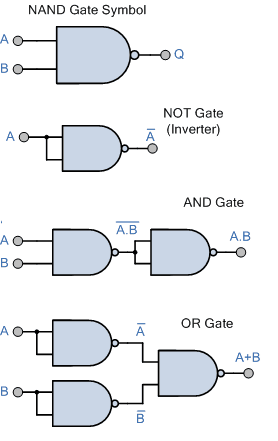
1. NOT gate:
\( Y = \overline{A \cdot A} \)

Explanation:
NAND definition → \( \overline{A \cdot B} \)
Put both inputs same (A = B) → \( \overline{A \cdot A} = \overline{A} \)

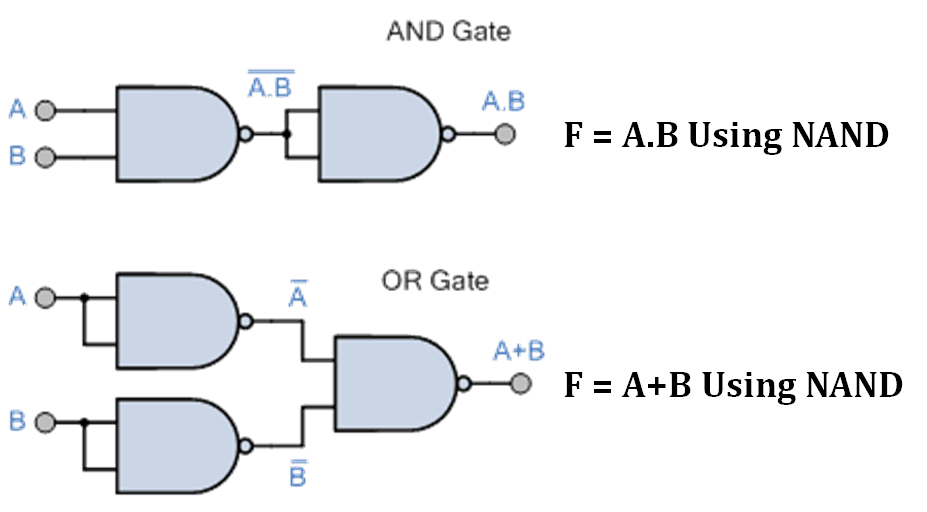
2. AND gate:

Explanation:
A AND B = \( A \cdot B \)
NAND gives complement → \( \overline{A \cdot B} \)
So invert again using NAND:
\( A \cdot B = \overline{\overline{A \cdot B}} \)

3. OR gate:
\( Y = \overline{\overline{A \cdot A} \cdot \overline{B \cdot B}} \)

Explanation:
From De Morgan:
\( A + B = \overline{\overline{A} \cdot \overline{B}} \)

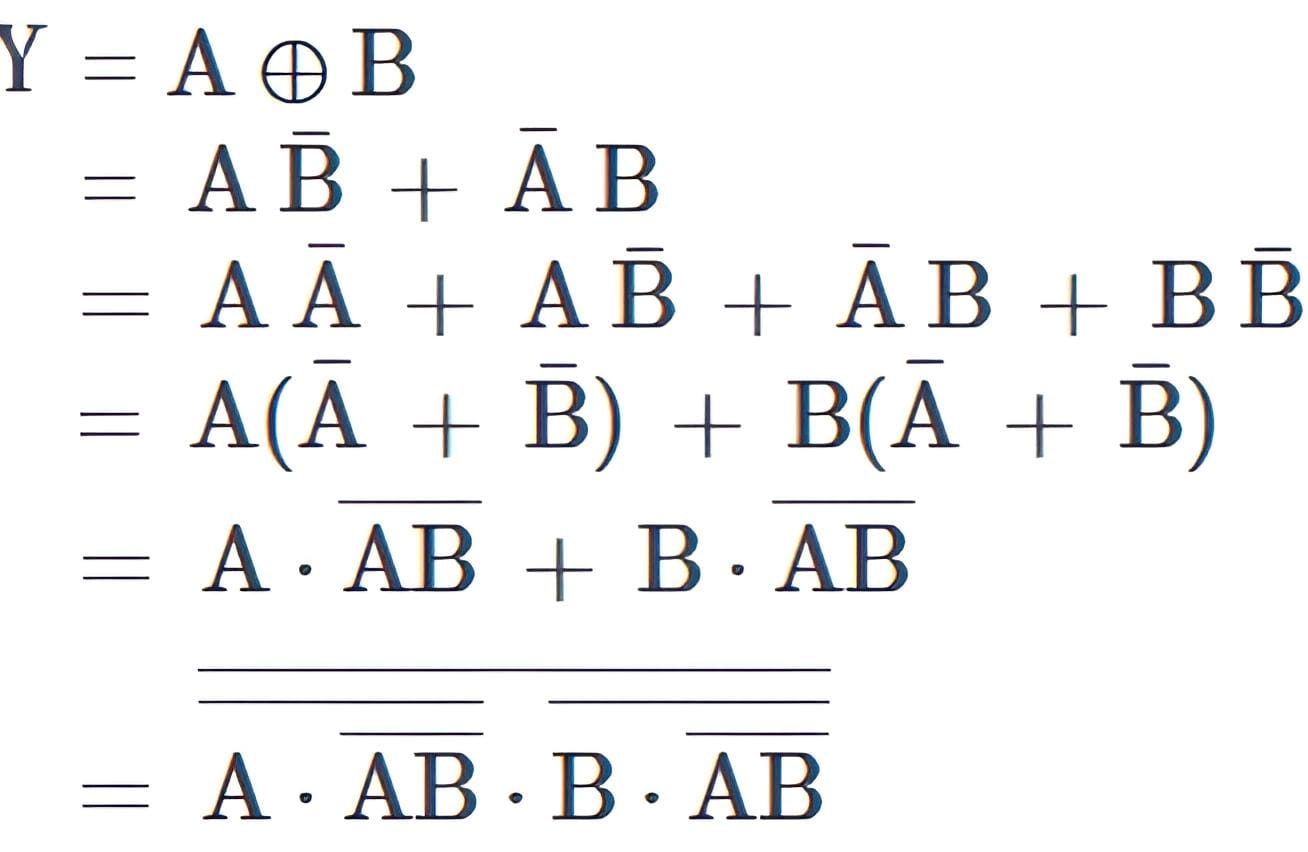
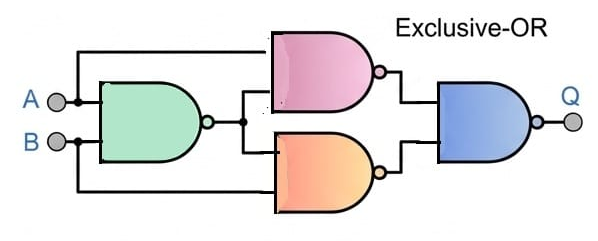
4. XOR gate: (Using 4 NAND Gates)

5. XNOR gate:

A ⊙ B = AB + A’B’
= [(AB + A’B’)’]’
= (AB)’.(A’B’)’ [deMorgan’s Law]

6. Buffer gate:
\( Y = \overline{\overline{A \cdot A} \cdot \overline{A \cdot A}} \)

Explanation:
First NAND → \( \overline{A} \)
Second NAND → \( A \)

7. NOR gate:

(A+B)’ = [[(A+B)’]’]’
= [(A’.B’)’ ]’ [deMorgan’s Law]

Some Logic Gate Using NOR Gate

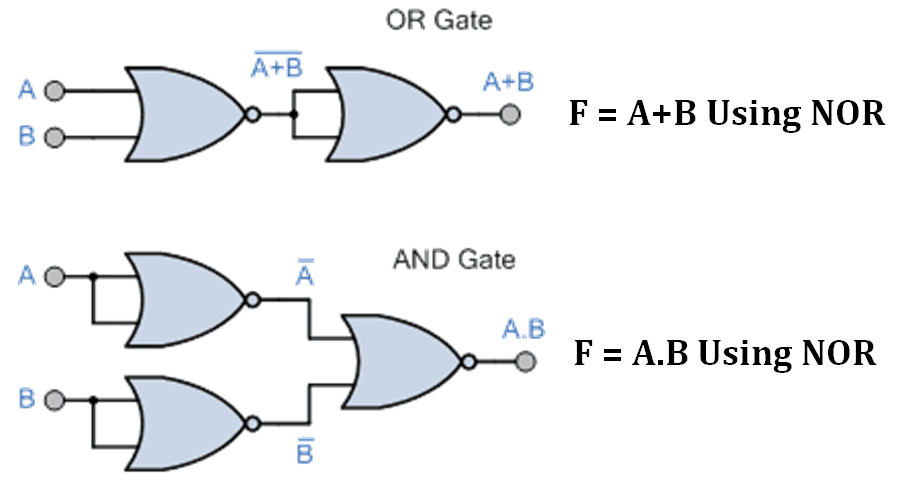
1. NOT gate:
\( Y = \overline{A + A} \)

Explanation:
NOR definition → \( \overline{A + B} \)
Put both inputs same (A = B) → \( \overline{A + A} = \overline{A} \)

2. OR gate:
\( A + B = \overline{\overline{A + B}} \)

3. AND gate:

Y = A . B = [(A . B)’]’ = [A’+B’]’

4. XNOR gate: (Using NOR gates)

\( Y = \overline{ \left(\overline{A + \overline{A + B}}\right) + \left(\overline{B + \overline{A + B}}\right) } \)

5. XOR gate:
A xor B = A’B + AB’ = AA’+A’B+BB’+AB’
=A'(A+B)+B'(A+B)
=(A+B).(A’+B’)
=[(A+B)’+(A’+B’)’]’

6. Buffer gate:
\( Y = \overline{\overline{A + A} + \overline{A + A}} \)

Explanation:
First NOR → \( \overline{A} \)
Second NOR → \( A \)

7. NAND gate:

(A.B)’ = ((A’+B’)’)’

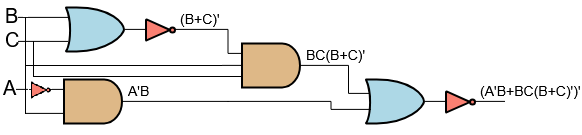
Draw by NAND Gate: (A+B)C + DE

Draw by NAND Gate: (A+B + CD)E

Draw by only NOR Gate: AB+BC+CA

What is Boolean Algebra? Write the laws of Boolean Algebra.

Boolean Algebra is a branch of mathematics that deals with variables having only two possible values: 0 and 1 (or false and true).

It is mainly used to perform logical operations in digital systems.

  • Binary Values: Variables can take only two values (0 or 1).
  • Logical Operations: It includes operations such as AND, OR, and NOT.
  • Application: It is widely used in digital circuits and computer systems.

Boolean Algebra হলো গণিতের একটি শাখা যেখানে variable-এর মান শুধুমাত্র দুইটি হতে পারে: 0 এবং 1 (অথবা false এবং true)।

এটি মূলত digital system-এ logical operation করার জন্য ব্যবহৃত হয়।

  • Binary Values: Variable শুধুমাত্র 0 বা 1 মান নিতে পারে।
  • Logical Operations: এতে AND, OR এবং NOT operation অন্তর্ভুক্ত থাকে।
  • Application: এটি digital circuit এবং computer system-এ ব্যাপকভাবে ব্যবহৃত হয়।

Boolean Function and its form.

A Boolean function is a mathematical expression that consists of binary variables and logical operators. It defines the relationship between input variables and a binary output (0 or 1).

Forms of Boolean Function

  1. Standard form
  2. Canonical Form

Boolean function হলো একটি mathematical expression যেখানে binary variable এবং logical operator ব্যবহার করা হয়। এটি input variable এবং output (0 বা 1)-এর মধ্যে সম্পর্ক নির্ধারণ করে।
Forms of Boolean Function

  1. Standard form
  2. Canonical Form
Boolean Function: Standard form (SOP, POS)
  • SOP (Sum of Products) Form:
    In SOP form, multiple product terms (created using AND) are combined using OR operation.
    Example: f(A,B,C) = ABC + A’BC + ABC’
  • POS (Product of Sums) Form:
    In POS form, multiple sum terms (created using OR) are combined using AND operation.
    Example: f(A,B,C) = (A+B+C)(A’+B+C)(A+B+C’)
  • SOP (Sum of Products) Form:
    SOP form-এ একাধিক product term (যা AND দিয়ে তৈরি) OR operation দ্বারা যুক্ত করা হয়।
    Example: f(A,B,C) = ABC + A’BC + ABC’
  • POS (Product of Sums) Form:
    POS form-এ একাধিক sum term (যা OR দিয়ে তৈরি) AND operation দ্বারা যুক্ত করা হয়।
    Example: f(A,B,C) = (A+B+C)(A’+B+C)(A+B+C’)
Boolean Function: Canonical form (Sum of Minterm , Product of Maxterm)

Canonical forms provide a standard way to represent Boolean functions using minterms and maxterms.

Minterms:
A minterm is a product (AND) of all variables where the output is 1. Each variable appears exactly once.
If a variable value is 1, it is taken in normal form; if it is 0, it is taken in complemented form.

Maxterms:
A maxterm is a sum (OR) of all variables where the output is 0. Each variable appears exactly once.
If a variable value is 0, it is taken in normal form; if it is 1, it is taken in complemented form.

Canonical form হলো একটি standard পদ্ধতি যার মাধ্যমে Boolean function-কে minterm এবং maxterm ব্যবহার করে প্রকাশ করা হয়।

Minterms:
Minterm হলো সবগুলো variable-এর AND product, যেখানে output 1 হয় এবং প্রতিটি variable একবার করে থাকে।
যদি variable-এর মান 1 হয়, তাহলে সেটি normal আকারে নেওয়া হয় এবং যদি 0 হয়, তাহলে complement আকারে নেওয়া হয়।

Maxterms:
Maxterm হলো সবগুলো variable-এর OR sum, যেখানে output 0 হয় এবং প্রতিটি variable একবার করে থাকে।
যদি variable-এর মান 0 হয়, তাহলে সেটি normal আকারে নেওয়া হয় এবং যদি 1 হয়, তাহলে complement আকারে নেওয়া হয়।

Truth table representing minterm and maxterm

S. No.

X

Y

Z

Minterms (Product Terms)

Maxterms (Sum Terms)

0000

m0​ = X’.Y’.Z’

M0 = X + Y + Z

1001

m1​ = X’.Y’.Z

M1 = X + Y + Z’

2010

m2​ = X’.Y.Z’

M2 = X + Y’ + Z

3011

m3​ = X’.Y.Z

M3 = X + Y’ + Z’

4100

m4​ = X.Y’.Z’

M4 = X’ + Y + Z

5101

m5​ = X.Y’.Z

M5 = X’ + Y + Z’

6110

m6​ = X.Y.Z’

M6 = X’ + Y’ + Z

7111

m7 = X.Y.Z

M7 = X’ + Y’ + Z’

Convert F = x+yz into Sum of Minterm, and product of Maxterm
Sum of minterm
Product of Maxterm
Convert F = xy+yz+zx into Sum of Minterm
Sum of minterm
Convert F = (x+y).(y+z).(z+x) into product of Maxterm
Product of Maxterm
Convert F = (A+BC)(B+AC') into SOP and POS

SOP conversion
Y = (A+BC) (B+AC’)
= AB+AAC’+BBC+ABCC’
=AB+AC’+BC [SOP]

POS conversion
Y = (A+BC) (B+AC’)
=(A+B).(A+C)(B+A)(B+C’)
=(A+B)(A+C)(B+C’)

Simplify follwoing equation: A'BC+ABC'+ABC

A’BC+ABC’+ABC
=BC(A’+A)+ABC’
=BC+ABC’
= B(C+AC’)
= B[(C+A)(C+C’)]
=B(A+C)

Simplify follwoing equation: A(B'+C)+AB+B'(C+A') and draw it logic circuit

A(B’+C)+AB+B'(C+A’)
=AB’+AC+AB+B’C+B’A’
=AB’+AB+AC+B’C+A’B’
=A(B’+B)+AC+B’C+A’B’
=A+AC+B’C+A’B’
=A+B’C+A’B’
=A+(A’+C)B’
=A+A’B’+CB’
=(A+A’)(A+B’)+CB’
=(A+B’)+CB’
=B’+A+CB’
=A+B’

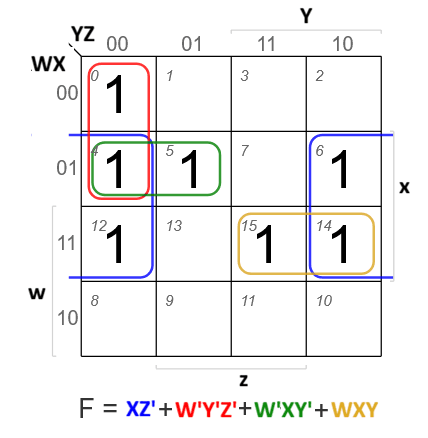
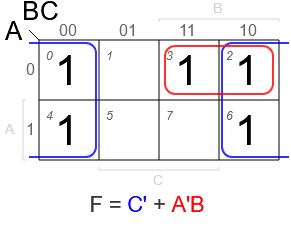
Simplify the follwoing boolean expression using K-map, F= a'bc+ab'c'+abc+abc'

Simplify the follwoing boolean expression using K-map, F= A'BC'+ABC'+BC'D

Use the Karnaugh Map to simplify the following function. f(A,B,C)=A'B'C'+A'B'C+A'BC+A'BC+ABC'+ABC [Ministry of food, network/website Manager(ICT),2025]
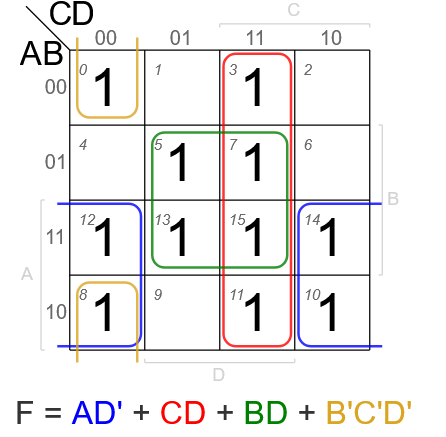
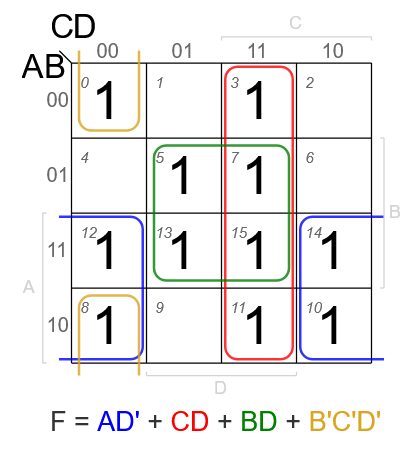
Simplify Using K-map F (A,B,C,D) = ∑ (1,3,5,6,7,8,9,11,14,15)

Simplify Using K-map F (A,B,C,D) = ∏ (1,3,5,7,13,15)

What is half adder? Half Adder Truth table & Circuit

A combinational logic circuit which is designed to add two binary digits is called as a half adder. The half adder provides the output along with a carry value (if any).

InputsOutputs
ABS (Sum)C (Carry)
0000
0110
1010
1101

The sum (S) of the half-adder is the XOR of A and B. Thus,

Sum,S=AB′+A′B=A⊕B

The carry (C) of the half-adder is the AND of A and B. Therefore,

Carry,C=A⋅B

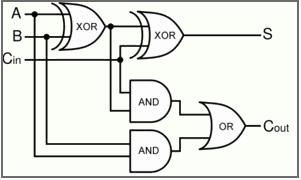
What is Full adder? Full Adder Truth table & Circuit

A combinational logic circuit which is designed to add two binary digits is called as a half adder. The half adder provides the output along with a carry value (if any).

InputsOutputs
ABCinS (Sum)Cout (Carry)
00000
00110
01010
01101
10010
10101
11001
11111

Without K-map

S= A′B′Cin+A′BC′in+AB′C′in+ ABCin
= Cin(A′B′ + AB) + C′in(A′B + AB′)
= Cin(A ⊙ B) + C′in(A ⊕ B)
= (A ⊕ B)′Cin + (A ⊕ B)C′in
=(A ⊕ B) ⊕ Cin [ x⊕y=xy’+x’y]

COUT = A′BCin + AB′Cin + ABC′in + ABCin
= Cin(A′B + AB′ + AB) + ABC′in
=Cin (A’B+A(B+B’))+ABC′in
=Cin (A’B+A)+ABC′in
=Cin (A’+A)(B+A)+ABC′in
= Cin(A + B) + ABC′in
= ACin + BCin + ABC′in
= A(Cin + BC′in) + BCin
= A[(Cin + B)(Cin + C′in)] + BCin
= A(B + Cin) + BCin
= AB + ACin + BCin
=AB + ACin + BCin

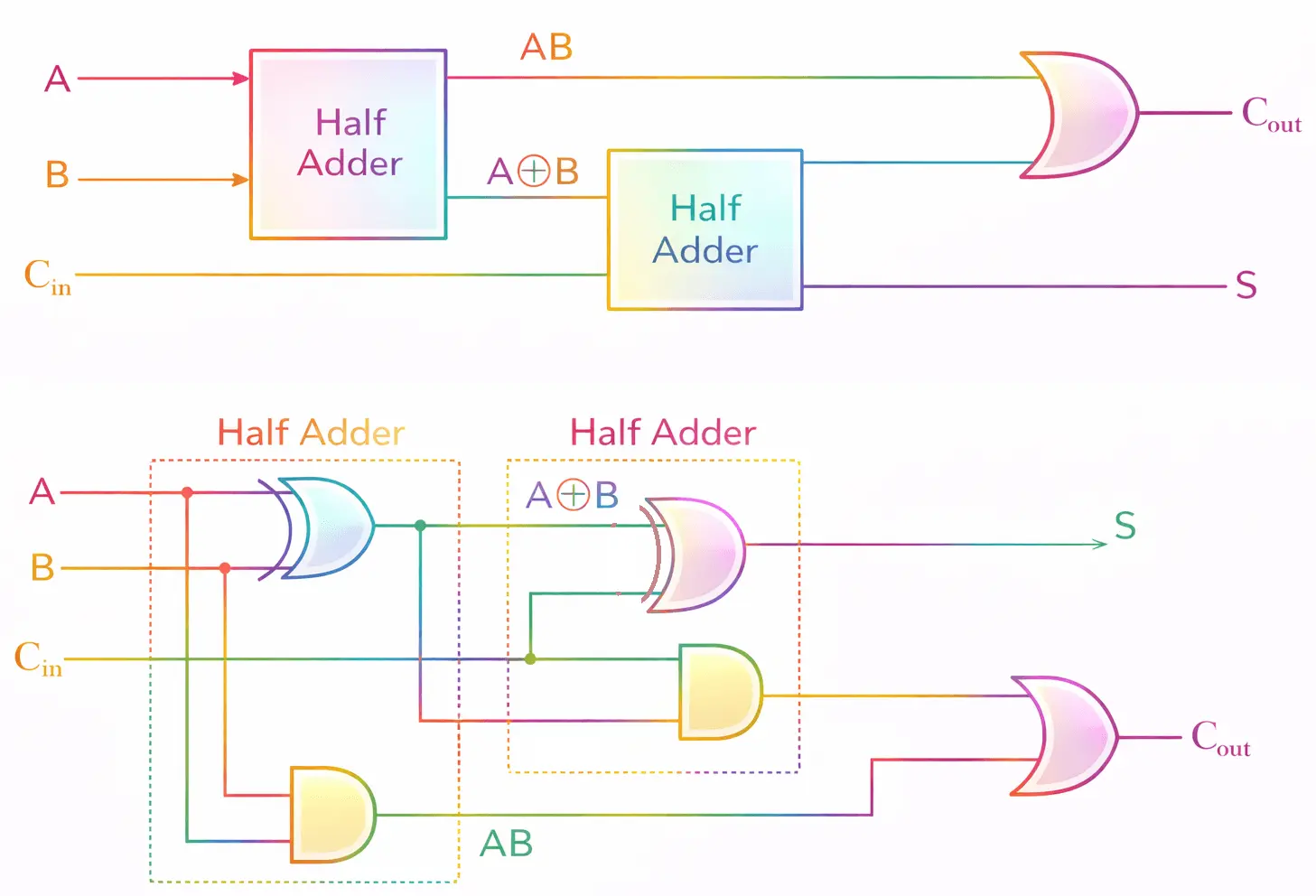
Design Full Adder by Half adder

Half Adder Equations:
S₁ = A ⊕ B
C₁ = AB

Second Half Adder (with Cin)
S = S₁ ⊕ Cin = (A ⊕ B) ⊕ Cin
C₂ = S₁ · Cin = (A ⊕ B)Cin

Final Carry:
Cout = C₁ + C₂ = AB + (A ⊕ B)Cin
=AB + ACin + BCin

Explanation

Cout = AB + (A ⊕ B)Cin
= AB + (A′B + AB′)Cin
= AB + A′BCin + AB′Cin
= AB + ACin(A′ + B′) + BCin(A′ + A)
= AB + ACinA′ + ACinB′ + BCin
= AB + ACin + BCin
=AB + ACin + BCin

What is Half Subtractor? Desinging of Half Subtractor

A half-subtractor is a combinational logic circuit that has two inputs and two outputs, namely difference and borrow.

  • Inputs: It takes two binary inputs.
  • Outputs: It produces two outputs — Difference and Borrow.
  • Function: It subtracts one binary bit from another and generates the result.
  • Terminology: In subtraction (A − B), A is called the Minuend and B is called the Subtrahend.

Half-subtractor হলো একটি combinational logic circuit যার দুইটি input এবং দুইটি output থাকে, যথা difference এবং borrow

  • Inputs: এটি দুইটি binary input গ্রহণ করে।
  • Outputs: এটি দুইটি output প্রদান করে — Difference এবং Borrow
  • Function: এটি একটি binary bit থেকে আরেকটি bit বিয়োগ করে এবং result প্রদান করে।
  • Terminology: (A − B) subtraction-এ A কে Minuend এবং B কে Subtrahend বলা হয়।
InputsOutputs
ABD (Difference)B (Borrow)
0000
0111
1010
1100

Difference, d = A′B+AB′ = A⊕B
Borrow, b = A′B

What is Full Subtractor? Desinging of Full Subtractor

A full subtractor is a combinational logic circuit that has three inputs A, B, Bin and two outputs D (difference) and Bout (borrow).

  • Inputs: A (Minuend), B (Subtrahend), and Bin (borrow from previous stage).
  • Outputs: D represents the difference and Bout represents the borrow output.
  • Function: It performs subtraction of two binary bits along with the borrow from the previous stage.
  • Need of Full Subtractor: A half subtractor can only handle subtraction of LSB (Least Significant Bit). It cannot consider borrow from previous stages.
  • Borrow Handling: Full subtractor solves this limitation by including Bin, allowing proper subtraction across multiple bits.

Full subtractor হলো একটি combinational logic circuit যার তিনটি input A, B, Bin এবং দুইটি output D (difference)Bout (borrow) থাকে।

  • Inputs: A (Minuend), B (Subtrahend) এবং Bin (আগের stage থেকে আসা borrow)।
  • Outputs: D difference নির্দেশ করে এবং Bout borrow output নির্দেশ করে।
  • Function: এটি দুইটি binary bit এবং পূর্বের borrow সহ subtraction সম্পন্ন করে।
  • Need of Full Subtractor: Half subtractor শুধুমাত্র LSB (Least Significant Bit) subtraction করতে পারে এবং previous borrow বিবেচনা করতে পারে না।
  • Borrow Handling: Full subtractor-এ Bin থাকার কারণে multiple bit subtraction সঠিকভাবে করা সম্ভব হয়।
InputsOutputs
ABbinD (Difference)B (Borrow)
00000
00111
01011
01101
10010
10100
11000
11111

From Truth Table

Difference, d = A′B′bin+AB′b′in+A′Bb′in+ABbin =A⊕B⊕bin

Borrow,b=A′B′bin+A′Bb′in+A′Bbin+ABbin

Borrow,b=A′B(bin+b′in)+(AB+A′B′)bin=A′B+(A⊕B)′bin

What is Parallel Adder? Draw its Block Diagram.

A parallel adder is a digital circuit used to add two binary numbers of any bit length simultaneously and produce the result in parallel form.

  • Structure: It is made up of multiple full adders connected in a chain.
  • Working: Each full adder adds corresponding bits of the input numbers along with a carry input.
  • Carry Propagation: The carry output of one full adder is connected to the carry input of the next full adder.
  • Parallel Operation: All bits are added at the same time, making the process faster than serial addition.

Parallel adder হলো একটি digital circuit যা দুইটি binary number (যেকোনো bit length-এর) একসাথে যোগ করে এবং result parallel form-এ প্রদান করে।

  • Structure: এটি একাধিক full adder একসাথে chain আকারে সংযুক্ত করে তৈরি করা হয়।
  • Working: প্রতিটি full adder input number-এর corresponding bit এবং carry input যোগ করে।
  • Carry Propagation: একটি full adder-এর carry output পরবর্তী full adder-এর carry input-এ যায়।
  • Parallel Operation: সব bit একসাথে যোগ করা হয়, তাই এটি serial addition-এর তুলনায় দ্রুত কাজ করে।

Explain the operations of serial adder and parallel adder with examples.NTMC, AME(CSE),2022

1) Serial Adder:

A Serial Adder performs binary addition one bit at a time using a single Full Adder, shift registers, and a flip-flop to store carry.

Operation:

  • Bits are shifted from registers A and B.
  • One pair of bits is added at a time along with previous carry.
  • Sum is stored back in register.
  • Process repeats for n clock pulses.

Example:
Add 1011 and 1101 (binary)

Step-by-step (LSB first):

1 + 1 = 0 carry 1
1 + 0 + 1 = 0 carry 1
0 + 1 + 1 = 0 carry 1
1 + 1 + 1 = 1 carry 1

Result = 11000

Features:

  • Uses less hardware (only one Full Adder)
  • Slower (requires multiple clock cycles)

2) Parallel Adder:

A Parallel Adder adds all bits simultaneously using multiple Full Adders.


Each Full Adder handles one bit position.

Operation:

  • All bits are applied at the same time.
  • Carry from one Full Adder goes to the next stage.
  • Entire addition is completed in one clock cycle.

Example:
Add 1011 and 1101

   1011
+  1101
-------
  11000

Features:

  • Faster (single operation)
  • Requires more hardware (multiple Full Adders)

Comparison:

  • Serial Adder → Slow but economical.
  • Parallel Adder → Fast but costlier.

১) Serial Adder:

Serial Adder এক সময়ে একটি করে bit যোগ করে। এতে একটি Full Adder, shift register এবং carry সংরক্ষণের জন্য flip-flop ব্যবহৃত হয়।

কার্যপ্রণালী:

  • Register A ও B থেকে bit shift হয়ে আসে।
  • প্রতি clock pulse-এ একটি bit যোগ হয়।
  • Carry পরবর্তী যোগে ব্যবহৃত হয়।
  • n clock pulse-এ n-bit যোগ সম্পন্ন হয়।

উদাহরণ:
1011 + 1101 = 11000

বৈশিষ্ট্য:

  • কম hardware লাগে
  • ধীরগতির (একাধিক clock লাগে)

২) Parallel Adder:

Parallel Adder একসাথে সব bit যোগ করে। এতে একাধিক Full Adder ব্যবহৃত হয়।

কার্যপ্রণালী:

  • সব input bit একসাথে দেওয়া হয়।
  • Carry এক stage থেকে পরবর্তী stage-এ যায়।
  • একবারেই যোগ সম্পন্ন হয়।

উদাহরণ:
1011 + 1101 = 11000

বৈশিষ্ট্য:

  • দ্রুত
  • বেশি hardware প্রয়োজন

তুলনা:

  • Serial Adder → ধীর কিন্তু সাশ্রয়ী
  • Parallel Adder → দ্রুত কিন্তু ব্যয়বহুল
What is Encoder? Types of Encoder.

An encoder is a combinational digital circuit that converts information from a normal (human-readable) form into a coded form suitable for machine processing. This process is called encoding.

  • Function: It converts multiple input signals into a smaller number of output codes.
  • Input-Output Relation: An encoder can have up to 2ⁿ input lines and n output lines.
  • Working: It encodes information from many input lines into a binary code of fewer bits.

Encoder হলো একটি combinational digital circuit যা human-friendly information-কে machine-এর জন্য উপযোগী coded form-এ রূপান্তর করে। এই প্রক্রিয়াকে encoding বলা হয়।

  • Function: এটি একাধিক input signal-কে কম সংখ্যক output code-এ রূপান্তর করে।
  • Input-Output Relation: একটি encoder-এ সর্বোচ্চ 2ⁿ input line এবং n output line থাকতে পারে।
  • Working: এটি অনেকগুলো input line-এর information-কে কম bit-এর binary code-এ রূপান্তর করে।


Types of Encoders

  • 4 to 2 Encoder
  • 8 to 3 Encoder (Octal Encoder)
  • Decimal to BCD Encoder
4 to 2 Encoder

A 4 to 2 encoder is a combinational circuit that has 4 input lines and 2 output lines.

  • Function: It converts one of the 4 input signals into a 2-bit binary code.
  • Input-Output Relation: Since there are 4 inputs (2²), only 2 output bits are required.
  • Working: Based on which input line is active, the encoder produces the corresponding 2-bit output.

4 to 2 encoder হলো একটি combinational circuit যার 4টি input line এবং 2টি output line থাকে।

  • Function: এটি 4টি input-এর মধ্যে একটি active input-কে 2-bit binary code-এ রূপান্তর করে।
  • Input-Output Relation: এখানে 4টি input (2²) থাকায় output হিসেবে 2টি bit যথেষ্ট।
  • Working: কোন input line active আছে তার উপর ভিত্তি করে encoder নির্দিষ্ট 2-bit output প্রদান করে।


The working of a 4 to 2 Encoder for different input combinations is described in the following truth table −

InputsOutputs
I3I2I1I0Y1Y0
000100
001001
010010
100011

From this truth table, we can derive:
Y0=I1+I3
Y1=I2+I3

8 to 3 Encoder (Octal to Binary Encoder)

An octal to binary encoder is a combinational circuit that converts 8 input lines into a 3-bit binary output

  • Function: It converts octal input signals into binary code.
  • Input-Output Relation: It has 8 inputs (2³) and 3 outputs.
  • Working: Depending on which input line is active, the encoder produces the corresponding 3-bit binary output.
  • Also Known As: It is called an 8 to 3 Encoder.

Octal to binary encoder হলো একটি combinational circuit যা 8টি input line কে 3-bit binary output-এ রূপান্তর করে।

  • Function: এটি octal input signal-কে binary code-এ convert করে।
  • Input-Output Relation: এতে 8টি input (2³) এবং 3টি output থাকে।
  • Working: কোন input line active আছে তার উপর ভিত্তি করে encoder সংশ্লিষ্ট 3-bit binary output প্রদান করে।
  • Also Known As: এটিকে 8 to 3 Encoder বলা হয়।

The following truth table describes the working of an octal to binary encoder −

From this truth table, we can write the Boolean expression for the outputs of the octal to binary encoder as follows.

Y0 = I1 + I3 + I5 + I7
Y1 = I2 + I3 + I6 + I7
Y2 = I4 + I5 + I6 + I7

Decimal to BCD Encoder

A decimal to BCD encoder is a combinational circuit that converts decimal input into its equivalent binary-coded decimal (BCD) format.

  • Function: It converts decimal numbers (0–9) into 4-bit BCD code.
  • Input-Output Relation: It typically has 10 input lines and 4 output lines.
  • Working: When one decimal input is active, the encoder generates the corresponding BCD output.

Decimal to BCD encoder হলো একটি combinational circuit যা decimal number-কে তার সমতুল্য BCD (Binary-Coded Decimal) format-এ রূপান্তর করে।

  • Function: এটি decimal সংখ্যা (0–9) কে 4-bit BCD code-এ convert করে।
  • Input-Output Relation: এতে সাধারণত 10টি input line এবং 4টি output line থাকে।
  • Working: যখন কোনো একটি decimal input active হয়, তখন encoder সংশ্লিষ্ট BCD output প্রদান করে।

The truth table describing the working of the decimal to BCD encoder is −

From the given truth table, the Boolean expressions for the decimal-to-BCD encoder can be written as follows:
Y0 = D1 + D3 + D5 + D7 + D9
Y1 = D2 + D3 + D6 + D7
Y2 = D4 + D5 + D6 + D7
Y3 = D8 + D9

Decoder and it types

A decoder is a combinational logic circuit that converts an N-bit binary input into one of the possible output lines such that only one output is active at a time.

  • Function: It decodes binary input into a specific output line.
  • Input-Output Relation: A decoder converts N input lines into a maximum of 2ⁿ output lines.
  • Working: For each combination of input, only one output channel becomes active.
  • Example: A 3-to-8 decoder has 3 inputs and 8 outputs.

Decoder হলো একটি combinational logic circuit যা N-bit binary input কে এমনভাবে output-এ রূপান্তর করে যাতে প্রতিটি input combination-এর জন্য শুধুমাত্র একটি output line active থাকে।

  • Function: এটি binary input-কে নির্দিষ্ট একটি output line-এ decode করে।
  • Input-Output Relation: একটি decoder N input line কে সর্বোচ্চ 2ⁿ output line-এ রূপান্তর করে।
  • Working: প্রতিটি input combination-এর জন্য শুধুমাত্র একটি output active হয়।
  • Example: একটি 3-to-8 decoder-এ 3টি input এবং 8টি output থাকে।

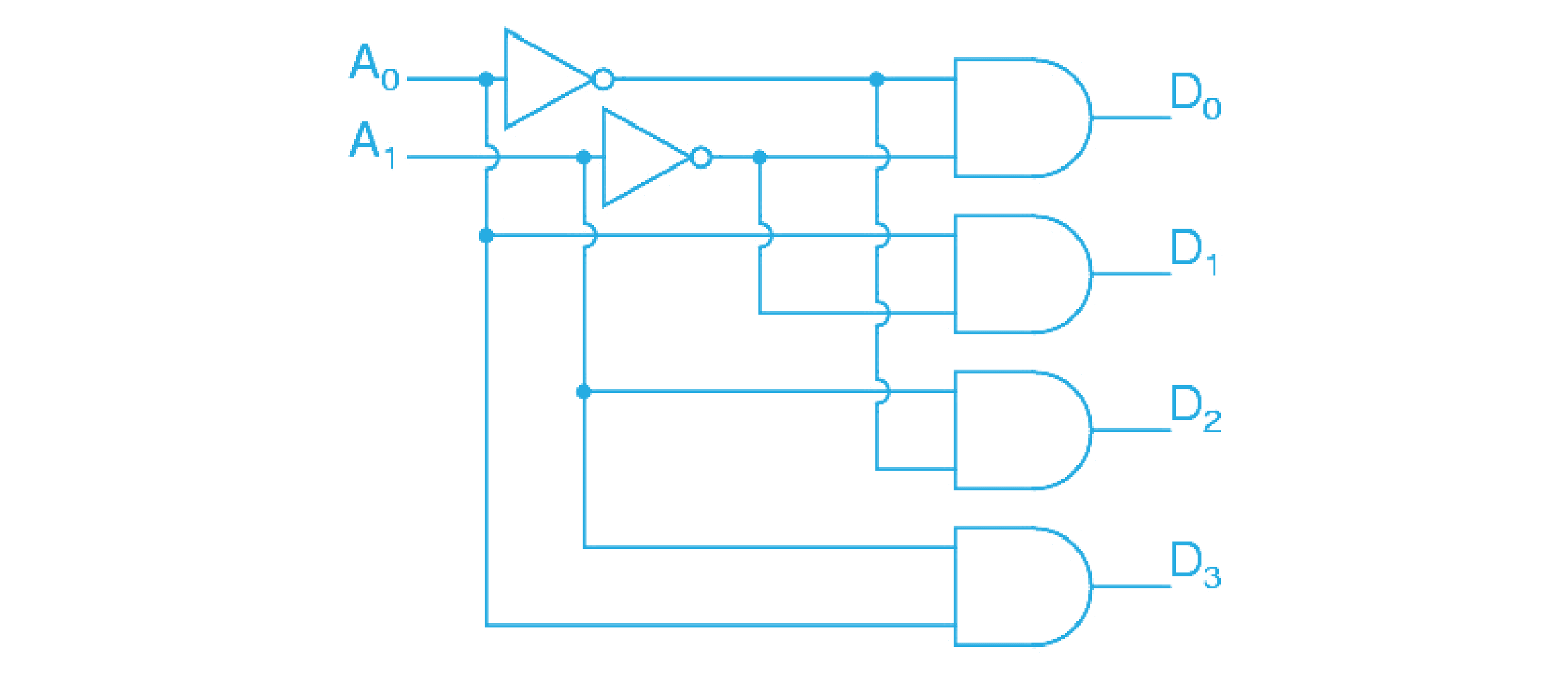
2 to 4 Decoder
A2 to 4 decoder is a combinational circuit that has 2 input lines and 4 output lines.
  • Enable Input: It has an enable input E. When E = 1, the decoder works; when E = 0, all outputs are 0.
  • Working: For each input combination of A and B, only one output becomes active.
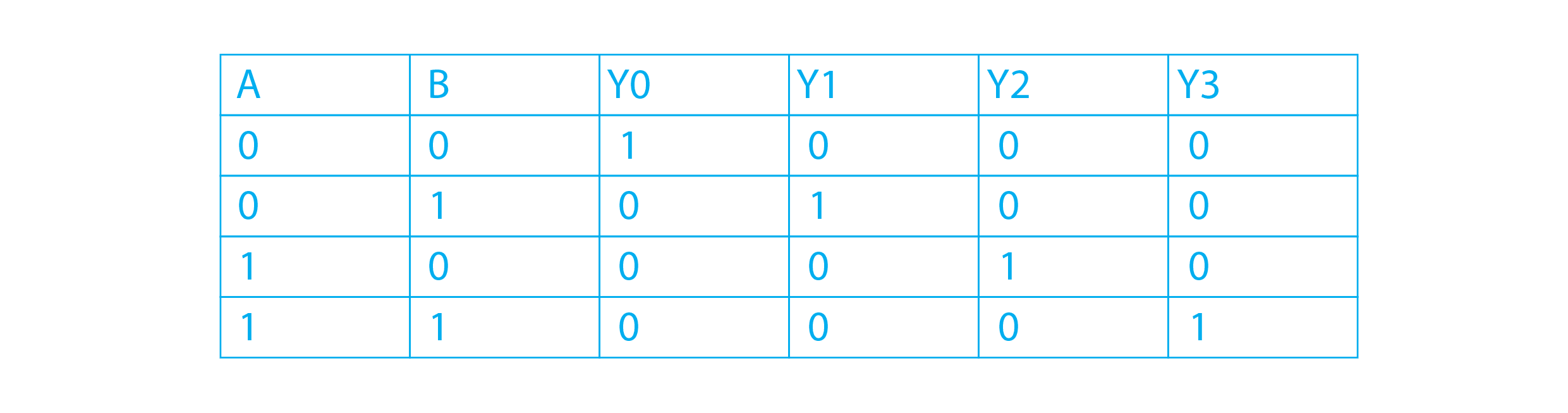
InputsOutputs
EABY3Y2Y1Y0
0XX0000
1000001
1010010
1100100
1111000
Output Expressions: Y₀ = E·A’·B’ Y₁ = E·A’·B Y₂ = E·A·B’ Y₃ = E·A·B
4 to 16 Decoder

A 4 to 16 decoder is a combinational logic circuit that has 4 input lines and 16 output lines

  • Function: It converts a 4-bit binary input into one of the 16 output lines.
  • Input-Output Relation: Since there are 4 inputs, the decoder produces 2⁴ = 16 outputs.
  • Working: For each input combination, only one output becomes active and all other outputs remain inactive.
  • Example: If input is 1010, then the corresponding output line (Y₁₀) will be active.

4 to 16 decoder হলো একটি combinational logic circuit যার 4টি input line এবং 16টি output line থাকে।

  • Function: এটি 4-bit binary input-কে 16টি output line-এর মধ্যে একটি active করে।
  • Input-Output Relation: এখানে 4টি input থাকায় 2⁴ = 16টি output তৈরি হয়।
  • Working: প্রতিটি input combination-এর জন্য শুধুমাত্র একটি output active থাকে এবং বাকিগুলো inactive থাকে।
  • Example: যদি input = 1010 হয়, তাহলে সংশ্লিষ্ট output line (Y₁₀) active হবে।

InputsOutput
EABCD
0XXXX0
10000Y0
10001Y1
10010Y2
10011Y3
10100Y4
10101Y5
10110Y6
10111Y7
11000Y8
11001Y9
11010Y10
11011Y11
11100Y12
11101Y13
11110Y14
11111Y15

Details Truth Table:

Y0 = E A’ B’ C’ D’
Y1 = E A’ B’ C’ D
Y2 = E A’ B’ C D’
Y3 = E A’ B’ C D
Y4 = E A’ B C’ D’
Y5 = E A’ B C’ D
Y6 = E A’ B C D’
Y7 = E A’ B C D
Y8 = E A B’ C’ D’
Y9 = E A B’ C’ D
Y10 = E A B’ C D’
Y11 = E A B’ C D
Y12 = E A B C’ D’
Y13 = E A B C’ D
Y14 = E A B C D’
Y15 = E A B C D

Minimum P × Q Decoders for M × N Decoder Construction

To determine the minimum number of P × Q decoders (with enable input) required to construct an M × N decoder, follow these steps:

  • Divide Q by N and find the quotient. Let it be X.
  • Again divide X by N and continue this process until the quotient becomes 1.
  • Add all the quotients obtained in each step including 1. This sum gives the required number of decoders.
  • If the quotient never becomes 1, then additional logic gates will be needed to complete the construction.

একটি M × N decoder তৈরি করতে কতগুলো P × Q decoder (enable input সহ) লাগবে তা নির্ণয়ের জন্য নিচের ধাপগুলো অনুসরণ করতে হয়:

  • প্রথমে Q কে N দ্বারা ভাগ করে quotient বের করতে হবে। এটিকে X ধরা হয়।
  • এরপর আবার X কে N দ্বারা ভাগ করতে হবে এবং এইভাবে চালিয়ে যেতে হবে যতক্ষণ না quotient 1 হয়।
  • প্রতিটি ধাপে পাওয়া সবগুলো quotient (১ সহ) যোগ করলে মোট যতগুলো decoder লাগবে তা পাওয়া যাবে।
  • যদি quotient কখনো 1 না হয়, তাহলে অতিরিক্ত logic gate ব্যবহার করতে হবে।
Designing a 3 to 8 Decoder with 2 to 4 Decoders

A 3 × 8 binary decoder can be constructed by using two 2 × 4 binary decoders with active HIGH enable pins.

  • Number of Decoders: Two 2 × 4 decoders are required to design one 3 × 8 decoder.
  • Inputs and Outputs: The circuit has 3 inputs (X2, X1, X0) and 8 outputs.
  • Enable Control: Input X2 is used as the enable control signal. A NOT gate is used to generate X2, so that only one decoder is enabled at a time.
  • Decoder 2 Operation: DECODER2 receives inputs X1 and X0 with enable input X2. It decodes the first four outputs.
  • Decoder 1 Operation: DECODER1 receives inputs X1 and X0 with enable input X2. It decodes the last four outputs.

3 × 8 binary decoder দুটি 2 × 4 binary decoder এবং active HIGH enable pin ব্যবহার করে তৈরি করা যায়।

  • Number of Decoders: একটি 3 × 8 decoder তৈরি করতে দুটি 2 × 4 decoder প্রয়োজন হয়।
  • Inputs and Outputs: এই circuit-এ 3টি input (X2, X1, X0) এবং 8টি output থাকে।
  • Enable Control: X2 input-কে enable signal হিসেবে ব্যবহার করা হয়। একটি NOT gate ব্যবহার করে X2 তৈরি করা হয়, যাতে এক সময়ে শুধুমাত্র একটি decoder active থাকে।
  • Decoder 2 Operation: DECODER2-এর input হলো X1 এবং X0, আর enable input হলো X2। এটি প্রথম চারটি output decode করে।
  • Decoder 1 Operation: DECODER1-এর input হলো X1 এবং X0, আর enable input হলো X2। এটি শেষ চারটি output decode করে।

Designing a 4 × 16 Decoder with 3 × 8 Decoders

A 4 × 16 binary decoder can be designed using two 3 × 8 binary decoders with active HIGH enable pins.

  • Number of Decoders: Two 3 × 8 decoders are required to construct a 4 × 16 decoder.
  • Inputs and Outputs: The circuit has 4 inputs (X3, X2, X1, X0) and 16 outputs.
  • Enable Control: Input X3 is used as the control signal. A NOT gate generates X3 so that only one decoder is enabled at a time.
  • Decoder 2 Operation: DECODER2 takes inputs X2, X1, X0 with enable X3. It generates the first eight outputs (Y₀ to Y₇).
  • Decoder 1 Operation: DECODER1 takes inputs X2, X1, X0 with enable X3. It generates the last eight outputs (Y₈ to Y₁₅).

4 × 16 binary decoder দুটি 3 × 8 binary decoder এবং active HIGH enable pin ব্যবহার করে তৈরি করা যায়।

  • Number of Decoders: একটি 4 × 16 decoder তৈরি করতে দুটি 3 × 8 decoder প্রয়োজন হয়।
  • Inputs and Outputs: এই circuit-এ 4টি input (X3, X2, X1, X0) এবং 16টি output থাকে।
  • Enable Control: X3 input-কে control signal হিসেবে ব্যবহার করা হয়। একটি NOT gate ব্যবহার করে X3 তৈরি করা হয়, যাতে এক সময়ে শুধুমাত্র একটি decoder active থাকে।
  • Decoder 2 Operation: DECODER2-এর input হলো X2, X1, X0 এবং enable হলো X3। এটি প্রথম আটটি output (Y₀ থেকে Y₇) তৈরি করে।
  • Decoder 1 Operation: DECODER1-এর input হলো X2, X1, X0 এবং enable হলো X3। এটি শেষ আটটি output (Y₈ থেকে Y₁₅) তৈরি করে।

Designing a 4 × 16 Decoder with 2 × 4 Decoders

A 4 × 16 decoder can be designed using five 2 × 4 decoders with active HIGH enable pins.

  • Number of Decoders: To construct one 4 × 16 decoder, 5 decoders of 2 × 4 are required.
  • Inputs: The inputs are X3, X2, X1, X0, where X3 is the MSB and X0 is the LSB.
  • Role of DECODER1: DECODER1 takes inputs X3 and X2. Its enable pin is connected to constant logic 1, and it is used to control the other four decoders.
  • Decoder Selection:
    If X3X2 = 00, then DECODER2 is enabled.
    If X3X2 = 01, then DECODER3 is enabled.
    If X3X2 = 10, then DECODER4 is enabled.
    If X3X2 = 11, then DECODER5 is enabled.
  • Final Output Generation: Inputs X1 and X0 are applied to DECODER2, DECODER3, DECODER4, and DECODER5. These decoders produce the final 16 outputs (Y₀ to Y₁₅).

4 × 16 decoder পাঁচটি 2 × 4 decoder এবং active HIGH enable pin ব্যবহার করে তৈরি করা যায়।

  • Number of Decoders: একটি 4 × 16 decoder তৈরি করতে 5টি 2 × 4 decoder প্রয়োজন হয়।
  • Inputs: এই decoder-এর input হলো X3, X2, X1, X0, যেখানে X3 হলো MSB এবং X0 হলো LSB
  • Role of DECODER1: DECODER1-এর input হলো X3 এবং X2। এর enable pin constant logic 1-এ connected থাকে এবং এটি অন্য চারটি decoder-কে control করে।
  • Decoder Selection:
    যদি X3X2 = 00 হয়, তাহলে DECODER2 enable হবে।
    যদি X3X2 = 01 হয়, তাহলে DECODER3 enable হবে।
    যদি X3X2 = 10 হয়, তাহলে DECODER4 enable হবে।
    যদি X3X2 = 11 হয়, তাহলে DECODER5 enable হবে।
  • Final Output Generation: X1 এবং X0 input, DECODER2, DECODER3, DECODER4 এবং DECODER5-এ দেওয়া হয়। এই decoder-গুলো মিলেই চূড়ান্ত 16টি output (Y₀ থেকে Y₁₅) তৈরি করে।

Designing a Full Adder Circuit by 3 to 8 Decoder ( Designing a Full Adder Circuit by two OR gate)
DecimalABCinSCout
000000
100110
201010
301101
410010
510101
611001
711111

Sum =∑ (1,2,4,7)
Carry = ∑(3,5,6,7)

2×4 Decoder ও একটি OR Gate ব্যবহার করে Half Adder Design করুন। [BTCL,JAM(2024)]
InputsOutputs
EABD3D2D1D0
0XX0000
1000001
1010010
1100100
1111000
We Know For Half Adder: Sum = A xor B= A’B + AB’ = ∑(D1+D2) Carry = AB = D3
What is Multiplexer? Draw it basic block diagram.

A multiplexer (MUX) is a combinational logic circuit that selects one input from multiple input lines and forwards it to a single output line.

  • Function: It selects one out of N (2ⁿ) input signals and sends it to the output.
  • Also Known As: It is called a data selector because it selects one input from many.
  • Select Lines: It has n select lines which determine which input is selected.
  • Working: Based on the combination of select lines, one input (I₀, I₁, … Iₙ₋₁) is connected to the output.
  • Concept: It works like a multi-position switch controlled by digital signals.

Multiplexer (MUX) হলো একটি combinational logic circuit যা একাধিক input থেকে একটি নির্দিষ্ট input নির্বাচন করে একটি output line-এ পাঠায়।

  • Function: এটি N (2ⁿ) input-এর মধ্যে একটি নির্বাচন করে output-এ পাঠায়।
  • Also Known As: এটিকে data selector বলা হয় কারণ এটি অনেক input থেকে একটি নির্বাচন করে।
  • Select Lines: এতে nটি select line থাকে যা নির্ধারণ করে কোন inputটি নির্বাচন হবে।
  • Working: Select line-এর combination অনুযায়ী একটি input (I₀, I₁, … Iₙ₋₁) output-এর সাথে যুক্ত হয়।
  • Concept: এটি একটি multi-position switch এর মতো কাজ করে যা digital signal দ্বারা নিয়ন্ত্রিত হয়।

Function of Multiplexing.

A multiplexer (MUX) is a digital logic device used to perform multiplexing, which means selecting one data from multiple inputs and sending it through a single output line

  • Data Selection: It selects one input data from multiple sources and transmits it to the output.
  • Data Sharing: It allows multiple devices to share a single communication channel efficiently.
  • Multiplexing Types: There are two main types of multiplexing:
    • Time Multiplexing (TDM): Multiple devices share the same transmission line but use it at different time intervals.
    • Frequency Multiplexing (FDM): Multiple devices transmit data simultaneously using different frequencies on the same line.

Multiplexer (MUX) হলো একটি digital logic device যা multiplexing করে, অর্থাৎ অনেকগুলো input data-এর মধ্যে একটি নির্বাচন করে একটি output line-এ পাঠায়

  • Data Selection: এটি একাধিক input থেকে একটি data নির্বাচন করে output-এ প্রেরণ করে।
  • Data Sharing: এটি একাধিক device-কে একটি single communication channel share করতে সাহায্য করে।
  • Multiplexing-এর ধরন: Multiplexing প্রধানত দুই ধরনের:
    • Time Multiplexing (TDM): একাধিক device একই transmission line ব্যবহার করে কিন্তু ভিন্ন ভিন্ন সময়ে data পাঠায়।
    • Frequency Multiplexing (FDM): একাধিক device একই line-এ ভিন্ন ভিন্ন frequency ব্যবহার করে একসাথে data পাঠায়।
2×1 Multiplexer

A 2 × 1 multiplexer is a basic combinational logic circuit that has two input lines (I₀, I₁), one select line (S), and one output line (Y).

  • Function: It selects one of the two input signals and sends it to the output.
  • Select Line: The digital value applied to S determines which input is selected.
  • Select Line (S)Output (Y)
    0I0
    1I1
  • Application: It is used to connect two 1-bit data sources to a single output line.
4×1 Multiplexer

A 4 × 1 multiplexer is a digital circuit that has four input lines (I₀, I₁, I₂, I₃), two select lines (S₁, S₀), and one output line (Y).

    • Function: It selects one of the four inputs and sends it to the output.
    • Select Lines: The combination of S₁ and S₀ determines which input is selected.
  • Selection LinesOutput
    S1S0Y
    00I0
    01I1
    10I2
    11I3
  • Boolean Expression:
    Y = S₁’ S₀’ I₀ + S₁’ S₀ I₁ + S₁ S₀’ I₂ + S₁ S₀ I₃


Implementation: It can be implemented using NOT gates, AND gates, and OR gate.

8×1 Multiplexer

An 8 × 1 multiplexer is a digital circuit that has eight input lines (I₀ to I₇), three select lines (S₂, S₁, S₀), and one output line (Y).

    • Function: It selects one of the eight inputs and forwards it to the output.
    • Select Lines: The combination of S₂, S₁, S₀ determines which input is selected.
Selection InputsOutput
S2S1S0Y
000I0
001I1
010I2
011I3
100I4
101I5
110I6
111I7
  • Boolean Expression:
    Y = S₂’S₁’S₀’I₀ + S₂’S₁’S₀I₁ + S₂’S₁S₀’I₂ + S₂’S₁S₀I₃ + S₂S₁’S₀’I₄ + S₂S₁’S₀I₅ + S₂S₁S₀’I₆ + S₂S₁S₀I₇
  • Implementation: It can be implemented using NOT gates, AND gates, and OR gate.

16×1 Multiplexer

A 16 × 1 multiplexer is a digital circuit that has 16 input lines (I₀ to I₁₅), 4 select lines (S₃, S₂, S₁, S₀), and one output (Y).

  • Function: It selects one of the 16 inputs and sends it to the output.
  • Construction: It can be implemented using two 8 × 1 multiplexers (first stage) and one 2 × 1 multiplexer (second stage).
  • Working:
    The select lines S₂, S₁, S₀ are applied to both 8×1 multiplexers.
    Upper 8×1 handles inputs I₈ to I₁₅ and lower 8×1 handles I₀ to I₇.
    Their outputs are given to a 2×1 multiplexer.
  • Final Selection:
    If S₃ = 0 → Output comes from inputs I₀ to I₇
    If S₃ = 1 → Output comes from inputs I₈ to I₁₅
Selection InputsOutput
S3S2S1S0Y
0000I0
0001I1
0010I2
0011I3
0100I4
0101I5
0110I6
0111I7
1000I8
1001I9
1010I10
1011I11
1100I12
1101I13
1110I14
1111I15

Use a 4:1 multiplexer to implement the following two variable logic function. F(A+B)=∑m(0,1,3)

The truth table of the 4:1 multiplexer for the given logic function is as follows

Select LinesOutput
S1 = AS0 = BY
001
011
100
111

Implement the following two variable logic function by using a 4:1 MUX. F(A,B)=∑m(1,3)

The truth table of the 4:1 multiplexer for the given logic function is as follows,

Select LinesOutput
S1 = AS0 = BY
000
011
100
111

What is Demultiplexer?

A demultiplexer (DEMUX) is a combinational logic circuit that takes a single input and distributes it to one of many output lines.

  • Function: It sends the input data to one selected output line.
  • Also Known As: It is called a data distributor.
  • Structure: It has 1 input line, 2ⁿ output lines, and n select lines.
  • Select Lines: The combination of select lines determines which output will receive the input.
  • Relation: It performs the opposite operation of a multiplexer (MUX).
  • Application: Used in digital circuits like decoders and Boolean function generators.

Demultiplexer (DEMUX) হলো একটি combinational logic circuit যা একটি single input নিয়ে সেটিকে একাধিক output line-এর মধ্যে একটি নির্দিষ্ট output-এ পাঠায়।

  • Function: এটি input data-কে নির্দিষ্ট একটি output line-এ প্রেরণ করে।
  • Also Known As: এটিকে data distributor বলা হয়।
  • Structure: এতে ১টি input line, 2ⁿটি output line এবং nটি select line থাকে।
  • Select Lines: Select line-এর combination অনুযায়ী কোন output-এ data যাবে তা নির্ধারিত হয়।
  • Relation: এটি multiplexer (MUX)-এর বিপরীত কাজ করে।
  • Application: এটি decoder এবং Boolean function generator-এর মতো digital circuit-এ ব্যবহৃত হয়।

1x4 Demultiplexer

A 1 × 4 demultiplexer is a combinational circuit that has 1 input (I), 2 select lines (S₁, S₀), and 4 output lines (Y₀ to Y₃).

Function: It transfers the input signal to one of the four outputs based on select lines.

Select Lines: The combination of S₁ and S₀ determines which output will receive the input.

Working (Truth Table):

Select LineOutputs
S1S0Y3Y2Y1Y0
00000I
0100I0
100I00
11I000

Boolean Expressions:
Y₀ = S₁’ S₀’ I
Y₁ = S₁’ S₀ I
Y₂ = S₁ S₀’ I
Y₃ = S₁ S₀ I

Implementation: It can be implemented using AND gates and NOT gates.

1x8 Demultiplexer

A 1 × 8 demultiplexer can be implemented by using two 1 × 4 demultiplexers and one 1 × 2 demultiplexer.

Structure: A 1 × 8 demultiplexer has 1 input (I), 3 select lines (S2, S1, S0), and 8 outputs (Y0 to Y7).

Construction: One 1 × 2 demultiplexer is used in the first stage and two 1 × 4 demultiplexers are used in the second stage.

First Stage: The input I is given to the 1 × 2 demultiplexer. The select line S2 controls which second-stage demultiplexer will be activated.

Second Stage: The common select lines S1 and S0 are applied to both 1 × 4 demultiplexers. These lines decide the exact output line.

Working:
If S2 = 0, one of the outputs Y0 to Y3 becomes equal to input I based on S1 and S0.
If S2 = 1, one of the outputs Y4 to Y7 becomes equal to input I based on S1 and S0.

Output Distribution: The lower 1 × 4 demultiplexer produces outputs Y0 to Y3, and the upper 1 × 4 demultiplexer produces outputs Y4 to Y7.

Truth Table:

What is Sequential Circuit and its Application.

A Sequential Circuit is a digital logic circuit in which the output depends not only on the present inputs but also on the past history (previous outputs) of the system.

Basic Concept:
Unlike combinational circuits (which depend only on current inputs), sequential circuits have memory elements that store previous states. Because of this, the circuit behavior changes over time based on input sequence.

Block Structure:
A sequential circuit consists of:

  • Combinational Logic Circuit → Performs logical operations on inputs.
  • Memory Element → Stores previous output (state).
  • Feedback Path → Connects output back to input.

Working Principle:

  • The input is processed by combinational logic.
  • The output is stored in memory (flip-flops).
  • This stored value is fed back and used in the next operation.
  • Thus, output = present input + past state.

Main Components:

  • Logic Gates: AND, OR, NOT etc. perform logical operations.
  • Flip-Flops: Store binary information (memory).
  • Clock Signal: Controls timing of operations (in synchronous circuits).
  • Feedback Mechanism: Maintains system history..

Examples:

  • Flip-Flops: Store 1-bit data.
  • Counters: Count pulses (e.g., binary counter).
  • Registers: Store multi-bit data.

Characteristics:

  • Has memory capability.
  • Output depends on input sequence.
  • Requires feedback path.
  • Used in real-time systems and control systems.

Application:

  • Digital clocks
  • Computers (CPU registers, memory units)
  • Control systems
  • Communication systems

Sequential Circuit হলো এমন একটি digital circuit যার output নির্ভর করে বর্তমান input এবং পূর্বের output (memory)-এর উপর।

মূল ধারণা:
Combinational circuit শুধুমাত্র বর্তমান input-এর উপর নির্ভর করে, কিন্তু sequential circuit-এ memory element থাকে যা পূর্বের state সংরক্ষণ করে। তাই input-এর sequence অনুযায়ী output পরিবর্তিত হয়।

Block Structure:

  • Combinational Logic Circuit: Input-এর উপর logical operation করে।
  • Memory Element: পূর্বের output সংরক্ষণ করে (flip-flop)।
  • Feedback Path: Output আবার input-এ পাঠায়।

কাজ করার পদ্ধতি:

  • Input combinational logic-এ প্রবেশ করে।
  • Output memory-তে সংরক্ষণ হয়।
  • এই stored value আবার future input-এ ব্যবহৃত হয়।
  • অতএব output = বর্তমান input + পূর্বের state


প্রধান উপাদান:

  • Logic Gates: AND, OR, NOT gate data process করে।
  • Flip-Flops: Memory হিসেবে কাজ করে।
  • Clock Signal: Timing control করে (synchronous circuit-এ)।
  • Feedback: System-এর history ধরে রাখে।

উদাহরণ:

  • Flip-Flop: 1-bit data সংরক্ষণ করে।
  • Counter: Pulse গণনা করে।
  • Register: একাধিক bit data সংরক্ষণ করে।

বৈশিষ্ট্য:

  • Memory থাকে
  • Output input-এর sequence-এর উপর নির্ভর করে
  • Feedback path থাকে
  • Real-time system-এ ব্যবহৃত হয়

ব্যবহার:

  • Digital clock
  • Computer (CPU register, memory)
  • Control system
  • Communication system
Types of Sequential Circuit and its difference.

Asynchronous Sequential Circuit

An asynchronous sequential circuit is a circuit whose operation does not depend on a clock signal. The state of the circuit changes immediately with the change in input signals.

  • No Clock: Works without a clock signal.
  • Working: Output changes instantly when input changes.
  • Components: Uses combinational logic and unclocked memory (latches/flip-flops).
  • Speed: Faster because no need to wait for clock.
  • Disadvantage: Difficult to design and may produce unstable or unpredictable output.
  • Example: Ripple counter.

Synchronous Sequential Circuit

A synchronous sequential circuit is a circuit where all operations are controlled by a common clock signal.

  • Clock Controlled: Works based on clock pulses.
  • Working: Output changes only at specific clock intervals.
  • Components: Uses clocked flip-flops and combinational logic.
  • Speed: Slower than asynchronous because it waits for clock signal.
  • Advantage: More stable, reliable, and predictable.
  • Example: Counters, registers, memory units.

Key Differences:

  • Clock: Asynchronous → No clock; Synchronous → Uses clock.
  • Speed: Asynchronous → Faster; Synchronous → Slower.
  • Design: Asynchronous → Complex; Synchronous → Easier.
  • Reliability: Asynchronous → Less stable; Synchronous → More stable.

Asynchronous Sequential Circuit

Asynchronous circuit হলো এমন একটি circuit যা clock signal ছাড়াই কাজ করে এবং input পরিবর্তনের সাথে সাথে output পরিবর্তিত হয়।

  • No Clock: Clock signal ব্যবহার করে না।
  • Working: Input পরিবর্তন হলেই output পরিবর্তিত হয়।
  • Components: Combinational logic এবং unclocked memory ব্যবহার করে।
  • Speed: দ্রুত কাজ করে (clock-এর জন্য অপেক্ষা করতে হয় না)।
  • Disadvantage: Design কঠিন এবং output কখনো unstable হতে পারে।
  • Example: Ripple counter।

Synchronous Sequential Circuit

Synchronous circuit হলো এমন circuit যা একটি common clock signal দ্বারা নিয়ন্ত্রিত হয়।

  • Clock Controlled: Clock signal অনুযায়ী কাজ করে।
  • Working: Output শুধুমাত্র clock pulse-এ পরিবর্তিত হয়।
  • Components: Clocked flip-flop এবং logic circuit ব্যবহার করে।
  • Speed: তুলনামূলক ধীর (clock-এর জন্য অপেক্ষা করতে হয়)।
  • Advantage: বেশি stable এবং predictable।
  • Example: Counter, register, memory unit।

মূল পার্থক্য:

  • Clock: Asynchronous → নেই; Synchronous → আছে।
  • Speed: Asynchronous → দ্রুত; Synchronous → ধীর।
  • Design: Asynchronous → জটিল; Synchronous → সহজ।
  • Reliability: Asynchronous → কম stable; Synchronous → বেশি stable।

Sequential Circuit vs Combinational Circuit

Sequential Circuits (Advantages over Combinational Circuits)

  • Memory Capability: Sequential circuits can store past information (history), which is not possible in combinational circuits.
  • Dynamic Behavior: They can perform complex operations over time based on input sequence.
  • Feedback Mechanism: Presence of feedback improves system control and stability.
  • Clock Synchronization: Synchronous circuits use a clock signal to ensure reliable and organized operation.
  • Complex Operations: Can perform complicated tasks with comparatively simpler hardware design.

Combinational Circuits (For Comparison)

  • No memory (depends only on present input).
  • No feedback path.
  • Simpler but limited functionality.
  • Faster response (no clock delay).

Sequential circuits are more powerful and flexible than combinational circuits because they can remember past data and perform complex real-time operations.

Sequential Circuit-এর সুবিধা

  • Memory Capability: Sequential circuit পূর্বের data সংরক্ষণ করতে পারে, কিন্তু combinational circuit পারে না।
  • Dynamic Behavior: Input-এর sequence অনুযায়ী complex operation করতে পারে।
  • Feedback Mechanism: Feedback থাকার কারণে system বেশি stable এবং efficient হয়।
  • Clock Synchronization: Synchronous circuit clock ব্যবহার করে reliable operation নিশ্চিত করে।
  • Complex Operation: তুলনামূলক সহজ design দিয়ে জটিল কাজ করা যায়।

Combinational Circuit (তুলনার জন্য)

  • Memory নেই (শুধু বর্তমান input-এর উপর নির্ভর করে)।
  • Feedback নেই।
  • সহজ কিন্তু সীমিত কাজ করতে পারে।
  • দ্রুত কাজ করে (clock delay নেই)।

Sequential circuit বেশি শক্তিশালী কারণ এটি past data মনে রাখতে পারে এবং complex real-time কাজ করতে পারে।

Latch and it types: SR Latch, D Latch, JK Latch, T Latch

Latch in Digital Electronics

A latch is an asynchronous sequential circuit that can store 1-bit of information. It is a fundamental memory element used in digital systems.

A latch has two stable states:

  • Set (1)
  • Reset (0)

Because of these two stable states, it is called a bistable multivibrator. The state of a latch changes according to the input applied.

Important Feature:
Latches do not use a clock signal, so they operate immediately when input changes.

Characteristics of Latch

  • Stores 1-bit data (0 or 1).
  • Uses feedback to maintain its state.
  • Output depends directly on input changes.
  • Works without synchronization (clock).

Types of Latches

  • SR Latch
  • JK Latch
  • D Latch
  • T Latch

1. SR Latch (Set-Reset)

SR latch has two inputs:

  • S → Set
  • R → Reset

Operation:

  • S = 1 → Q = 1 (Set)
  • R = 1 → Q = 0 (Reset)
  • S = R = 1 → Forbidden state

Truth Table:

S   R   Q   Q'   Comment
0   0   Q   Q'   No change
0   1   0   1    Reset
1   0   1   0    Set
1   1   X   X    Forbidden


2. JK Latch

JK latch is an improved version of SR latch (no forbidden state).

  • J → Set
  • K → Reset

Special Case:

  • J = K = 1 → Toggle

Truth Table:

J   K   Q   Q'   Comment
0   0   Q   Q'   No change
0   1   0   1    Reset
1   0   1   0    Set
1   1   Q'  Q    Toggle


3. D Latch (Data Latch)

Inputs:

  • D → Data
  • E → Enable

Working:

  • E = 1 → Output follows input D
  • E = 0 → Output remains unchanged

Truth Table:

D   E   Q   Q'   Comment
0   0   Q   Q'   No change
0   1   0   1    Reset
1   0   Q   Q'   No change
1   1   1   0    Set


4. T Latch (Toggle Latch)

Input:

  • T → Toggle input

Working:

  • T = 0 → No change
  • T = 1 → Output toggles

Truth Table:

T   Q(t)   Q(t+1)
0    0       0
0    1       1
1    0       1
1    1       0


Applications of Latches

  • Used as 1-bit memory element
  • Used in registers for data storage
  • Used to design flip-flops
  • Used in buffering and communication systems

Conclusion:
Latch is a simple and fast memory device used in digital circuits where immediate response is required without clock control.

Latch (ডিজিটাল ইলেকট্রনিক্সে)

Latch হলো একটি asynchronous sequential circuit যা ১-bit data সংরক্ষণ করতে পারে এবং এটি digital system-এর একটি মৌলিক memory element।

এটির দুটি স্থিতিশীল অবস্থা আছে:

  • Set (1)
  • Reset (0)

তাই এটিকে bistable multivibrator বলা হয়।

গুরুত্বপূর্ণ বৈশিষ্ট্য:
Latch-এ clock signal নেই, তাই input পরিবর্তন হলেই সাথে সাথে output পরিবর্তিত হয়।

বৈশিষ্ট্য

  • ১-bit data সংরক্ষণ করে
  • Feedback ব্যবহার করে state ধরে রাখে
  • Input পরিবর্তনের সাথে output পরিবর্তিত হয়
  • Clock ছাড়াই কাজ করে

প্রকারভেদ

  • SR Latch
  • JK Latch
  • D Latch
  • T Latch

1. SR Latch

S   R   Q   Q'   Comment
0   0   Q   Q'   No change
0   1   0   1    Reset
1   0   1   0    Set
1   1   X   X    Forbidden

2. JK Latch

J   K   Q   Q'   Comment
0   0   Q   Q'   No change
0   1   0   1    Reset
1   0   1   0    Set
1   1   Q'  Q    Toggle

3. D Latch

D   E   Q   Q'   Comment
0   0   Q   Q'   No change
0   1   0   1    Reset
1   0   Q   Q'   No change
1   1   1   0    Set

4. T Latch

T   Q(t)   Q(t+1)
0    0       0
0    1       1
1    0       1
1    1       0

ব্যবহার

  • ১-bit memory হিসেবে
  • Register design-এ
  • Flip-flop তৈরিতে
  • Communication system-এ data buffer হিসেবে

উপসংহার:
Latch একটি দ্রুত এবং সহজ memory device যা clock ছাড়া কাজ করে এবং digital circuit-এ ব্যাপকভাবে ব্যবহৃত হয়।

What is Flip Flop(FF)? Types of Flip Flop.

A flip-flop is a sequential digital circuit that has two stable states and is used to store one bit of data. It is a basic building block of memory systems.

Types of Flip-Flops

  • S-R Flip-Flop: Uses Set (S) and Reset (R) inputs to control the output.
  • J-K Flip-Flop: Improved version of S-R flip-flop with no invalid state.
  • D Flip-Flop: Stores the value of input (D) at the clock edge.
  • T Flip-Flop: Toggles the output state on each clock pulse.

Flip-flop হলো একটি sequential digital circuit যার দুটি stable state থাকে এবং এটি ১ bit data সংরক্ষণ করতে ব্যবহৃত হয়। এটি memory device-এর মূল building block

Flip-Flop-এর ধরন

  • S-R Flip-Flop: Set (S) এবং Reset (R) input দিয়ে output নিয়ন্ত্রণ করে।
  • J-K Flip-Flop: S-R flip-flop-এর উন্নত version যেখানে invalid state নেই।
  • D Flip-Flop: Clock signal অনুযায়ী input (D) এর মান store করে।
  • T Flip-Flop: প্রতিটি clock pulse-এ output toggle করে।
SR Flip Flops

The S-R (Set-Reset) flip-flop is the simplest type of flip-flop. It has two inputs S (Set) and R (Reset) and two outputs Q and Q’.

  • Set Condition: When S = 1 and R = 0, output Q = 1 (Set state).
  • Reset Condition: When S = 0 and R = 1, output Q = 0 (Reset state).
  • No Change: When S = 0 and R = 0, output remains unchanged.
  • Invalid State: When S = 1 and R = 1, output becomes undefined.

Characteristics Table of S-R Flip-Flop

SRQ(t)Q(t+1)
0000
0011
0100
0110
1001
1011
110X
111X

Characteristic Equation:
Q(t+1) = S + R’Q(t)
Circuit Diagram:

JK Flip Flops

The J-K flip-flop is an improved version of the S-R flip-flop that eliminates the invalid state. It works based on clock signals.

  • No Change: When J = 0 and K = 0, output remains unchanged.
  • Reset: When J = 0 and K = 1, output Q = 0.
  • Set: When J = 1 and K = 0, output Q = 1.
  • Toggle: When J = 1 and K = 1, output toggles (0 → 1 or 1 → 0).

Working: Output changes only at the clock edge (positive or negative transition).

Characteristics:

JKQ(t)Q(t+1)
0000
0011
0100
0110
1001
1011
1101
1110

Characteristic Equation:
Q(t+1) = JQ'(t) + K’Q(t)

Circuit Diagram:

D Flip Flops

A D (Data) flip-flop is a sequential circuit where the output Q follows the input D at the clock edge.

Function: It stores the value of input D at the active clock transition.

Working: Output changes only at the clock edge (positive or negative).

Behavior: At clock edge → Q = D; otherwise, output remains unchanged.

Application: Used in shift registers and counters.

DQ
00
11

Characteristic Equation:
Q(t+1) = D

Circuit Diagram:

T Flip-Flop (Toggle Flip-Flop)

A T Flip-Flop is a simplified version of the JK Flip-Flop, where both J and K inputs are connected together to form a single input called T.

  • Input: One input (T) and a clock signal.
  • Working:
    • If T = 0 → No change in output.
    • If T = 1 → Output toggles (0 → 1 or 1 → 0).
  • Toggle Property: It changes its state on every clock pulse when T=1.

Truth Table:

T   Q(t+1)
0     Q(t)
1     Q'(t)

Application: Widely used in counters and frequency division circuits.

T Flip-Flop হলো JK Flip-Flop-এর একটি সরল রূপ, যেখানে J এবং K input একসাথে যুক্ত করে একটি input T তৈরি করা হয়

  • Input: একটি input (T) এবং একটি clock signal থাকে।
  • Working:
    • T = 0 হলে output অপরিবর্তিত থাকে।
    • T = 1 হলে output toggle হয় (0 → 1 বা 1 → 0)।
  • Toggle Property: T=1 হলে প্রতিটি clock pulse-এ output পরিবর্তিত হয়।

Truth Table:

T   Q(t+1)
0     Q(t)
1     Q'(t)

Application: Counter এবং frequency division circuit-এ বেশি ব্যবহৃত হয়।

Master-Slave JK Flip-Flop

A Master-Slave JK Flip-Flop is an improved version of the JK flip-flop designed to eliminate the race-around condition. It consists of two JK flip-flops connected in cascade: one acts as the master and the other as the slave.

Structure:

  • The master flip-flop receives the input (J, K) and clock signal.
  • The slave flip-flop receives input from the master.
  • An inverter (NOT gate) is used so that master and slave operate on opposite clock signals.

Working Principle:

  • When Clock = 1 (High): Master is active, Slave is inactive.
  • When Clock = 0 (Low): Slave becomes active and copies the master’s output.
  • This ensures output changes only once per clock cycle.

Why Master-Slave is Needed:

  • In normal JK flip-flop, when J = K = 1, output toggles continuously (race-around problem).
  • Master-Slave design prevents multiple toggling in one clock cycle.

Operation:

  • J = 0, K = 0: No change (Hold)
  • J = 0, K = 1: Reset (Q = 0)
  • J = 1, K = 0: Set (Q = 1)
  • J = 1, K = 1: Toggle (once per clock cycle)

Truth Table:

J   K   Q(n+1)   Comment
0   0    Q(n)    No change (hold)
0   1    0       reset
1   0    1       Set
1   1    Q'(n)   Toggle

Key Advantage:
Eliminates race-around condition and provides stable output.

Master-Slave JK Flip-Flop হলো JK flip-flop-এর উন্নত সংস্করণ যা race-around problem দূর করার জন্য ব্যবহৃত হয়। এটি দুইটি JK flip-flop দিয়ে তৈরি—একটি master এবং অন্যটি slave

গঠন:

  • Master flip-flop input (J, K) এবং clock signal গ্রহণ করে।
  • Slave flip-flop master-এর output গ্রহণ করে।
  • একটি NOT gate ব্যবহার করা হয় যাতে master ও slave বিপরীত clock-এ কাজ করে।

কাজ করার পদ্ধতি:

  • Clock = 1 (High): Master active, Slave inactive।
  • Clock = 0 (Low): Slave active হয়ে master-এর output গ্রহণ করে।
  • এভাবে output প্রতি clock cycle-এ একবার পরিবর্তিত হয়।

কেন এটি দরকার:

  • সাধারণ JK flip-flop-এ J = K = 1 হলে output বারবার toggle হয় (race-around problem)।
  • Master-Slave design এই সমস্যা দূর করে

Operation:

  • J = 0, K = 0: No Change (Hold)
  • J = 0, K = 1: Reset (Q = 0)
  • J = 1, K = 0: Set (Q = 1)
  • J = 1, K = 1: Toggle (প্রতি clock-এ একবার)

Truth Table:

J   K   Q(n+1)   Comment
0   0    Q(n)    No Change(Hold)  
0   1    0       Reset  
1   0    1       Set  
1   1    Q'(n)   Toggle

মূল সুবিধা:
Race-around problem দূর করে এবং stable output দেয়।

  1. 2×4 Decoder ও একটি OR Gate ব্যবহার করে Half Adder Design করুন। [BTCL,JAM(2024)]
  2. What is the purpose of priority encoder in digital systems? State the operation of Decimal to BCD encoder. NTMC, AME(CSE),2022
  3. Explain the operations of serial adder and parallel adder with examples. NTMC, AME(CSE),2022
  4. Simplify the following expression using K-Map for 5 Variables Σm (0, 2, 4, 7, 8, 10, 12, 16, 18, 20, 23, 24, 25, 26, 27, 28). NTMC, AME(CSE),2022
  5. Use the Karnaugh Map to simplify the following function. f(A,B,C)=A’B’C’+A’B’C+A’BC+A’BC+ABC’+ABC [Food min., network/website Manager(ICT),2025]
  6. What is a Universal Gate? Prove that the NAND Gate is a Universal Gate. [CB, AP, 2026]
Upcoming more

Here Total Question: 20
To show all question with answer click: See Answer or take exam

1.
Which of the following is a type of digital logic circuit?
2.
Which of the following digital logic circuits can be used to add more than 1 – bit simultaneously?
3.
Which gates in Digital Circuits are required to convert a NOR-based SR latch to an SR flip-flop?
4.
When does a negative level triggered flip-flop in Digital Electronics changes its state?
5.
Which of the following options represent the synchronous control inputs in an S – R flip flop?
6.
What must be used along with synchronous control inputs to trigger a change in the flip flop?
7.
What will be the output from a D flip – flop if the clock is low and D = 0?
8.
What will be the output from a D flip-flop if D = 1 and the clock is low?
9.
What input should be given to “S” when SR flip – flop is converted to JK flip – flop?
10.
What value is to be considered for a “don’t care condition”?
11.
In Digital Circuits, which of the following options represent the synchronous control inputs in a T flip flop?
12.
Which of these flip – flops cannot be used to construct a serial shift register?
13.
How many AND gates are required to construct a 4 – bit parallel multiplier if four 4 – bit parallel binary adders are given?
14.
What kind of operation occurs in a J – K flip flop when both inputs J and K are equal to 1?
15.
The result “X + XY = X” follows which of these laws?
16.
Which gate is called the anti – coincidence and coincidence gate respectively?
17.
Which of the following options represent the correct reduction of XY'Z + X'Y'Z ?
18.

A priority encoder has four inputs I0, I1, I2, and I3 where I3 has the highest priority and I0 has the least priority. If I2 = 1, what will be the output?

19.
Which of the following options are correct for a 4×1 multiplexer?
20.
What determines the output from the combinational logic circuit in Digital Electronics?
WhatsApp Telegram Messenger