Previous Year Written Question(old)
#include <iostream>
using namespace std;
int main() {
    int size1, size2;
    // Taking input size of first array
    cout << "Enter size of first array: ";
    cin >> size1;
    int arr1[size1];
    cout << "Enter elements of first array:\n";
    for (int i = 0; i < size1; i++) {
        cin >> arr1[i];
    }
    // Taking input size of second array
    cout << "Enter size of second array: ";
    cin >> size2;
    int arr2[size2];
    cout << "Enter elements of second array:\n";
    for (int i = 0; i < size2; i++) {
        cin >> arr2[i];
    }
    // To store common elements
    int commonElements[size1 < size2 ? size1 : size2];
    int count = 0;
    // Check each element in arr1 against arr2
    for (int i = 0; i < size1; i++) {
        bool found = false;
        for (int j = 0; j < size2; j++) {
            if (arr1[i] == arr2[j]) {
                found = true;
                break;
            }
        }
        if (found) {
            // Check for duplicates
            bool alreadyExists = false;
            for (int k = 0; k < count; k++) {
                if (commonElements[k] == arr1[i]) {
                    alreadyExists = true;
                    break;
                }
            }
            if (!alreadyExists) {
                commonElements[count] = arr1[i];
                count++;
            }
        }
    }
    // Print common elements
    cout << "Common elements: ";
    for (int i = 0; i < count; i++) {
        cout << commonElements[i] << " ";
    }
    cout << endl;
    // Print total count
    cout << "Total number of common elements: " << count << endl;
    return 0;
}
Sample I/O:
Enter size of first array: 5
Enter elements of first array: 0 20 30 40 50
Enter size of second array: 6
Enter elements of second array: 10 2 20 30 60 90
Common elements: 20 30
Total number of common elements: 2

=== Code Execution Successful ===#include <stdio.h> /* Function to calculate sum of even numbers from 1 to n */ int sumOfEven(int n) { int sum = 0; for (int i = 2; i <= n; i += 2) { sum += i; } return sum; } int main() { int n, result; printf("Enter an integer: "); scanf("%d", &n); result = sumOfEven(n); printf("Sum of even numbers from 1 to %d = %d\n", n, result); return 0; }
Sample I/O:
  Enter an integer: 50
Sum of even numbers from 1 to 50 = 650


=== Code Execution Successful ===
#include <stdio.h>
void printDivisibleBy3(int arr[], int size) {
    for (int i = 0; i < size; i++) {
        if (arr[i] % 3 == 0) {
            printf("%d\n", arr[i]);
        }
    }
}
int main() {
    int size;
    printf("Enter the number of elements: ");
    scanf("%d", &size);

    int numbers[size];  // Variable Length Array (VLA)
    printf("Enter %d numbers:\n", size);
    for (int i = 0; i < size; i++) {
        scanf("%d", &numbers[i]);
    }
    printf("Numbers divisible by 3:\n");
    printDivisibleBy3(numbers, size);
    return 0;
}
Sample I/O:
Enter the number of elements: 6
Enter 6 numbers:
5 6 9 12 8 11
Numbers divisible by 3:
6
9
12
=== Code Execution Successful ===. A class BankAccount with data members for account holder's name, account number, and balance.
. Member functions to deposit() money, withdraw() money (ensuring sufficient balance), and display() account details.
Demonstrate the concept of encapsulation by keeping data member's private and providing appropriate public methods for accessing and modifying them. CB, SO (it), 2025
#include <iostream>
using namespace std;

class BankAccount {
private:
    string name;
    int accountNumber;
    double balance;

public:
    void setDetails(string n, int accNo, double bal) {
        name = n;
        accountNumber = accNo;
        balance = bal;
    }

    void deposit(double amount) {
        balance += amount;
        cout << "Deposited: " << amount << endl;
    }

    void withdraw(double amount) {
        if (amount <= balance) {
            balance -= amount;
            cout << "Withdrawn: " << amount << endl;
        } else {
            cout << "Insufficient balance" << endl;
        }
    }
    void display() {
        cout << "\nAccount Details\n";
        cout << "Account Holder: " << name << endl;
        cout << "Account Number: " << accountNumber << endl;
        cout << "Balance: " << balance << endl;
    }
};
int main() {
    BankAccount acc;
    string name;
    int accNo;
    double bal, dep, wit;
    cout << "Enter account holder name: ";
    getline(cin, name);

    cout << "Enter account number: ";
    cin >> accNo;
    cout << "Enter initial balance: ";
    cin >> bal;
    acc.setDetails(name, accNo, bal);
    cout << "Enter amount to deposit: ";
    cin >> dep;
    acc.deposit(dep);
    cout << "Enter amount to withdraw: ";
    cin >> wit;
    acc.withdraw(wit);
    acc.display();
    return 0;
}
        Sample I/O:
 Enter account holder name: itjobqns
Enter account number: 02252016
Enter initial balance: 5000
Enter amount to deposit: 300
Deposited: 300
Enter amount to withdraw: 100
Withdrawn: 100

Account Details
Account Holder: itjobqns
Account Number: 2252016
Balance: 5200
=== Code Execution Successful ===
#include <stdio.h>

// Function to find the missing number
int findMissing(int arr[], int size) {
    int total = (size * (size + 1)) / 2;   // Sum of numbers from 1 to size
    int sum = 0;

    for(int i = 0; i < size; i++) {
        sum += arr[i];
    }

    return total - sum;   // Missing number
}

int main() {
    int arr[10] = {1, 2, 3, 4, 5, 0, 7, 8, 9, 10};
    int missing;

    missing = findMissing(arr, 10);

    // Replace zero with missing number
    for(int i = 0; i < 10; i++) {
        if(arr[i] == 0) {
            arr[i] = missing;
        }
    }

    printf("Restored Array:\n");
    for(int i = 0; i < 10; i++) {
        printf("%d ", arr[i]);
    }

    return 0;
}
Sample input:
Enter value of n: 20
Sample Output:
Prime Numbers: 2, 3, 5, 7, 11, 13, 17, 19Combined Bank (SO(it)), 2024
#include <iostream>
using namespace std;
bool isPrime(int num) {
    if (num < 2) return false;
    for (int i = 2; i * i <= num; i++) {
        if (num % i == 0) return false;
    }
    return true;
}

void findPrimes(int n) {
    cout << "Prime Numbers: ";
    for (int i = 1; i <= n; i++) {
        if (isPrime(i))
            cout << i << " ";
    }
    cout << endl;
}

int main() {
    int n;
    cout << "Enter value of n: ";
    cin >> n;
    findPrimes(n);
    return 0;
}
Sample I/O:Enter value of n: 20
Prime Numbers: 2 3 5 7 11 13 17 19
 Combined Bank (SO(it)), 2024
 #include <stdio.h>
int main() {
int m, n, i, j;
// Input matrix dimensions
printf("Enter the number of rows (m): ");
scanf("%d", &m);
printf("Enter the number of columns (n): ");
scanf("%d", &n);
int matrix[m][n];
// Input matrix elements
printf("Enter the elements of the matrix row-wise:\n");
for (i = 0; i < m; i++) {
for (j = 0; j < n; j++) {
scanf("%d", &matrix[i][j]);
}
}
// Calculate and print row sums
printf("\nMatrix with Row Sums:\n");
for (i = 0; i < m; i++) {
int rowSum = 0;
for (j = 0; j < n; j++) {
printf("%d ", matrix[i][j]);
rowSum += matrix[i][j];
}
printf("%d\n", rowSum); // Row sum
}
// Calculate and print column sums
printf("\nColumn Sums:\n");
for (j = 0; j < n; j++) {
int colSum = 0;
for (i = 0; i < m; i++) {
colSum += matrix[i][j];
}
printf("%d ", colSum);
}
return 0;
}
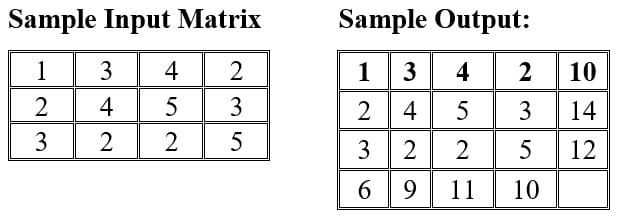
Sample I/O:Enter the number of rows (m): 3
Enter the number of columns (n): 4
Enter the elements of the matrix row-wise:
1  3  4  2
2  4  5  3
3  2  2  5
Output:
Matrix with Row Sums:
1  3  4  2  10
2  4  5  3  14
3  2  2  5  12

Column Sums:
6  9  11  10
#include <iostream>
using namespace std;
int main() {
    int i, num, n, count;
    cout << "Enter the range: ";
    cin >> n;
    cout << "The prime numbers in between the range 1 to " << n << " are: ";

    for (num = 1; num <= n; num++) {
        count = 0;
        for (i = 2; i <= num / 2; i++) {
            if (num % i == 0) {
                count++;
                break;
            }
        }
        if (count == 0 && num != 1)
            cout << num << " ";
    }

    return 0;
}
Sample I/O:
Enter the range: 50
The prime numbers in between the range 1 to 50 are: 2 3 5 7 11 13 17 19 23 29 31 37 41 43 47
=== Code Execution Successful ===Expected Output:
1
01
101
0101
10101
#include <iostream>
using namespace std;
int main() {
    int i, j, n, p, q;
    cout << "Input number of rows: ";
    cin >> n;
    for (i = 1; i <= n; i++) {
        if (i % 2 == 0) {
            p = 1;
            q = 0;
        } else {
            p = 0;
            q = 1;
        }
        for (j = 1; j <= i; j++) {
            if (j % 2 == 0)
                cout << p;
            else
                cout << q;
        }
        cout << endl;
    }
    return 0;
}
Sample I/O:
Input number of rows: 6
1
01
101
0101
10101
010101
=== Code Execution Successful ===#include <iostream>
using namespace std;
int main() {
int n, i, sum = 0, term = 1, nextTerm;
cout << "Enter the value of n: ";
cin >> n;
cout << "The series is: ";
for (i = 1; i <= n; i++) {
cout << term << " ";
sum += term;
nextTerm = term + i;
term = nextTerm;
}
cout << "\nThe sum of the series is: " << sum << endl;
return 0;
}Sample I/O:
Enter the value of n: 10
The series is: 1 2 4 7 11 16 22 29 37 46
The sum of the series is: 175
=== Code Execution Successful ===#include <stdio.h>
int main() {
int n, i;
int a = 0, b = 1, next;
printf("Enter number of terms: ");
scanf("%d", &n);
printf("Fibonacci Series:\n");
for(i = 1; i <= n; i++) {
printf("%d ", a);
next = a + b;
a = b;
b = next;
}
return 0;
}
Input:
5
Output:
Fibonacci Series:
0 1 1 2 3
#include <stdio.h>

int main() {
    int n, i, pos[100], neg[100];
    int p = 0, ne = 0;

    printf("Enter number of elements: ");
    scanf("%d", &n);

    int arr[100];

    printf("Enter elements:\n");
    for(i = 0; i < n; i++) {
        scanf("%d", &arr[i]);
    }

    // Separate positive and negative numbers
    for(i = 0; i < n; i++) {
        if(arr[i] >= 0)
            pos[p++] = arr[i];
        else
            neg[ne++] = arr[i];
    }

    // Rearrange: positives first, then negatives
    printf("Rearranged array:\n");

    for(i = 0; i < p; i++) {
        printf("%d ", pos[i]);
    }

    for(i = 0; i < ne; i++) {
        printf("%d ", neg[i]);
    }

    return 0;
}
Input:
5
1 -2 3 -4 5
Output:
Rearranged array:
1 3 5 -2 -4
#include <stdio.h>

int isLeapYear(int year) {
    if ((year % 4 == 0 && year % 100 != 0) || (year % 400 == 0))
        return 1;
    return 0;
}

int main() {
    int day, month, year;
    int valid = 1;

    printf("Enter day month year: ");
    scanf("%d %d %d", &day, &month, &year);

    // Check month validity
    if (month < 1 || month > 12)
        valid = 0;

    // Days in months
    int daysInMonth[] = {31,28,31,30,31,30,31,31,30,31,30,31};

    // Adjust February for leap year
    if (isLeapYear(year))
        daysInMonth[1] = 29;

    // Check day validity
    if (day < 1 || day > daysInMonth[month - 1])
        valid = 0;

    if (valid)
        printf("Valid Date\n");
    else
        printf("Invalid Date\n");

    return 0;
}
A year is considered a leap year if:
• It is divisible by 4 but not divisible by 100, OR
• It is divisible by 400
In the program, February (month = 2) is assigned 29 days instead of 28 when the year is a leap year.
#include <stdio.h>

int main() {
    int num, i, isPrime = 1;

    printf("Enter a number: ");
    scanf("%d", &num);

    if (num <= 1) {
        isPrime = 0;
    } else {
        for (i = 2; i <= num / 2; i++) {
            if (num % i == 0) {
                isPrime = 0;
                break;
            }
        }
    }

    if (isPrime)
        printf("%d is a prime number.\n", num);
    else
        printf("%d is not a prime number.\n", num);

    return 0;
}
int a = 5, b= 18, c = 27,
a=b++ + ++c;
b = a++ - c --;
c= a++ + b --;
C++ Code Execution Explanation
Step-by-Step Execution
Initial values:
a = 5, b = 18, c = 27
Step 1: a = b++ + ++c;
• b++ → use 18, then b = 19
• ++c → increment first → c = 28, use 28
⇒ a = 18 + 28 = 46
Now: a = 46, b = 19, c = 28
Step 2: b = a++ - c--;
• a++ → use 46, then a = 47
• c-- → use 28, then c = 27
⇒ b = 46 – 28 = 18
Now: a = 47, b = 18, c = 27
Step 3: c = a++ + b--;
• a++ → use 47, then a = 48
• b-- → use 18, then b = 17
⇒ c = 47 + 18 = 65
Now: a = 48, b = 17, c = 65
Final Output
a = 48
b = 17
c = 65
#include <stdio.h>
int main() {
int num, sum = 0, digit;
printf("Enter a 5-digit number: ");
scanf("%d", &num);
while (num != 0) {
digit = num % 10;   // get last digit
        sum = sum + digit; // add digit to sum
        num = num / 10;// remove last digit
    }
printf("Sum of digits = %d\n", sum);
return 0;
}
#include <stdio.h>

// Recursive function to find nth Fibonacci number
int fibonacci(int n) {
    if (n == 0)
        return 0;
    else if (n == 1)
        return 1;
    else
        return fibonacci(n - 1) + fibonacci(n - 2);
}

int main() {
    int n;

    printf("Enter value of n: ");
    scanf("%d", &n);

    printf("The %dth Fibonacci number is: %d\n", n, fibonacci(n));

    return 0;
}
#include <stdio.h>
int main() {
    int n, i;
    float x, sum = 1, term = 1;
    printf("Enter value of x: ");
    scanf("%f", &x);
    printf("Enter number of terms: ");
    scanf("%d", &n);
    // Calculate series
    for (i = 1; i <= n; i++) {
        term = term * x / i;   // x^i / i!
        sum = sum + term;
    }
    printf("Value of e^x = %.4f\n", sum);
    return 0;
}
1, 2, 2, 3, 3, 3, ……………………..100 (100times )Sonali and Janata Bank, O(it), 2023
#include <iostream>
using namespace std;

int main() {
    // Loop from 1 to 100
    for (int n = 1; n <= 100; n++) {
        // Inner loop to repeat 'n' exactly 'n' times
        for (int i = 0; i < n; i++) {
            cout << n << " ";
        }
    }
    cout << endl; // Print a newline at the end of the sequence
    return 0;
}
int F(n) {
if n == 0
return 0;
if n == 1
return 1;
return F(n-2)+F(n-1);
}
int main () {
result F(5);
}
The output of the program will be 5.
=====================
Code Analysis
- Function
F(n):- The function calculates the Fibonacci number for a given
nusing recursion. - Base Cases:
- If
n == 0, it returns 0. - If
n == 1, it returns 1.
- If
- Recursive Case:
- For other values of
n, it returnsF(n-2) + F(n-1).
- For other values of
- The function calculates the Fibonacci number for a given
- Main Function:
- The main function calls
F(5)and stores the result (though it should be assigned to a variable likeresult).
- The main function calls
Calculation of F(5)
The Fibonacci sequence calculated by the function is:
A) Find matrices C that is multiplication A and B.
B) Find average in A and B.
C) Max from matrices C CB, SO(it), 2023
#include <iostream>
using namespace std;
void matrix_multiply(int A[10][10], int B[10][10], int C[10][10], int m, int n, int p, int q) {
if (n != p) {
cout << "Matrices A and B cannot be multiplied due to incompatible dimensions.\n";
return;
}
for (int i = 0; i < m; i++) {
for (int j = 0; j < q; j++) {
C[i][j] = 0;
for (int k = 0; k < n; k++) {
C[i][j] += A[i][k] * B[k][j];
}
}
}
}
float calculate_average(int matrix[10][10], int m, int n) {
int sum = 0;
for (int i = 0; i < m; i++) {
for (int j = 0; j < n; j++) {
sum += matrix[i][j];
}
}
return static_cast(sum) / (m * n);
}
int find_max(int matrix[10][10], int m, int n) {
int max = matrix[0][0];
for (int i = 0; i < m; i++) {
for (int j = 0; j < n; j++) { if (matrix[i][j] > max) {
max = matrix[i][j];
}
}
}
return max;
}
int main() {
int A[10][10], B[10][10], C[10][10];
int m, n, p, q;
cout << "Enter the number of rows and columns for matrix A (m x n): "; cin >> m >> n;
cout << "Enter the number of rows and columns for matrix B (p x q): "; cin >> p >> q;
if (n != p) {
cout << "Matrices A and B cannot be multiplied due to incompatible dimensions.\n";
return 0;
}

// Input matrices A and B
cout << "Enter elements of matrix A:\n";
for (int i = 0; i < m; i++) {
for (int j = 0; j < n; j++) { cin >> A[i][j];
}
}
cout << "Enter elements of matrix B:\n";
for (int i = 0; i < p; i++) {
for (int j = 0; j < q; j++) { cin >> B[i][j];
}
}
// A) Multiply matrices A and B
matrix_multiply(A, B, C, m, n, p, q);
cout << "Matrix C (A x B):\n";
for (int i = 0; i < m; i++) {
for (int j = 0; j < q; j++) {
cout << C[i][j] << " ";
}
cout << endl;
}

// B) Calculate the average of matrices A and B
float average_A = calculate_average(A, m, n);
float average_B = calculate_average(B, p, q);
cout << "Average of Matrix A: " << average_A << endl;
cout << "Average of Matrix B: " << average_B << endl;
// C) Find the maximum value in matrix C
int max_C = find_max(C, m, q);
cout << "Maximum value in Matrix C: " << max_C << endl;
return 0;
}
   Sample I/O:
        Enter the number of rows and columns for matrix A (m x n): 3 3
Enter the number of rows and columns for matrix B (p x q): 3 3
Enter elements of matrix A:
1 5 7 6 3 2 69 7 12
Enter elements of matrix B:
45 63 2 9 8 7 12 10 3
Matrix C (A x B):
174 173 58
321 422 39
3312 4523 223
Average of Matrix A: 12.4444
Average of Matrix B: 17.6667
Maximum value in Matrix C: 4523
=== Code Execution Successful ===
🔗 Run Online: Matrix Calculation
#include <iostream>
int main() {
int n;
std::cout << "Enter the number of terms for the fibonacci series: ";
std::cin >> n;
int first = 0, second = 1;
if (n > 1) {
std::cout << "Fibonacci Series: " << first;
if (n > 2) {
std::cout << ", " << second;
}
for (int i = 2; i < n; i++) {
int next = first + second;
std::cout << ", " << next;
first = second;
second = next;
}
}
std::cout << std::endl;
return 0;
}Rupali, ANE, 2023
Algorithm to Find the Smallest Element in an Array
START
Step 1 → Initialize an array A with given values.
Step 2 → Create a variable min_value and set it to a large number (e.g., infinity) or the first element of the array.
Step 3 → Loop through each element A[i] in the array starting from the first element.
Step 4 → For each element, check if A[i] is smaller than min_value.
Step 5 → If A[i] < min_value, update min_value to A[i].
Step 6 → Repeat Steps 4 and 5 until all elements have been checked.
Step 7 → Display min_value as the smallest element of the array.
STOP
#include <stdio.h>

int findSmallest(int arr[], int size) {

    // 1. Assume the first number is the smallest
    int smallest = arr[0];

    // 2. Look at the rest of the numbers one by one
    for (int i = 1; i < size; ++i) {

        // 3. If we find a number that is smaller, save it
        if (arr[i] < smallest) {
            smallest = arr[i];
        }
    }

    // 4. Send back the smallest number we found
    return smallest;
}#include <stdio.h> int main () { int n1, n2, max; printf ("Enter two positive integers: "); scanf ("%d %d", &n1, &n2); // maximum number between n1 and n2 is stored in max max = (n1> n2) ? n1: n2; while (1) { // Check if max is divisible by both n1 and n2 if ((max% n1 == 0)&& (max % n2 ==0)) { // If true, max is the LCM of n1 and n2 printf("The LCM of %d and %d is %d.", n1,n2,max); break; } ++max; } return 0; }
Sample I/O:
Enter two positive integers: 14 8
The LCM of 14 and 8 is 56.
=== Code Execution Successful ===
Previous Year Written Question
- ☆1Programming ConceptWrite a recursive function that returns a boolean after taking a string as parameter to check if its a palindrome or not.CB, SO(IT), 22 | Senior Officer (IT)
- ☆2Programming ConceptWrite pseudocode or code in any programming language where every character of a string increases by 1 alphabetically, such as a -> b and z -> a.ICB, AP, 26 | Assistant Programmer
- ☆3Programming ConceptConsider the following Java program and determine the integer value printed by the execution of the main() method.
class Test {

static int x = 5;
public static int fun (int n) {

if (n <= 1) {
return 1;
}
x=x+2;
return fun(n - 1) + x;
}
public static void main (String[] args) {
System.out.println(fun(3));
}
}
Combined Bank, SO(IT-24), 26 | Senior Officer (IT) - ☆4Programming ConceptWrite a java code which returns a valueIslami, QA(Engineer), 25 | Bank
- ☆5Programming ConceptWrite JAVA CodeIslami, QA(Engineer), 25 | Bank
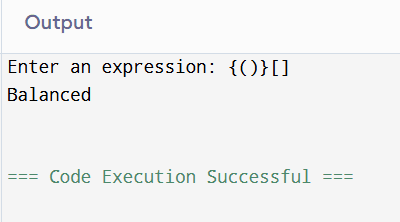
- ☆6Programming ConceptWrite a C/C++ program to check Balanced parentheses in an Expression.6 Bank & FI, AP, 21 | Assistant Programmer
#include <bits/stdc++.h>
using namespace std;

// function to check if brackets are balanced
bool areBracketsBalanced(string expr)
{
    stack s;
    char x;

    // Traversing the Expression
    for (int i = 0; i < expr.length(); i++)
    {
        if (expr[i] == '(' || expr[i] == '[' || expr[i] == '{')
        {
            // Push the element in the stack
            s.push(expr[i]);
            continue;
        }

        // IF current current character is not opening
        // bracket, then it must be closing. So stack
        // cannot be empty at this point.
        if (s.empty())
            return false;

        switch (expr[i]) {
        case ')':
            // Store the top element in a
            x = s.top();
            s.pop();
            if (x == '{' || x == '[')
                return false;
            break;

        case '}':
            // Store the top element in b
            x = s.top();
            s.pop();
            if (x == '(' || x == '[')
                return false;
            break;

        case ']':
            // Store the top element in c
            x = s.top();
            s.pop();
            if (x == '(' || x == '{')
                return false;
            break;
        }
    }

    // Check Empty Stack
    return (s.empty());
}

// Driver code
int main()
{
    string expr;

    // Taking input from the user
    cout << "Enter an expression: "; cin >> expr;

    // Function call
    if (areBracketsBalanced(expr))
        cout << "Balanced\n";
    else
        cout << "Not Balanced\n";
    return 0;
}
Source : GeeksforGeeks
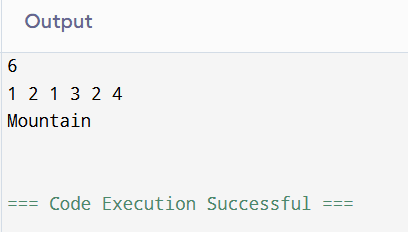
- ☆7Programming ConceptWe are given an array of integers and a range, we need to find whether the subarray which falls in this range has values in the form of a mountain or not. All values of the subarray are said to be in the form of a mountain if either all values are increasing or decreasing or first increasing and then decreasing. Write a C/C++ Program that shows input is a Mountain sequence or Not Mountain sequence.6 Bank & FI, AP, 21 | Assistant Programmer
#include <bits/stdc++.h>
using namespace std;

#define ll long long

bool isMountain(vector<ll> a) {
    ll n = a.size();

    if (n < 3)
        return false;

    ll i = 1;

    // Increasing part
    while (i < n && a[i] > a[i - 1]) {
        i++;
    }

    // Peak cannot be first or last
    if (i == 1 || i == n)
        return false;

    // Decreasing part
    while (i < n && a[i] < a[i - 1]) {
        i++;
    }

    return i == n;
}

int main() {
    ll n;
    cin >> n;

    vector<ll> a(n);
    for (ll i = 0; i < n; i++) {
        cin >> a[i];
    }

    if (isMountain(a)) {
        cout << "Mountain" << endl;
    } else {
        cout << "Not Mountain" << endl;
    }

    return 0;
}
Source: Geeksforgeeks
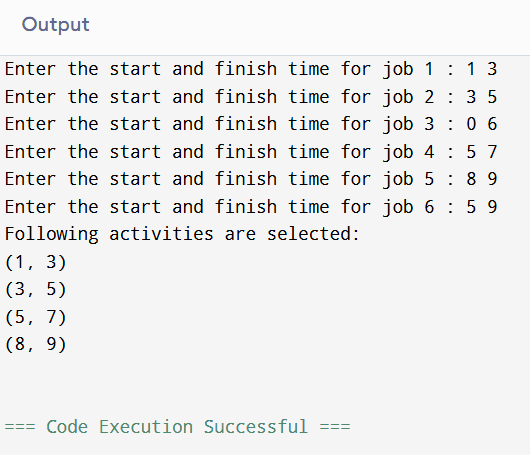
- ☆8Programming ConceptGiven n jobs starting time n[] and duration d[], print maximum number of jobs that don't overlap between each other.6 Bank & FI, AP, 21 | Assistant Programmer
#include <bits/stdc++.h>
using namespace std;

#define N 6

// Define structure for Activity
struct Activity {
    int start, finish;
};

// Function to compare two activities
bool Sort_activity(Activity s1, Activity s2) {
    return (s1.finish < s2.finish); // Sort by finish time
}

// Function to print the maximum number of activities
void print_Max_Activities(Activity arr[], int n) {
    // Sort activities based on finish time
    sort(arr, arr + n, Sort_activity);

    cout << "Following activities are selected: \n";

    int i = 0;
    cout << "(" << arr[i].start << ", " << arr[i].finish << ")\n";

    // Select the next activity that starts after the last selected activity finishes
    for (int j = 1; j < n; j++) {
        if (arr[j].start >= arr[i].finish) {
            cout << "(" << arr[j].start << ", " << arr[j].finish << ")\n";
            i = j;
        }
    }
}

int main() {
    Activity arr[N];

    // Taking input from the user
    for (int i = 0; i < N; i++) {
        cout << "Enter the start and finish time for job " << i + 1 << " : ";
        cin >> arr[i].start >> arr[i].finish;
    }

    // Function call to print the selected activities
    print_Max_Activities(arr, N);

    return 0;
}
Code Link
- ☆9Programming ConceptWrite a C/C++ Program that has a Class Account, Subclass Savings Account, Current Account etc with related hierarchy way.6 Bank & FI, AP, 21 | Assistant Programmer
- ☆10Programming ConceptAn employee's total weekly pay is calculated by multiplying the hourly wage and number of regular hours plus any overtime pay which in turn is calculated as total overtime hours multiplied by 1.5 times the hourly wage. Write a program that takes as inputs the hourly wage. Total regular hours,and total overtime hours and prints an employee's total weekly pay.CB, O(IT), 20 | Officer (IT)
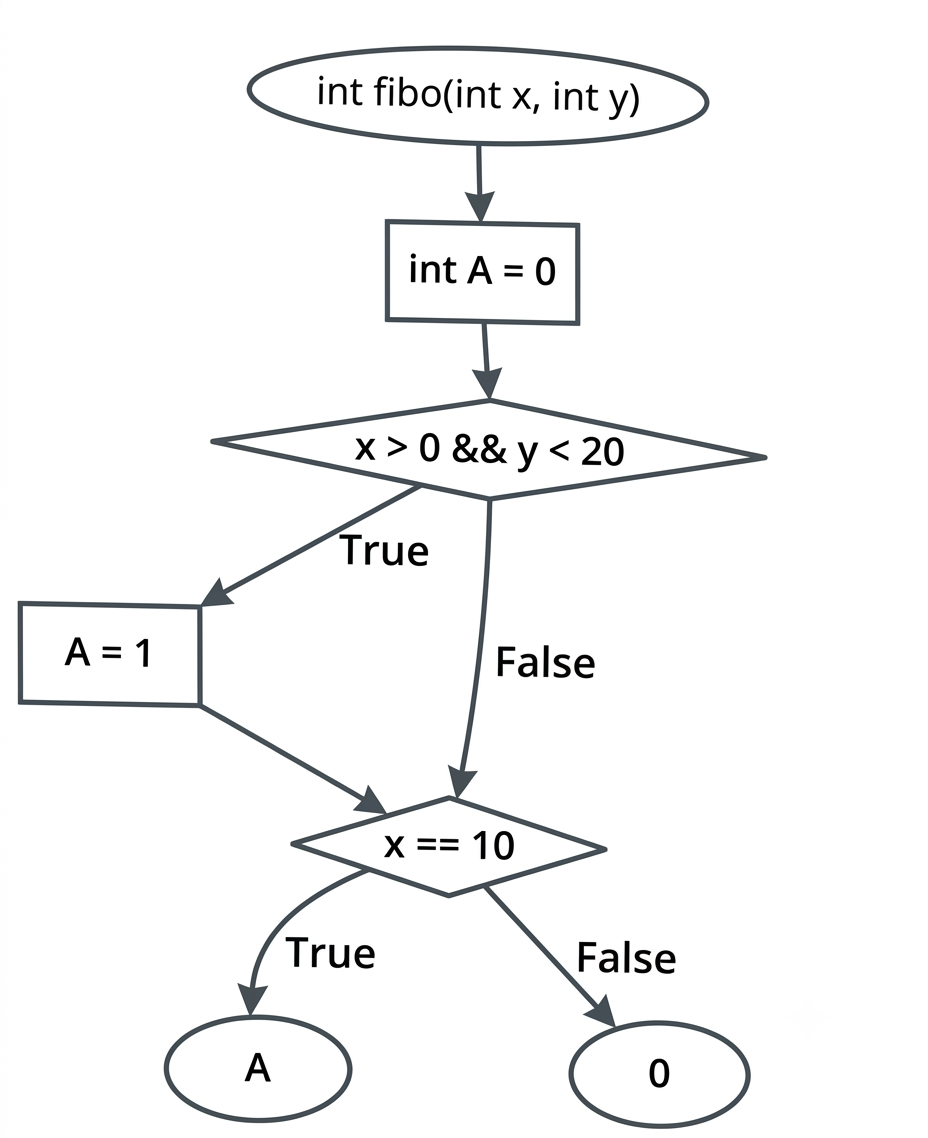
- ☆11Programming ConceptAnswer the following question from the below code:
int fibo (int x, int y)
{
int A = 0; if (x>0&& y<20 {
A = 1 ; }
if ( x = = 10) {
return A; }
return 0;
}
(i) Draw the flowchart based on above code
(ii) How many conditions are in this code?
(iii) Finding the possible path.Pubali, SQA, 23 |(i) Answer:
(ii) Answer: There are two conditions in the code:
(a) The first condition is x> 0 && y <20
(b) The second condition is x=10
(iii) Answer:
(iii) Finding the possible path. There are two possible paths through the code: (a) If x>0&&y<20 is true and x is not equal to 10, the function returns 0.
(b) If x> 0 && y 0 && y < 20 is false, the function also returns 0.
- ☆12Programming ConceptWrite a structured program (in C or Python) that takes an integer input n and prints the sum of all even numbers from 1 to n.Combined Bank, SO-IT, 25 | Senior Officer (IT)
- ☆13Programming ConceptWrite a program using any object-oriented language (e.g., C++ / Java / Python) to represent a Bank Account. Your program should include:
. A class BankAccount with data members for account holder's name, account number, and balance.
. Member functions to deposit() money, withdraw() money (ensuring sufficient balance), and display() account details.
Demonstrate the concept of encapsulation by keeping data member's private and providing appropriate public methods for accessing and modifying them.Combined Bank, SO-IT, 25 | Senior Officer (IT) - ☆14Programming ConceptWhat is the difference between exception and Error in java?SPCBL, SAP, 22 | Assistant Programmer
- ☆15Programming ConceptWhat is exception handling? Write with an example.SPCBL, SAP, 22 | Assistant Programmer
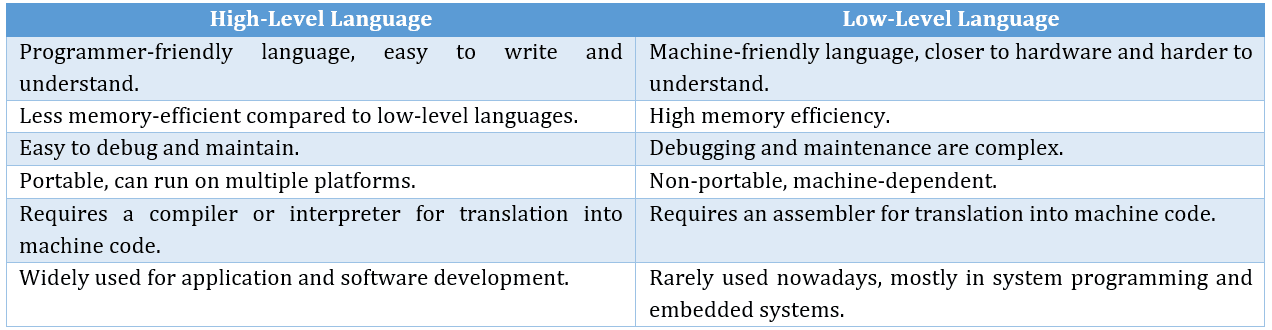
- ☆16Programming ConceptDifference between High level language low level languages with some example?SPCBL, SAP, 22 | Assistant Programmer

Examples:
- High-Level Languages: C, C++, Java, Python, etc.
- Low-Level Languages: Assembly Language, Machine Code.
- ☆17Programming ConceptGiven a IPV4 address string, write C/C++/JAVA code to show the class the IP address belongs to.
Sample Input: 192.168.0.0
Sample Output: Class CRupali, ANE, 21 | - ☆18Programming ConceptWrite a program in any language that takes two matrices A and B as inputs ensure your code handles matrices of different dimensions-
A) Find matrices C that is multiplication A and B.
B) Find average in A and B.
C) Max from matrices C 10CB, SO(IT), 23 | Senior Officer (IT) - ☆19Programming ConceptWrite a C/C++ program to check balanced parenthesis in an ExpressionJB, ANE, 20 | Assistant Network Engineer
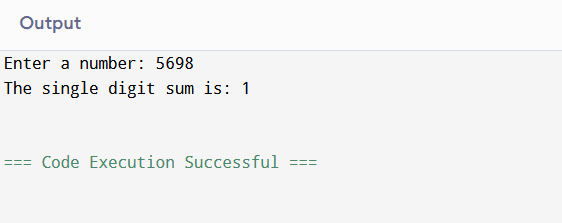
- ☆20Programming ConceptWrite a Program to find summation for a number until it's become single digit.Sonali, O(it), 21 | Officer (IT)
#include <iostream>
using namespace std;

int singleDigit(int n) {
    int sum = n;

    // Repeatedly calculate sum of digits until it becomes a single digit
    while (sum >= 10) {
        int tempSum = 0;

        // Calculate sum of digits of the number
        while (sum > 0) {
            tempSum += sum % 10;
            sum /= 10;
        }

        sum = tempSum;  // Update sum to the sum of digits
    }

    return sum;
}

int main() {
    int n;

    // Taking user input
    cout << "Enter a number: ";
    cin >> n;

    // Calling the function and printing the result
    cout << "The single digit sum is: " << singleDigit(n) << endl;

    return 0;
}
Input: n = 1234
Output: 1
Explanation:
Step 1: 1 + 2 + 3 + 4 = 10
Step 2: 1 + 0 = 1Input: n = 5674
Output: 4
Explanation:
Step 1: 5 + 6 + 7 + 4 = 22
Step 2: 2 + 2 = 4 - ☆21Programming ConceptFind the output of the following program.i=5;
While (i>=0)
printf("%d", i);
i=i-1;
}Sonali, O(it), 21 | Officer (IT) - ☆22Programming ConceptFind the output of the following program.int main() {
printf ("%d\t", sizeof (6.5));
printf ("%d\t", sizeof(90000));
printf ("%d\t", sizeof ("A"));
return 0; }Sonali, O(it), 21 | Officer (IT) - ☆23Programming ConceptWrite a program in C++ / Java using method overriding to calculate electricity bills for Residential and Commercial customers. Create a base class Customer with a method
calculateBill(int units)and override it in the Residential class to charge 6 TK per unit and in the Commercial class to charge 10 TK per unit. In the main method, create objects of both classes, calculate the bills for given units, and display the results.BPDB, AE(CSE),2026 | Power Sector - ☆24Programming ConceptWrite a function to find the smallest element from an arrayCB, AP, 23 | Assistant Programmer
- ☆25Programming ConceptWrite a Program to print Prime numbers from 1 to n.Combined Bank, AP, 24 | Assistant Programmer
- ☆26Programming ConceptWrite a Program to print Floyd's Triangle for n = 5.
Expected Output:
1
01
101
0101
10101Combined Bank, AP, 24 | Assistant Programmer - ☆27Programming ConceptWrite a C++ program to find the sum of the series: 1 + 2 + 4 + 7 + 11 + ... + N.Combined Bank, AP, 24 | Assistant Programmer
- ☆28Programming ConceptFind the output of the following recursion:
#include <stdio.h>
void fun(int x){
if(x<0){
return;
}
printf("%d\n", x--);
fun(--x);
printf("%d\n", x);
}
int main() {
fun(5);
return 0;
}Combined Bank, AP, 24 | Assistant Programmer
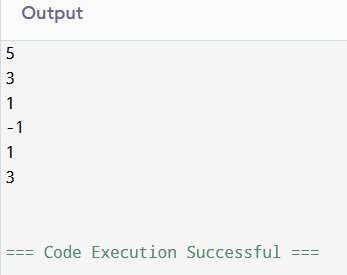
Step-by-Step Execution
Initial call:
fun(5)x = 5- Print
5 x--(post-decrement) → Passx = 4tofun(--x)
Recursive call:
fun(3)x = 3- Print
3 x--(post-decrement) → Passx = 2tofun(--x)
Recursive call:
fun(1)x = 1- Print
1 x--(post-decrement) → Passx = 0tofun(--x)
Recursive call:
fun(-1)x = -1- The
if(x<0) return;triggers, stopping recursion. - Nothing is printed here.
Returning from
fun(1):x = -1at this point (becausexwas decremented before recursion)- Print
-1
Returning from
fun(3):x = 1- Print
1
Returning from
fun(5):x = 3- Print
3
- ☆29Programming ConceptWhat will be the output of the following program?
#include int main() {
int i = -1, j = -1, k = 0, l = 2, m;
m = i++ && j++ && k++ || l++;
printf("%d %d %d %d %d", i, j, k, l, m);
return 0;
}Dwasa,AME,25 | Other - ☆30Programming ConceptWrite the different approaches of debugging a code.CB, SO(IT), 20 | Senior Officer (IT)
- ☆31Programming ConceptWrite a program that check a number is Armstrong or not.CB, SO(IT), 20 | Senior Officer (IT)
- ☆32Programming ConceptGiven two integers A and B as input write a program to compute the least common multiple of A and B.BB, AP, 23 | Assistant Programmer
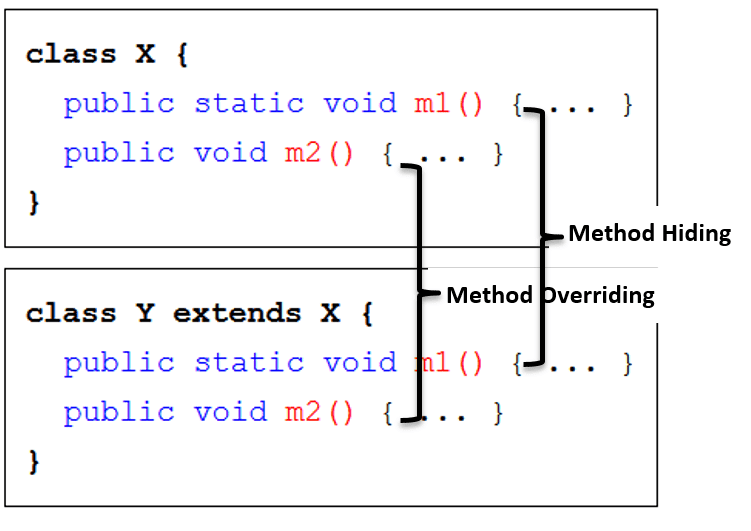
- ☆33Programming ConceptConsider the following code:
Public class Class A {
Mention which of the methods overload, override and hied supper class methods. What about the remaining method?
Public void m1 () {}
Public void m2 (int i) {}
Public void m3 (int i) {}
Public static void m4 (int i) {}
Public class class B extends class A {
Public static void ml (int i) {}
Public void m2 (int i) {}
Public void m3 (string s) {}
Public static void m4 (int i) {}BB, AP, 23 | Assistant Programmer
- ☆34Programming ConceptString reverse program but without using new storage.SB & JB, ADA, 22 | ADA
- ☆35Programming Concept
What will be the output in C and Java code?
(i) C program:
#include<stdio.h>
int main(){
    int a[] = {5,3,4,2,1};
    int i;
    for(i=0; i<10; i++)
        printf("%d\n", a[i]);
}
(ii) Java program:
public class MyFirst {
    public static void main(String[] args) {
        MyFirst obj = new MyFirst(n);
    }

    static int a = 10;
    static int n;
    int b = 5;
    int c;

    public MyFirst(int m) {
        System.out.println(a + ", " + b + ", " + c + ", " + n + ", " + m);
    }

    {
        b = 30;
        n = 20;
    }

    static {
        a = 60;
    }
}
CB, AP, 20 | Assistant Programmer - ☆36Programming ConceptWrite a code in C/C++ that will output the 2nd largest number. (If N>=1)CB, AP, 20 | Assistant Programmer
- ☆37Programming ConceptFind the sum of the digits of a number until the sum is reduced to a single digit.
Sample input = 12345
Sample output = 6CB 3 Bank, SO(IT), 20 | Senior Officer (IT) - ☆38Programming ConceptWrite a C program to find max price from 20 items.BB, AP, 19 | Assistant Programmer
- ☆39Programming ConceptSuppose, you are implementing “Overdraft Account (OD)” class using Java for a banking app. An OD type account is opened with an approved loan limit (e.g. 100000/-). The account holder can deposit any amount of money in the OD account at any time. S/he can draw an amount of money from the account until sufficient cash balance. S/he is allowed to draw money beyond his/her cash balance if the total over-drawing amount remains within the loan limit. A Java sketch for OD account is given below and code is expected to run in multi-threading mode (same code with run by different counter in the Bank).BB, AP, 19 | Assistant Programmer
- ☆40Programming ConceptBasicWrite a program for the following series: e^x = 1 + x/1! + x²/2! + x³/3! + ...Sonali Bank, ADA, 24 | ADA
- ☆41Programming ConceptBasicWrite a program for following sequence and analyze complexity of the program
1, 2, 2, 3, 3, 3, ……………………..100 (100times )CB, O(IT), 23 | Officer (IT) - ☆42Programming ConceptBasicWrite a function which receives an array of integers as parameter and print the numbers divisible by 3 in the array.Combined Bank, O(IT), 24 | Officer (IT)
- ☆43Programming ConceptPointer#include
int main() {
int ledger[5] = {10, 20, 30, 40, 50};
int *ptr1 = (int *)(&ledger + 1);
int *ptr2 = (int *)(ledger + 1);
printf("%d, %d", *(ptr1 - 1), *(ptr2 + 2));
return 0;
}
Find the output.Combined Bank, AP-23, 26 | Assistant ProgrammerCode:
#include <stdio.h>

int main() {
    int ledger[5] = {10, 20, 30, 40, 50};

    int *ptr1 = (int *)(&ledger + 1);
    int *ptr2 = (int *)(ledger + 1);

    printf("%d, %d", *(ptr1 - 1), *(ptr2 + 2));
    return 0;
}
Output:
50, 40Step-by-Step Explanation
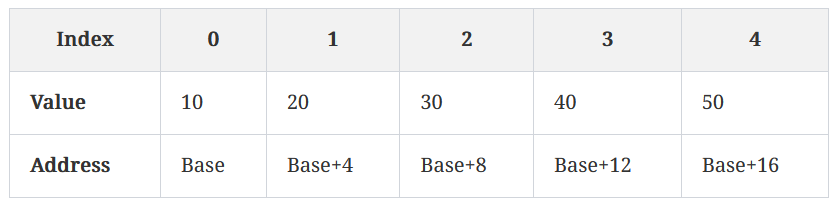
1. Array Layout in Memory

2. ptr1 = (int *)(&ledger + 1)
- &ledger is a pointer to the entire array, type int (*)[5].
- &ledger + 1 moves forward by the size of the whole array (5 ints = 20 bytes), landing just after the array.
- ptr1 now points to memory right after ledger[4].
3. ptr2 = (int *)(ledger + 1)
- ledger decays to pointer to first element (int *).
- ledger + 1 moves to ledger[1], which contains 20.
- ptr2 points to ledger[1].
4. *(ptr1 - 1)
- ptr1 is just past the array end.
- ptr1 - 1 moves back to ledger[4].
- Value = 50.
5. *(ptr2 + 2)
- ptr2 points to ledger[1].
- ptr2 + 2 lands on ledger[3].
- Value = 40.
- ☆44Programming ConceptRecursionUsually, recursion involves a function Write a recursive algorithm to find the factorial of a number.CB, O(IT), 20 | Officer (IT)
- ☆45Programming ConceptOthersWrite a program in any language to find the sum of rows and columns of a m X n matrix, where m and n is taken input from the user. Give the output in the following format:
 Combined Bank, SO(IT), 24 | Senior Officer (IT)
 - ☆46Programming ConceptOthersWrite a program in any language to find the prime numbers between 1....... n, where n is taken as user input.
Sample input:
Enter value of n: 20
Sample Output:
Prime Numbers: 2, 3, 5, 7, 11, 13, 17, 19Combined Bank, SO(IT), 24 | Senior Officer (IT) - ☆47Programming ConceptOthersSuppose we want to develop software for a graphic package and we are given the task to implement circle class. The circle class has to be translatable from its origin. And it should also be able to give perimeter and area of the circle. Identify the data and method requirements for the class and give the data flow of translation method.Combined Bank, O(IT), 24 | Officer (IT)
- ☆48Programming ConceptrecursionFind the output of following program:
int F(n) {
if n == 0
return 0;
if n == 1
return 1;
return F(n-2)+F(n-1);
}
int main () {
result F(5);
}CB, O(IT), 23 | Officer (IT)
- ☆49Programming ConceptArrayWrite the pseudocode/ program (in any language) to print the common element between two arrays and the total number of such elements found. [assume each element in an array distinct].BB, AD(ICT), 25 | Bangladesh Bank
- ☆50Programming ConceptER DiagramDraw ER Diagram (Not Fully Collected)CB, AP, 20 | Assistant Programmer