Introduction to Autometa Theory
- 1Introduction to Autometa TheoryWhat is Theory of Computation and Why we need it?Theory of Computation
Automata Theory (Theory of Computation)
Automata Theory, also known as the Theory of Computation (TOC), is a branch of Computer Science and Mathematics that studies abstract machines (Automata) to understand the capabilities and limitations of computation. It analyzes mathematical models to explain how machines process information and perform computations.
The Theory of Computation (TOC) focuses on determining which problems computers can solve, how they solve them, and how efficiently they can perform those computations.
Key Objectives of Theory of Computation
• Studies simple abstract machines and helps in designing compilers and language processors.
• Identifies which problems can and cannot be solved by a computer.
• Analyzes the time and memory required to solve problems and compares their efficiency.
• Provides a theoretical foundation for understanding the capabilities and limitations of computers and computation.Why We Need Theory of Computation
• Understand the limitations of computational systems.
• Design faster and more efficient algorithms and programs.
• Build a strong foundation in programming, algorithms, and computer science concepts.
• Improve the performance, efficiency, and reliability of computing systems.Example
The Theory of Computation can help a computer verify whether a password entered by a user is correct or incorrect. This demonstrates how computational problems are solved step by step using mathematical models.
Automata Theory (Theory of Computation)
Automata Theory, যা Theory of Computation (TOC) নামেও পরিচিত, Computer Science এবং Mathematics-এর একটি গুরুত্বপূর্ণ শাখা। এটি Abstract Machine (Automata) নিয়ে গবেষণা করে যাতে Computation-এর ক্ষমতা (Capabilities) এবং সীমাবদ্ধতা (Limitations) বোঝা যায়। এটি Mathematical Model-এর মাধ্যমে ব্যাখ্যা করে কীভাবে একটি Machine তথ্য Process করে এবং Computation সম্পন্ন করে।
Theory of Computation (TOC) মূলত অধ্যয়ন করে কোন Problem একটি Computer সমাধান করতে পারে, কীভাবে সমাধান করে এবং কতটা দক্ষতার (Efficiency) সাথে সেই Computation সম্পন্ন করতে পারে।
Theory of Computation-এর প্রধান উদ্দেশ্য
• সহজ Abstract Machine অধ্যয়ন করে এবং Compiler ও Language Processor ডিজাইনে সহায়তা করে।
• নির্ধারণ করে কোন Problem Computer দ্বারা সমাধান করা সম্ভব এবং কোনটি সম্ভব নয়।
• Problem সমাধানের জন্য প্রয়োজনীয় Time ও Memory বিশ্লেষণ করে এবং বিভিন্ন Solution-এর Efficiency তুলনা করে।
• Computer-এর Capabilities এবং Limitations বোঝার জন্য একটি শক্তিশালী Theoretical Foundation প্রদান করে।Theory of Computation-এর প্রয়োজনীয়তা
• Computer কোন ধরনের Problem সমাধান করতে পারে এবং কোথায় তার সীমাবদ্ধতা রয়েছে তা বোঝা যায়।
• আরও দ্রুত (Fast) এবং Efficient Algorithm ও Program ডিজাইন করা যায়।
• Programming, Algorithm এবং Computer Science-এর মৌলিক ধারণার উপর শক্ত ভিত্তি তৈরি হয়।
• Computing System-এর Performance, Efficiency এবং Reliability উন্নত করতে সহায়তা করে।উদাহরণ
Theory of Computation ব্যবহার করে একটি Computer সহজেই যাচাই করতে পারে যে ব্যবহারকারীর দেওয়া Password সঠিক নাকি ভুল। এটি দেখায় কীভাবে একটি Computational Problem ধাপে ধাপে Mathematical Model ব্যবহার করে সমাধান করা হয়।
- 2Introduction to Autometa TheorySome Term Used in Autometa TheoryTheory of Computation
Basic Terminologies of Automata Theory
1. Symbol
A Symbol (also called a Character) is the smallest unit in Automata Theory. A symbol may be a letter, digit, special character, or any other individual element used to build strings. Symbols cannot be divided into smaller meaningful parts.
Example
If Σ = {a, b}, then a and b are symbols.
If Σ = {0,1}, then 0 and 1 are symbols.2. Alphabet (Σ)
An Alphabet, denoted by Σ (Sigma), is a finite and non-empty set of symbols. All strings in a language are formed using the symbols of an alphabet.
Example
Σ = {a, b}
Σ = {0,1}
Σ = {A, B, C}The set {a, b} is an alphabet containing two symbols, while {0,1} is called the binary alphabet.
3. String
A String is a finite sequence of symbols taken from an alphabet. A string is usually represented by w, and its length is denoted by |w|. The length of a string is equal to the number of symbols it contains.
An Empty String is a string that contains no symbols. It is represented by ε (epsilon), and its length is zero.
Examples of Strings
If Σ = {a, b}, then possible strings are:
a
b
aa
ab
ba
bb
aba
babFor the string w = abbab:
|w| = 5For the empty string:
w = ε
|ε| = 0Example: Number of Strings of Length 2
Suppose the alphabet is:
Σ = {a, b}The possible strings of length 2 are:
aa
ab
ba
bbLength of each string = 2
Total number of strings = 4Since the alphabet contains 2 symbols, the total number of strings of length n is:
Number of Strings = 2n
For n = 2:
2² = 4 stringsFor n = 3:
2³ = 8 stringsImportance of Automata Theory
Automata Theory is widely used for modeling computational problems. It provides the theoretical foundation for designing Compilers, Interpreters, Programming Languages, Pattern Matching Systems, Digital Circuits, and many other computing applications. It also helps analyze whether a problem can be solved by a computer and how efficiently it can be solved.
Automata Theory-এর মৌলিক পরিভাষা (Basic Terminologies)
১. Symbol
Symbol (বা Character) হলো Automata Theory-এর সবচেয়ে ছোট একক। এটি একটি Letter, Digit, Special Character অথবা যেকোনো একক Element হতে পারে, যা ব্যবহার করে String তৈরি করা হয়। একটি Symbol-কে আরও ছোট অর্থপূর্ণ অংশে ভাগ করা যায় না।
উদাহরণ
যদি Σ = {a, b} হয়, তাহলে a এবং b দুটি Symbol।
যদি Σ = {0,1} হয়, তাহলে 0 এবং 1 দুটি Symbol।২. Alphabet (Σ)
Alphabet, যাকে Σ (Sigma) দ্বারা প্রকাশ করা হয়, হলো এক বা একাধিক Symbol-এর একটি সসীম (Finite) এবং শূন্য নয় (Non-empty) সেট। একটি Language-এর সকল String এই Alphabet-এর Symbol ব্যবহার করে তৈরি করা হয়।
উদাহরণ
Σ = {a, b}
Σ = {0,1}
Σ = {A, B, C}এখানে {a, b} দুটি Symbol নিয়ে গঠিত একটি Alphabet এবং {0,1} হলো Binary Alphabet।
৩. String
String হলো একটি Alphabet থেকে নেওয়া এক বা একাধিক Symbol-এর সসীম (Finite) ক্রম। সাধারণত একটি String-কে w দ্বারা প্রকাশ করা হয় এবং এর দৈর্ঘ্য |w| দ্বারা নির্দেশ করা হয়। String-এর দৈর্ঘ্য বলতে এতে মোট কতটি Symbol রয়েছে তা বোঝায়।
যে String-এ কোনো Symbol থাকে না তাকে Empty String বলা হয়। এটি ε (Epsilon) দ্বারা প্রকাশ করা হয় এবং এর দৈর্ঘ্য |ε| = 0।
String-এর উদাহরণ
যদি Σ = {a, b} হয়, তাহলে কিছু সম্ভাব্য String হলো:
a
b
aa
ab
ba
bb
aba
babযদি w = abbab হয়, তাহলে:
|w| = 5যদি w = ε হয়, তাহলে:
|ε| = 0উদাহরণ: দৈর্ঘ্য 2-এর String-এর সংখ্যা
ধরা যাক,
Σ = {a, b}তাহলে দৈর্ঘ্য 2-এর সম্ভাব্য String হলো:
aa
ab
ba
bbপ্রতিটি String-এর দৈর্ঘ্য = 2
মোট String-এর সংখ্যা = 4যেহেতু Alphabet-এ 2টি Symbol রয়েছে, তাই দৈর্ঘ্য n-এর মোট String-এর সংখ্যা হবে:
Number of Strings = 2n
যদি n = 2 হয়:
2² = 4 টি Stringযদি n = 3 হয়:
2³ = 8 টি StringAutomata Theory-এর গুরুত্ব
Automata Theory বিভিন্ন Computational Problem-এর Mathematical Model তৈরি করতে ব্যবহৃত হয়। এটি Compiler, Interpreter, Programming Language, Pattern Matching System, Digital Circuit এবং অন্যান্য Computing System ডিজাইনের মৌলিক ভিত্তি প্রদান করে। এছাড়া এটি নির্ধারণ করতে সাহায্য করে কোনো Problem Computer দ্বারা সমাধানযোগ্য কিনা এবং কতটা Efficient উপায়ে সেটি সমাধান করা সম্ভব।
- 3Introduction to Autometa TheoryClosure Representation in TOCTheory of Computation
In Theory of Computation (TOC), Closure Operations describe how new strings can be generated from a given language. The two most common closure operations are Positive Closure (L+) and Kleene Closure (L*).
1. Positive Closure (L+)
Positive Closure, denoted by L+, represents the set of all possible strings that can be formed by repeating the strings of a language one or more times. Since at least one occurrence is required, the Empty String (ε) is not included.
Mathematical Representation
L+ = L1 ∪ L2 ∪ L3 ∪ ...
Example
Let Σ = {g}.
Regular Expression: g+L+ = {g, gg, ggg, gggg, ggggg, ...}
Here, every string contains at least one g. The Empty String (ε) is not included.
2. Kleene Closure (L*)
Kleene Closure, denoted by L*, represents the set of all possible strings that can be formed by repeating the strings of a language zero or more times. Since zero repetitions are allowed, the Empty String (ε) is included.
Kleene Closure is also known as the Kleene Star or Kleene Operator. It is a Unary Operator used extensively in Regular Expressions, Finite Automata, Compiler Design, and Pattern Matching.
Mathematical Representation
L* = ε ∪ L+
Therefore,
L* = {ε} ∪ L+
Example
Let Σ = {g}.
Regular Expression: g*L* = {ε, g, gg, ggg, gggg, ggggg, ...}
Unlike Positive Closure, the Empty String (ε) is included because zero occurrences are allowed.
Difference Between L+ and L*
Feature L+ (Positive Closure) L* (Kleene Closure) Minimum Occurrence One Zero Includes ε No Yes Regular Expression g+ g* Generated Strings {g, gg, ggg, ...} {ε, g, gg, ggg, ...} Example of Kleene Star
Suppose the input string is "GFG".
Using Kleene Star, possible strings include:
Σ* = {ε, "GFG", "GGFG", "GGGFG", "GFGGG", "GGGGGGGGFFFFFFFFFGGGGGGGG", ...}
The set generated by Kleene Star is theoretically infinite because strings can be repeated any number of times. However, when grammar rules or language constraints are applied, the generated set may become finite.
Applications of Kleene Closure
• Designing Regular Expressions.
• Constructing Finite Automata.
• Compiler and Lexical Analyzer design.
• Pattern matching and text searching.
• Formal language processing.
Theory of Computation (TOC)-এ Closure Operation ব্যবহার করা হয় একটি Language থেকে কীভাবে নতুন নতুন String তৈরি করা যায় তা বোঝানোর জন্য। সবচেয়ে গুরুত্বপূর্ণ দুটি Closure হলো Positive Closure (L+) এবং Kleene Closure (L*)।
১. Positive Closure (L+)
Positive Closure, যা L+ দ্বারা প্রকাশ করা হয়, একটি Language-এর String-গুলোকে একবার বা তার বেশি (One or More Times) পুনরাবৃত্তি করে যে সকল String তৈরি হয় তাদের সমষ্টিকে বোঝায়। যেহেতু অন্তত একবার উপস্থিতি বাধ্যতামূলক, তাই Empty String (ε) এখানে অন্তর্ভুক্ত হয় না।
Mathematical Representation
L+ = L1 ∪ L2 ∪ L3 ∪ ...
উদাহরণ
ধরা যাক,
Σ = {g}
Regular Expression = g+L+ = {g, gg, ggg, gggg, ggggg, ...}
এখানে প্রতিটি String-এ অন্তত একটি g রয়েছে। তাই Empty String (ε) অন্তর্ভুক্ত নয়।
২. Kleene Closure (L*)
Kleene Closure, যা L* দ্বারা প্রকাশ করা হয়, একটি Language-এর String-গুলোকে শূন্য বা তার বেশি (Zero or More Times) পুনরাবৃত্তি করে যে সকল String তৈরি হয় তাদের সমষ্টিকে বোঝায়। যেহেতু শূন্যবার পুনরাবৃত্তিও অনুমোদিত, তাই Empty String (ε) এখানে অন্তর্ভুক্ত থাকে।
Kleene Closure-কে Kleene Star বা Kleene Operatorও বলা হয়। এটি একটি Unary Operator, যা Regular Expression, Finite Automata, Compiler Design এবং Pattern Matching-এ ব্যাপকভাবে ব্যবহৃত হয়।
Mathematical Representation
L* = ε ∪ L+
অর্থাৎ,
L* = {ε} ∪ L+
উদাহরণ
ধরা যাক,
Σ = {g}
Regular Expression = g*L* = {ε, g, gg, ggg, gggg, ggggg, ...}
এখানে Empty String (ε) অন্তর্ভুক্ত রয়েছে, কারণ শূন্যবার পুনরাবৃত্তিও গ্রহণযোগ্য।
L+ এবং L*-এর পার্থক্য
বিষয় L+ (Positive Closure) L* (Kleene Closure) সর্বনিম্ন পুনরাবৃত্তি ১ বার ০ বার Empty String (ε) অন্তর্ভুক্ত নয় অন্তর্ভুক্ত Regular Expression g+ g* String-এর সেট {g, gg, ggg, ...} {ε, g, gg, ggg, ...} Kleene Star-এর উদাহরণ
ধরা যাক Input String হলো "GFG"।
তাহলে Kleene Star ব্যবহার করে সম্ভাব্য কিছু String হলো:
Σ* = {ε, "GFG", "GGFG", "GGGFG", "GFGGG", "GGGGGGGGFFFFFFFFFGGGGGGGG", ...}
Kleene Star দ্বারা তৈরি String-এর সংখ্যা তাত্ত্বিকভাবে অসীম (Infinite), কারণ String যেকোনো সংখ্যক বার পুনরাবৃত্তি করা যায়। তবে নির্দিষ্ট Grammar Rule বা Language Constraint প্রয়োগ করলে এটি সীমিত (Finite) হতে পারে।
Kleene Closure-এর ব্যবহার
• Regular Expression তৈরিতে ব্যবহৃত হয়।
• Finite Automata নির্মাণে ব্যবহৃত হয়।
• Compiler এবং Lexical Analyzer ডিজাইনে গুরুত্বপূর্ণ ভূমিকা পালন করে।
• Pattern Matching এবং Text Searching-এ ব্যবহৃত হয়।
• Formal Language Processing-এর মৌলিক ভিত্তি হিসেবে কাজ করে।
- 4Introduction to Autometa TheoryLanguage in Theory of Computation (TOC)Theory of Computation
In Theory of Computation (TOC), a Language is a collection (set) of Strings formed using the symbols of a given Alphabet (Σ). Every string in a language is created by combining one or more symbols from the alphabet according to specific rules.
Mathematically, a language is defined as a subset of Σ*, where Σ* represents the set of all possible strings (including the Empty String (ε)) that can be formed from the alphabet Σ.
Therefore,
L ⊆ Σ*
Example
If Σ = {a, b}, then:
Σ* = {ε, a, b, aa, ab, ba, bb, aaa, aab, aba, ...}
A possible language can be:
L = {ab, ba, bb}
Since all these strings are formed using the symbols a and b, L is a valid language over the alphabet Σ.
Examples of Languages
1. Finite Language
A Finite Language contains a limited (finite) number of strings.
Example:
L = {xy, yx, xx, yy}This language contains only four strings, so it is a finite language.
2. Infinite Language
An Infinite Language contains an unlimited (infinite) number of strings.
Example:
L = {All strings that start with 'b'}Possible strings are:
ba
bb
baa
babb
baab
bbbb
...Since new strings can be generated indefinitely, this language is infinite.
Types of Languages in Theory of Computation
1. Regular Language
A Regular Language is the simplest type of formal language. It can be described using Regular Expressions and recognized by Finite Automata (FA).
Example:
L = {an | n ≥ 0}
Strings: {ε, a, aa, aaa, aaaa, ...}2. Context-Free Language (CFL)
A Context-Free Language is generated using a Context-Free Grammar (CFG) and recognized by a Pushdown Automaton (PDA). These languages are more powerful than regular languages because they can represent nested structures.
Example:
L = {anbn | n ≥ 0}
Strings: {ε, ab, aabb, aaabbb, aaaabbbb, ...}3. Context-Sensitive Language (CSL)
A Context-Sensitive Language is generated using a Context-Sensitive Grammar (CSG) and accepted by a Linear Bounded Automaton (LBA). These languages are more expressive than Context-Free Languages.
4. Recursive and Recursively Enumerable Language
These languages are recognized using a Turing Machine (TM).
A Recursive Language always halts and decides whether a string belongs to the language.
A Recursively Enumerable Language accepts valid strings, but it may not halt for invalid strings.Summary
Language Type Generated By Recognized By Regular Language Regular Expression Finite Automata (FA) Context-Free Language Context-Free Grammar (CFG) Pushdown Automaton (PDA) Context-Sensitive Language Context-Sensitive Grammar (CSG) Linear Bounded Automaton (LBA) Recursive / Recursively Enumerable Turing Machine Turing Machine (TM)
Theory of Computation (TOC)-এ Language বলতে একটি নির্দিষ্ট Alphabet (Σ)-এর Symbol ব্যবহার করে গঠিত String-এর একটি সমষ্টি (Set) বোঝায়। অর্থাৎ একটি Language হলো এমন কিছু String-এর সংগ্রহ, যা নির্দিষ্ট নিয়ম অনুসরণ করে তৈরি করা হয়।
গাণিতিকভাবে, একটি Language হলো Σ*-এর একটি Subset। এখানে Σ* বলতে Alphabet Σ থেকে তৈরি হওয়া সকল সম্ভাব্য String-এর সমষ্টি বোঝায়, যেখানে Empty String (ε)ও অন্তর্ভুক্ত থাকে।
অর্থাৎ,
L ⊆ Σ*
উদাহরণ
যদি Σ = {a, b} হয়, তাহলে:
Σ* = {ε, a, b, aa, ab, ba, bb, aaa, aab, aba, ...}
একটি সম্ভাব্য Language হতে পারে:
L = {ab, ba, bb}
যেহেতু প্রতিটি String শুধুমাত্র a এবং b Symbol ব্যবহার করে তৈরি হয়েছে, তাই এটি একটি বৈধ Language।
Language-এর উদাহরণ
১. Finite Language
Finite Language হলো এমন একটি Language যেখানে String-এর সংখ্যা সীমিত (Finite)।
উদাহরণ:
L = {xy, yx, xx, yy}এখানে মাত্র চারটি String রয়েছে, তাই এটি একটি Finite Language।
২. Infinite Language
Infinite Language হলো এমন একটি Language যেখানে অসীম (Infinite) সংখ্যক String তৈরি করা সম্ভব।
উদাহরণ:
L = {যে সকল String-এর শুরু 'b' দিয়ে}কিছু সম্ভাব্য String:
ba
bb
baa
babb
baab
bbbb
...নতুন নতুন String অসীম সংখ্যক তৈরি করা সম্ভব হওয়ায় এটি একটি Infinite Language।
Theory of Computation-এ Language-এর প্রকারভেদ
১. Regular Language
Regular Language হলো সবচেয়ে সহজ ধরনের Formal Language। এটি Regular Expression দ্বারা প্রকাশ করা যায় এবং Finite Automata (FA) দ্বারা গ্রহণ (Recognize) করা যায়।
উদাহরণ:
L = {an | n ≥ 0}
String: {ε, a, aa, aaa, aaaa, ...}২. Context-Free Language (CFL)
Context-Free Language একটি Context-Free Grammar (CFG) দ্বারা তৈরি হয় এবং Pushdown Automaton (PDA) দ্বারা গ্রহণ করা হয়। এটি Nested Structure প্রকাশ করতে সক্ষম হওয়ায় Regular Language-এর তুলনায় অধিক শক্তিশালী।
উদাহরণ:
L = {anbn | n ≥ 0}
String: {ε, ab, aabb, aaabbb, aaaabbbb, ...}৩. Context-Sensitive Language (CSL)
Context-Sensitive Language একটি Context-Sensitive Grammar (CSG) দ্বারা তৈরি হয় এবং Linear Bounded Automaton (LBA) দ্বারা গ্রহণ করা হয়। এটি Context-Free Language-এর তুলনায় আরও শক্তিশালী Language।
৪. Recursive এবং Recursively Enumerable Language
এই ধরনের Language Turing Machine (TM) দ্বারা শনাক্ত করা হয়।
Recursive Language-এর ক্ষেত্রে Turing Machine সবসময় থেমে (Halt) সিদ্ধান্ত দেয় যে একটি String Language-এর অন্তর্ভুক্ত কিনা।
অন্যদিকে Recursively Enumerable Language বৈধ String গ্রহণ করে, কিন্তু অবৈধ String-এর ক্ষেত্রে সবসময় Halt নাও করতে পারে।সারসংক্ষেপ
Language-এর ধরন Generated By Recognized By Regular Language Regular Expression Finite Automata (FA) Context-Free Language Context-Free Grammar (CFG) Pushdown Automaton (PDA) Context-Sensitive Language Context-Sensitive Grammar (CSG) Linear Bounded Automaton (LBA) Recursive / Recursively Enumerable Language Turing Machine Turing Machine (TM)
Finite Autometa
- 1Finite AutometaWhat is Finite Autometa and explain it features?Theory of Computation
Finite Automata (FA) is an abstract mathematical model used in Theory of Computation (TOC) to recognize patterns in input strings. It is one of the simplest computational models and forms the foundation for understanding Regular Languages. A Finite Automaton processes an input string one symbol at a time and determines whether the string belongs to a particular language.
A Finite Automaton consists of a finite number of States, Transitions, and Input Symbols. It starts from an initial state, processes each input symbol sequentially, and moves from one state to another according to predefined transition rules.
After processing the complete input string, if the automaton reaches an Accepting (Final) State, the input string is accepted. Otherwise, the string is rejected.
There are two main types of Finite Automata: Deterministic Finite Automata (DFA) and Non-deterministic Finite Automata (NFA). Although they work differently, both can recognize exactly the same set of Regular Languages.
Finite Automata are widely used in Compiler Design, Lexical Analysis, Pattern Matching, Text Processing, Network Protocols, Digital Circuit Design, and many other computer science applications.
Features of Finite Automata
1. Input
The Input is a sequence of symbols or characters taken from an Alphabet (Σ). The automaton reads one symbol at a time until the entire string has been processed.
Example
If Σ = {0,1}, then possible input strings are:
1010
111
001012. Output
After processing the input string, the automaton produces one of two outputs:
• Accept – The input belongs to the language.
• Reject – The input does not belong to the language.3. States of Automata
A State represents the current condition or configuration of the automaton while processing an input string. Every Finite Automaton contains one Start State, one or more intermediate states, and one or more Accepting (Final) States.
Example
States = {q0, q1, q2}
Start State = q0
Final State = q24. State Transition
A State Transition defines how the automaton moves from one state to another when an input symbol is read. These transitions are determined by the Transition Function.
Example
Current State = q0
Input = a
Next State = q15. Output Relation
The final decision depends on the state where the automaton stops after reading the entire input string.
If the final state is an Accepting State, the string is accepted.
If the final state is not an accepting state, the string is rejected.Working Example
Suppose a Finite Automaton accepts all strings ending with 1 over the alphabet Σ = {0,1}.
Accepted Strings:
1
01
101
111Rejected Strings:
0
10
1100The automaton accepts a string only if the last symbol is 1.
Finite Automata (FA) হলো Theory of Computation (TOC)-এর একটি Abstract Mathematical Model, যা Input String-এর মধ্যে নির্দিষ্ট Pattern শনাক্ত করার জন্য ব্যবহৃত হয়। এটি Regular Language বোঝার সবচেয়ে মৌলিক Computational Model। একটি Finite Automaton Input String-এর প্রতিটি Symbol একে একে পড়ে এবং নির্ধারণ করে String-টি নির্দিষ্ট Language-এর অন্তর্ভুক্ত কিনা।
একটি Finite Automaton-এ নির্দিষ্ট সংখ্যক State, Transition এবং Input Symbol থাকে। এটি একটি Start State থেকে শুরু করে প্রতিটি Input Symbol পড়ার পর নির্ধারিত Transition Rule অনুসারে এক State থেকে অন্য State-এ যায়।
সম্পূর্ণ Input String পড়া শেষ হলে যদি Automaton একটি Accepting (Final) State-এ পৌঁছায়, তাহলে String-টি গ্রহণ (Accept) করা হয়। অন্যথায় String-টি প্রত্যাখ্যান (Reject) করা হয়।
Finite Automata-এর দুটি প্রধান ধরন হলো Deterministic Finite Automata (DFA) এবং Non-deterministic Finite Automata (NFA)। এদের কাজের পদ্ধতি ভিন্ন হলেও উভয়ই একই ধরনের Regular Language শনাক্ত করতে পারে।
Finite Automata ব্যাপকভাবে Compiler Design, Lexical Analysis, Pattern Matching, Text Processing, Network Protocol, Digital Circuit Design এবং অন্যান্য Computing System-এ ব্যবহৃত হয়।
Finite Automata-এর বৈশিষ্ট্য
১. Input
Input হলো Alphabet (Σ) থেকে নেওয়া Symbol-এর একটি ধারাবাহিক String। Automaton প্রতিবার একটি করে Symbol পড়ে সম্পূর্ণ String Process করে।
উদাহরণ
যদি Σ = {0,1} হয়, তাহলে সম্ভাব্য Input String:
1010
111
00101২. Output
সম্পূর্ণ Input Process করার পর Automaton দুটি ফলাফলের একটি প্রদান করে।
• Accept – String নির্দিষ্ট Language-এর অন্তর্ভুক্ত।
• Reject – String নির্দিষ্ট Language-এর অন্তর্ভুক্ত নয়।৩. States of Automata
State হলো Input Process করার সময় Automaton-এর বর্তমান অবস্থা (Current Condition)। প্রতিটি Finite Automaton-এ একটি Start State, এক বা একাধিক মধ্যবর্তী State এবং এক বা একাধিক Accepting (Final) State থাকে।
উদাহরণ
States = {q0, q1, q2}
Start State = q0
Final State = q2৪. State Transition
State Transition নির্দেশ করে একটি নির্দিষ্ট Input Symbol পড়ার পর Automaton কীভাবে একটি State থেকে অন্য State-এ যাবে। এটি Transition Function দ্বারা নির্ধারিত হয়।
উদাহরণ
Current State = q0
Input = a
Next State = q1৫. Output Relation
সম্পূর্ণ Input String পড়া শেষ হলে Automaton যে State-এ অবস্থান করে, তার উপর ভিত্তি করে চূড়ান্ত সিদ্ধান্ত নেওয়া হয়।
যদি শেষ State একটি Accepting State হয়, তাহলে String গ্রহণ (Accept) করা হয়।
যদি শেষ State Accepting State না হয়, তাহলে String প্রত্যাখ্যান (Reject) করা হয়।কাজের উদাহরণ
ধরা যাক একটি Finite Automaton এমন সব String গ্রহণ করে যেগুলোর শেষ Symbol 1, যেখানে Σ = {0,1}।
Accepted String:
1
01
101
111Rejected String:
0
10
1100অর্থাৎ শুধুমাত্র যেসব String-এর শেষ Symbol 1, Automaton সেগুলোকেই Accept করবে।
- 2Finite AutometaDefinition & Types of Finite AutomataTheory of Computation
A Finite Automaton (FA) is formally defined as a mathematical model consisting of five components. These components describe how the automaton processes input symbols, changes states, and determines whether an input string is accepted or rejected.
A Finite Automaton is represented by the 5-tuple:
FA = {Q, Σ, q0, F, δ}
Each component of the tuple has a specific meaning and plays an important role in the operation of the automaton.
Components of Finite Automata
1. Q – Finite Set of States
Q represents the finite collection of states in the automaton. A state indicates the current condition of the machine while processing an input string.
Example
Q = {q0, q1, q2}
Here, the automaton has three states: q0, q1, and q2.
2. Σ – Input Alphabet
Σ (Sigma) is the finite set of input symbols that the automaton can read. Every input string must be formed using symbols from this alphabet.
Example
Σ = {0,1}
Σ = {a,b}3. q0 – Initial State
q0 is the Start State from which the automaton begins processing every input string. There is only one initial state in a finite automaton.
Example
q0 = q0
4. F – Set of Final States
F is the set of one or more Accepting (Final) States. If the automaton reaches any state in F after processing the entire input string, the string is accepted.
Example
F = {q2}
or
F = {q1, q3}5. δ – Transition Function
The Transition Function (δ) defines how the automaton moves from one state to another after reading an input symbol.
Mathematically,
δ : Q × Σ → Q
Example
δ(q0, a) = q1
δ(q1, b) = q2This means the automaton moves from q0 to q1 when it reads a, and from q1 to q2 when it reads b.
Summary of the 5-Tuple
Symbol Description Q Finite set of states Σ Input alphabet q0 Initial (Start) state F Set of accepting (Final) states δ Transition function Types of Finite Automata
There are two major types of Finite Automata.
1. Deterministic Finite Automata (DFA)
In a DFA, every state has exactly one transition for each input symbol. Therefore, for every input, the next state is uniquely determined.
Characteristics
• Only one possible next state for each input symbol.
• No ε-transition is allowed.
• Easy to implement and analyze.
• Recognizes all Regular Languages.2. Non-Deterministic Finite Automata (NFA)
In an NFA, a state may have multiple possible transitions for the same input symbol, or even an ε-transition. The automaton accepts the string if at least one possible path reaches an accepting state.
Characteristics
• Multiple transitions for the same input are allowed.
• ε-transition may exist.
• More flexible than DFA.
• Every NFA can be converted into an equivalent DFA.
Finite Automata (FA) হলো একটি Mathematical Model, যা পাঁচটি গুরুত্বপূর্ণ উপাদান (Components) নিয়ে গঠিত। এই উপাদানগুলো নির্ধারণ করে Automaton কীভাবে Input গ্রহণ করবে, State পরিবর্তন করবে এবং শেষ পর্যন্ত Input String গ্রহণ (Accept) করবে নাকি প্রত্যাখ্যান (Reject) করবে।
একটি Finite Automata-কে নিম্নলিখিত 5-Tuple দ্বারা প্রকাশ করা হয়:
FA = {Q, Σ, q0, F, δ}
এই Tuple-এর প্রতিটি অংশের নির্দিষ্ট অর্থ এবং কাজ রয়েছে।
Finite Automata-এর Components
১. Q – Finite Set of States
Q হলো Automaton-এর সকল State-এর একটি সসীম (Finite) Set। একটি State Input Process করার সময় Automaton-এর বর্তমান অবস্থা নির্দেশ করে।
উদাহরণ
Q = {q0, q1, q2}
এখানে Automaton-এর তিনটি State রয়েছে: q0, q1 এবং q2।
২. Σ – Input Alphabet
Σ (Sigma) হলো Input Symbol-এর একটি সসীম Set। সমস্ত Input String এই Alphabet-এর Symbol ব্যবহার করে তৈরি হয়।
উদাহরণ
Σ = {0,1}
Σ = {a,b}৩. q0 – Initial State
q0 হলো Start State, যেখান থেকে Automaton প্রতিটি Input String Process করা শুরু করে। প্রতিটি Automaton-এ মাত্র একটি Initial State থাকে।
উদাহরণ
q0 = q0
৪. F – Set of Final States
F হলো এক বা একাধিক Accepting (Final) State-এর Set। সম্পূর্ণ Input পড়া শেষে যদি Automaton F-এর কোনো একটি State-এ পৌঁছায়, তাহলে String গ্রহণ (Accept) করা হয়।
উদাহরণ
F = {q2}
অথবা
F = {q1, q3}৫. δ – Transition Function
Transition Function (δ) নির্ধারণ করে একটি নির্দিষ্ট Input Symbol পড়ার পর Automaton কোন State থেকে কোন State-এ যাবে।
গাণিতিকভাবে,
δ : Q × Σ → Q
উদাহরণ
δ(q0, a) = q1
δ(q1, b) = q2অর্থাৎ, Input a পড়লে Automaton q0 থেকে q1-এ যাবে এবং Input b পড়লে q1 থেকে q2-এ যাবে।
5-Tuple-এর সারসংক্ষেপ
Symbol বর্ণনা Q Finite Set of States Σ Input Alphabet q0 Initial (Start) State F Set of Accepting (Final) States δ Transition Function Finite Automata-এর প্রকারভেদ
Finite Automata প্রধানত দুই ধরনের।
১. Deterministic Finite Automata (DFA)
DFA-এ প্রতিটি State এবং প্রতিটি Input Symbol-এর জন্য মাত্র একটি নির্দিষ্ট Next State থাকে। অর্থাৎ একই Input-এর জন্য একাধিক পথ থাকে না।
বৈশিষ্ট্য
• প্রতিটি Input-এর জন্য মাত্র একটি Next State থাকে।
• ε-Transition থাকে না।
• বাস্তবায়ন (Implementation) সহজ।
• সকল Regular Language শনাক্ত করতে পারে।২. Non-Deterministic Finite Automata (NFA)
NFA-এ একটি State থেকে একই Input-এর জন্য একাধিক Transition থাকতে পারে। এছাড়া ε-Transition-ও থাকতে পারে। যদি কোনো একটি সম্ভাব্য পথ Accepting State-এ পৌঁছায়, তাহলে String গ্রহণ করা হয়।
বৈশিষ্ট্য
• একই Input-এর জন্য একাধিক Transition থাকতে পারে।
• ε-Transition থাকতে পারে।
• DFA-এর তুলনায় বেশি নমনীয় (Flexible)।
• প্রতিটি NFA-কে Equivalent DFA-তে রূপান্তর করা সম্ভব।
- 3Finite AutometaDeterministic Finite Automata (DFA)Theory of Computation
A Deterministic Finite Automata (DFA) is a type of Finite Automata (FA) in which, for every state and every input symbol, there is exactly one possible next state. Since the next state is uniquely determined, the automaton behaves in a deterministic manner. DFA is widely used for recognizing Regular Languages.
A DFA does not allow ε (Null) Transitions. Therefore, every state must have a defined transition for each input symbol in the alphabet.
Formal Definition of DFA
A DFA is represented by the following 5-tuple:
DFA = {Q, Σ, q0, F, δ}
Each component has a specific meaning in the operation of the automaton.
Components of DFA
1. Q – Finite Set of States
Q is the finite collection of all states in the automaton.
Example
Q = {q0, q1, q2}
2. Σ – Input Alphabet
Σ (Sigma) is the finite set of input symbols accepted by the automaton.
Example
Σ = {0,1}
Σ = {a,b}3. q0 – Initial State
q0 is the starting state from which the DFA begins processing every input string.
Example
q0 = q0
4. F – Set of Final States
F is the set of one or more Accepting (Final) States. If the DFA stops in any of these states after reading the complete input, the string is accepted.
Example
F = {q2}
5. δ – Transition Function
The Transition Function (δ) defines how the DFA moves from one state to another for every input symbol.
Mathematically,
δ : Q × Σ → Q
This means that for every combination of a state and an input symbol, there is exactly one next state.
Example
δ(q0, a) = q1
δ(q0, b) = q2If the current state is q0 and the input symbol is a, the DFA always moves to q1. There is no alternative path.
Characteristics of DFA
• Every state has exactly one transition for each input symbol.
• ε (Null) Transition is not allowed.
• Only one possible computation path exists for every input string.
• The next state is always uniquely determined.
• DFA recognizes all Regular Languages.Example
Suppose Σ = {0,1}. A DFA accepts all binary strings ending with 1.
Accepted Strings:
1
01
101
1111Rejected Strings:
0
10
1000The DFA accepts a string only when the last input symbol is 1.
Advantages of DFA
• Easy to implement and understand.
• Faster string recognition because only one path is followed.
• Commonly used in Lexical Analysis, Compiler Design, Pattern Matching, and Text Processing.
Deterministic Finite Automata (DFA) হলো Finite Automata (FA)-এর একটি ধরন, যেখানে প্রতিটি State এবং প্রতিটি Input Symbol-এর জন্য মাত্র একটি নির্দিষ্ট Next State থাকে। অর্থাৎ একই Input-এর জন্য একাধিক পথ (Path) থাকে না। তাই DFA-এর আচরণ সম্পূর্ণ Deterministic বা নির্দিষ্ট।
DFA-এ ε (Null) Transition অনুমোদিত নয়। অর্থাৎ প্রতিটি State-এর জন্য Alphabet-এর প্রতিটি Input Symbol-এর একটি নির্দিষ্ট Transition থাকতে হবে।
DFA-এর Formal Definition
একটি DFA নিম্নলিখিত 5-Tuple দ্বারা প্রকাশ করা হয়:
DFA = {Q, Σ, q0, F, δ}
এই 5-Tuple-এর প্রতিটি Component-এর নির্দিষ্ট কাজ রয়েছে।
DFA-এর Components
১. Q – Finite Set of States
Q হলো DFA-এর সকল State-এর একটি সসীম (Finite) Set।
উদাহরণ
Q = {q0, q1, q2}
২. Σ – Input Alphabet
Σ (Sigma) হলো DFA যে সকল Input Symbol গ্রহণ করতে পারে তাদের একটি সসীম Set।
উদাহরণ
Σ = {0,1}
Σ = {a,b}৩. q0 – Initial State
q0 হলো Start State, যেখান থেকে DFA প্রতিটি Input String Process করা শুরু করে।
উদাহরণ
q0 = q0
৪. F – Set of Final States
F হলো এক বা একাধিক Accepting (Final) State-এর Set। সম্পূর্ণ Input পড়া শেষে DFA যদি এই State-গুলোর যেকোনো একটিতে পৌঁছায়, তাহলে String গ্রহণ (Accept) করা হয়।
উদাহরণ
F = {q2}
৫. δ – Transition Function
Transition Function (δ) নির্ধারণ করে প্রতিটি State এবং Input Symbol-এর জন্য DFA কোন নতুন State-এ যাবে।
গাণিতিকভাবে,
δ : Q × Σ → Q
অর্থাৎ প্রতিটি State এবং প্রতিটি Input Symbol-এর জন্য মাত্র একটি নির্দিষ্ট Next State থাকবে।
উদাহরণ
δ(q0, a) = q1
δ(q0, b) = q2অর্থাৎ বর্তমান State যদি q0 হয় এবং Input a আসে, তাহলে DFA সবসময় q1-এ যাবে। অন্য কোনো বিকল্প পথ থাকবে না।
DFA-এর বৈশিষ্ট্য
• প্রতিটি State-এর জন্য প্রতিটি Input Symbol-এর মাত্র একটি Transition থাকে।
• ε (Null) Transition অনুমোদিত নয়।
• প্রতিটি Input String-এর জন্য মাত্র একটি Execution Path থাকে।
• Next State সবসময় নির্দিষ্ট (Deterministic) হয়।
• সকল Regular Language শনাক্ত করতে সক্ষম।উদাহরণ
ধরা যাক Σ = {0,1} এবং একটি DFA এমন সব Binary String গ্রহণ করে যেগুলোর শেষ Symbol 1।
Accepted String:
1
01
101
1111Rejected String:
0
10
1000অর্থাৎ শুধুমাত্র যেসব String-এর শেষ Symbol 1, DFA সেগুলো গ্রহণ করবে।
DFA-এর সুবিধা
• বোঝা এবং বাস্তবায়ন (Implementation) সহজ।
• মাত্র একটি Path অনুসরণ করায় String Recognition দ্রুত হয়।
• Lexical Analysis, Compiler Design, Pattern Matching এবং Text Processing-এ ব্যাপকভাবে ব্যবহৃত হয়।
- 4Finite AutometaNon-Deterministic Finite Automata (NFA)Theory of Computation
A Non-Deterministic Finite Automata (NFA) is a type of Finite Automata (FA) in which a state may have one, multiple, or no transitions for the same input symbol. Unlike a Deterministic Finite Automata (DFA), an NFA can have more than one possible path while processing an input string.
Another important feature of an NFA is the use of ε (Epsilon or Null) Transition. An ε-transition allows the automaton to move from one state to another without reading any input symbol.
Although an NFA may have multiple computation paths, an input string is accepted if at least one path ends in an Accepting (Final) State.
Formal Definition of NFA
An NFA is represented by the following 5-tuple:
NFA = {Q, Σ, q0, F, δ}
The components of an NFA are the same as those of a DFA, but the transition function is different.
Components of NFA
Q – Finite set of states.
Σ – Finite set of input symbols.
q0 – Initial (Start) State.
F – Set of Accepting (Final) States.
δ – Transition Function.The transition function of an NFA is defined as:
δ : Q × (Σ ∪ {ε}) → 2Q
This means that for a given state and input symbol, the NFA may move to zero, one, or multiple next states. It may also move using an ε-transition without consuming any input.
Characteristics of NFA
• A state may have multiple transitions for the same input symbol.
• ε (Null) Transition is allowed.
• Multiple computation paths may exist for a single input string.
• A string is accepted if at least one path reaches an Accepting State.
• Every NFA has an equivalent DFA.Example
Construct an NFA that accepts all strings ending with a.
Given:
Σ = {a, b}
Q = {q0, q1}
Start State = q0
Final State = {q1}Transition Table
Current State Input = a Input = b → q0 {q0, q1} {q0} * q1 { } { } Here,
→ indicates the Start State.
* indicates the Accepting (Final) State.Working Example
Input String = "bba"
q0 --b→ q0
q0 --b→ q0
q0 --a→ {q0, q1}Since one possible path reaches the final state q1, the string "bba" is accepted.
Input String = "abb"
The last symbol is b, so no computation path ends in q1. Therefore, the string is rejected.
Non-Deterministic Finite Automata (NFA) হলো Finite Automata (FA)-এর একটি ধরন, যেখানে একটি State থেকে একই Input Symbol-এর জন্য একাধিক, একটি অথবা কোনো Transition নাও থাকতে পারে। অর্থাৎ একটি নির্দিষ্ট Input-এর জন্য Automaton-এর একাধিক সম্ভাব্য পথ (Path) থাকতে পারে।
NFA-এর আরেকটি গুরুত্বপূর্ণ বৈশিষ্ট্য হলো ε (Epsilon বা Null) Transition। ε-Transition-এর মাধ্যমে কোনো Input Symbol না পড়েই Automaton একটি State থেকে অন্য State-এ যেতে পারে।
একটি NFA-এ যদি একাধিক সম্ভাব্য Path-এর মধ্যে অন্তত একটি Path Accepting (Final) State-এ পৌঁছায়, তাহলে Input String গ্রহণ (Accept) করা হয়।
NFA-এর Formal Definition
একটি NFA নিম্নলিখিত 5-Tuple দ্বারা প্রকাশ করা হয়:
NFA = {Q, Σ, q0, F, δ}
এর Components DFA-এর মতোই হলেও Transition Function ভিন্ন।
NFA-এর Components
Q – Finite Set of States।
Σ – Input Alphabet।
q0 – Initial (Start) State।
F – Set of Accepting (Final) States।
δ – Transition Function।NFA-এর Transition Function হলো:
δ : Q × (Σ ∪ {ε}) → 2Q
অর্থাৎ একটি নির্দিষ্ট State এবং Input Symbol-এর জন্য NFA শূন্য, একটি অথবা একাধিক Next State-এ যেতে পারে। এছাড়া ε-Transition-এর মাধ্যমে কোনো Input না পড়েও State পরিবর্তন করতে পারে।
NFA-এর বৈশিষ্ট্য
• একই Input-এর জন্য একাধিক Transition থাকতে পারে।
• ε (Null) Transition অনুমোদিত।
• একটি Input String-এর জন্য একাধিক Execution Path থাকতে পারে।
• অন্তত একটি Path যদি Accepting State-এ পৌঁছায়, তাহলে String গ্রহণ করা হয়।
• প্রতিটি NFA-কে Equivalent DFA-তে রূপান্তর করা সম্ভব।উদাহরণ
এমন একটি NFA তৈরি করতে হবে যা শেষ Symbol a হলে String গ্রহণ করবে।
দেওয়া আছে:
Σ = {a, b}
Q = {q0, q1}
Start State = q0
Final State = {q1}Transition Table
Current State Input = a Input = b → q0 {q0, q1} {q0} * q1 { } { } এখানে,
→ দ্বারা Start State বোঝানো হয়েছে।
* দ্বারা Accepting (Final) State বোঝানো হয়েছে।কাজের উদাহরণ
Input String = "bba"
q0 --b→ q0
q0 --b→ q0
q0 --a→ {q0, q1}শেষ Input a পড়ার পর একটি সম্ভাব্য Path q1-এ পৌঁছায়। তাই String "bba" গ্রহণ (Accept) করা হবে।
Input String = "abb"
শেষ Symbol b হওয়ায় কোনো Path q1-এ পৌঁছায় না। তাই String প্রত্যাখ্যান (Reject) করা হবে।
- 5Finite AutometaDFA vs NFATheory of Computation
The major differences between DFA and NFA are given below.
Feature DFA NFA Full Form Deterministic Finite Automata Non-Deterministic Finite Automata State Transition Exactly one transition exists for each input symbol from every state. Zero, one, or multiple transitions may exist for the same input symbol. ε (Epsilon) Transition Not allowed. Allowed. Machine Behavior Acts like a single machine with one execution path. Acts like multiple machines exploring different paths simultaneously. Next State Uniquely determined. May have multiple possible next states. Construction More difficult to construct. Easier to construct. Acceptance Accepts only if the single execution path ends in an Accepting State. Accepts if at least one execution path reaches an Accepting State. Execution Time Generally faster because only one path is followed. May take more time because multiple paths are considered. Relationship Every DFA is also an NFA. Not every NFA is a DFA. Memory Requirement Usually requires more states and more memory. Generally requires fewer states and less memory. Dead Configuration Not allowed. Every state must define a transition for every input symbol. Allowed. Some transitions may be undefined. Transition Function δ : Q × Σ → Q δ : Q × (Σ ∪ {ε}) → 2Q Regular Expression Conversion Converting a Regular Expression directly into a DFA is relatively difficult. Converting a Regular Expression into an NFA is simpler. Possible Transitions Only one transition for each input symbol. Multiple transitions for the same input symbol are allowed.
নিচে DFA এবং NFA-এর প্রধান পার্থক্যগুলো দেওয়া হলো।
বিষয় DFA NFA পূর্ণরূপ Deterministic Finite Automata Non-Deterministic Finite Automata State Transition প্রতিটি State-এর জন্য প্রতিটি Input Symbol-এ মাত্র একটি Transition থাকে। একই Input Symbol-এর জন্য শূন্য, একটি অথবা একাধিক Transition থাকতে পারে। ε (Epsilon) Transition অনুমোদিত নয়। অনুমোদিত। Machine Behavior একটি মাত্র Execution Path অনুসরণ করে। একাধিক সম্ভাব্য Path একই সঙ্গে বিবেচনা করতে পারে। Next State সবসময় নির্দিষ্ট (Unique)। একাধিক সম্ভাব্য Next State থাকতে পারে। Construction তৈরি করা তুলনামূলক কঠিন। তৈরি করা তুলনামূলক সহজ। String গ্রহণ একমাত্র Execution Path যদি Accepting State-এ শেষ হয়, তাহলে String গ্রহণ করা হয়। যেকোনো একটি Execution Path যদি Accepting State-এ পৌঁছায়, তাহলে String গ্রহণ করা হয়। Execution Time সাধারণত কম সময় লাগে, কারণ একটি Path অনুসরণ করা হয়। একাধিক Path বিবেচনা করায় তুলনামূলক বেশি সময় লাগতে পারে। সম্পর্ক প্রতিটি DFA-ই একটি NFA। প্রতিটি NFA, DFA নয়। Memory Requirement সাধারণত বেশি State ও বেশি Memory প্রয়োজন হয়। সাধারণত কম State ও কম Memory প্রয়োজন হয়। Dead Configuration অনুমোদিত নয়। প্রতিটি State-এর জন্য প্রতিটি Input Symbol-এর Transition থাকতে হবে। অনুমোদিত। কিছু Transition অনির্ধারিত থাকতে পারে। Transition Function δ : Q × Σ → Q δ : Q × (Σ ∪ {ε}) → 2Q Regular Expression Conversion Regular Expression থেকে DFA তৈরি করা তুলনামূলক কঠিন। Regular Expression থেকে NFA তৈরি করা সহজ। Possible Transition একটি Input-এর জন্য মাত্র একটি Transition থাকে। একটি Input-এর জন্য একাধিক Transition থাকতে পারে।
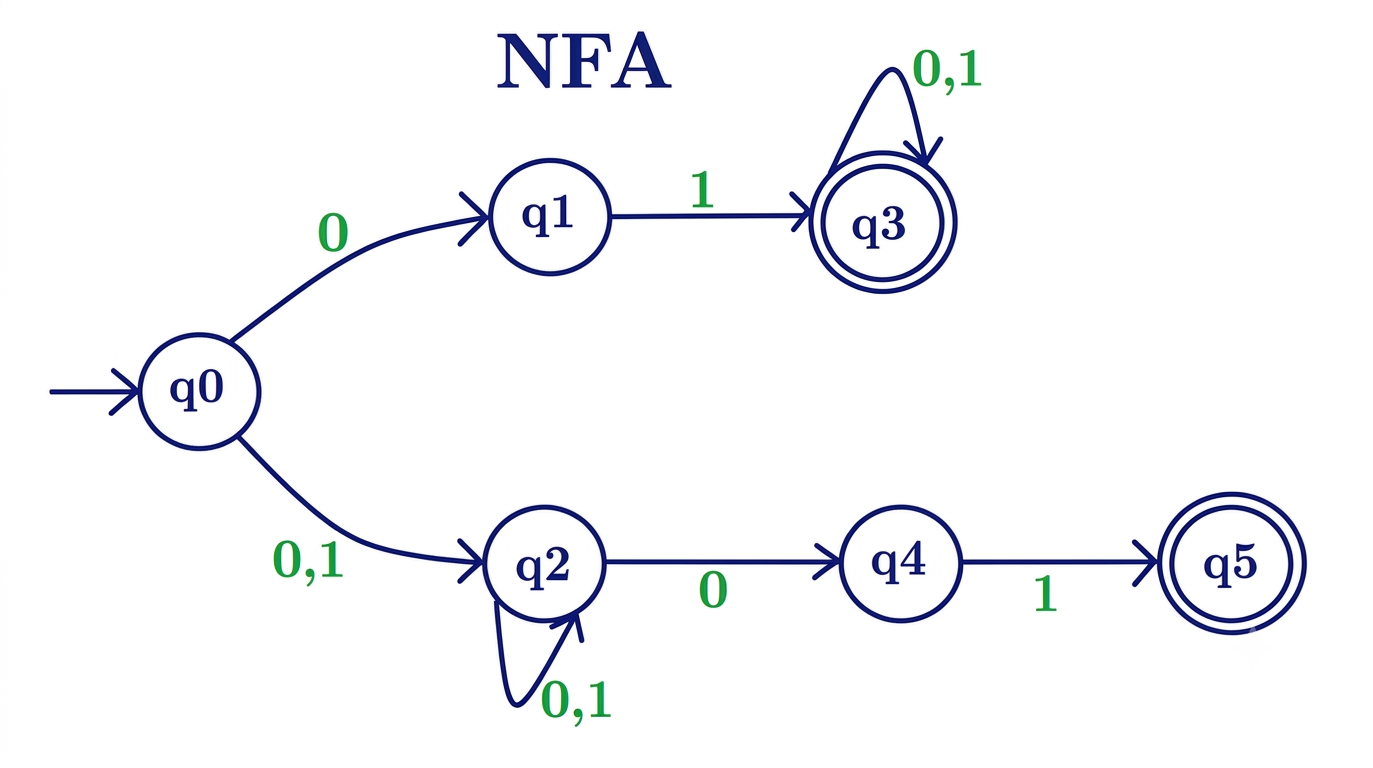
- 6Finite Autometa ExerciseDraw a deterministic and non-deterministic finite automate which either starts with 01 or end with 01 of a string containing 0, 1 in it.Theory of ComputationNFA Answer:

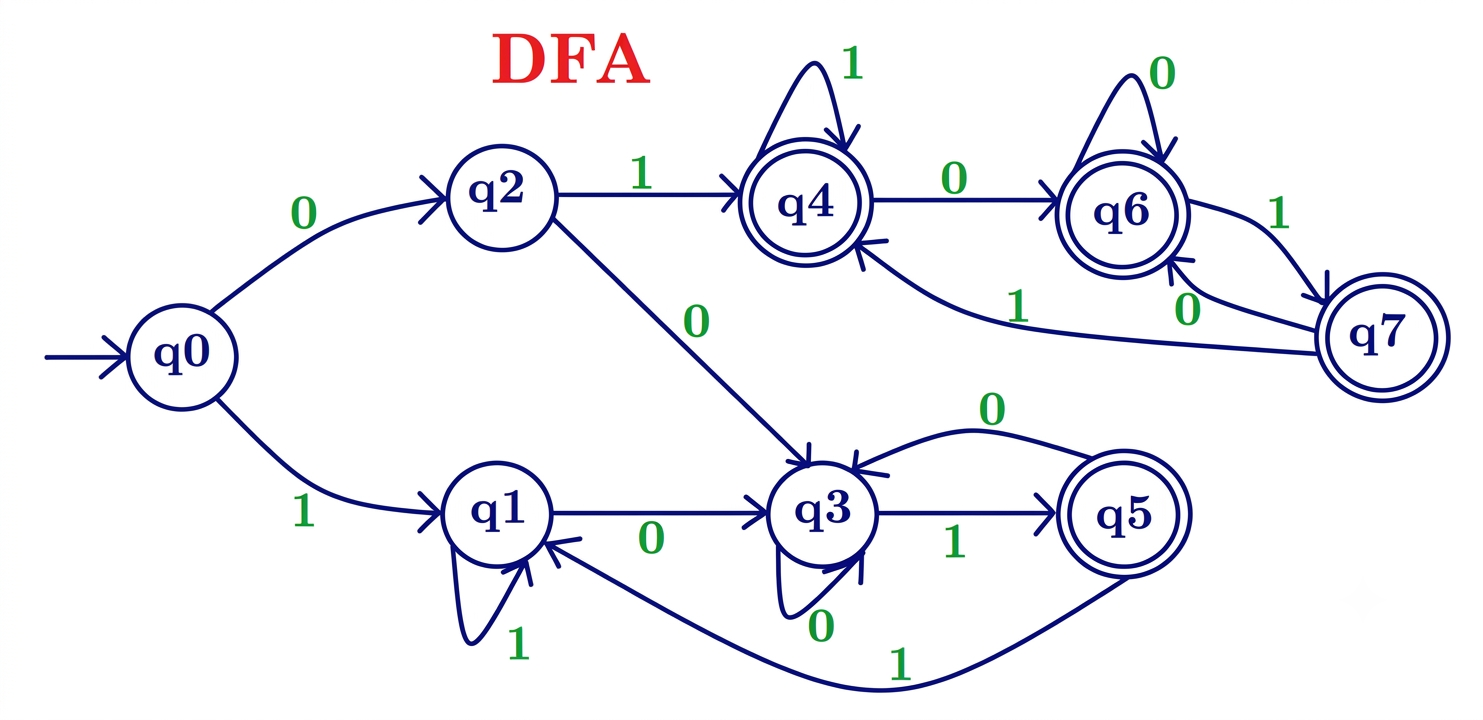
DFA Answer:

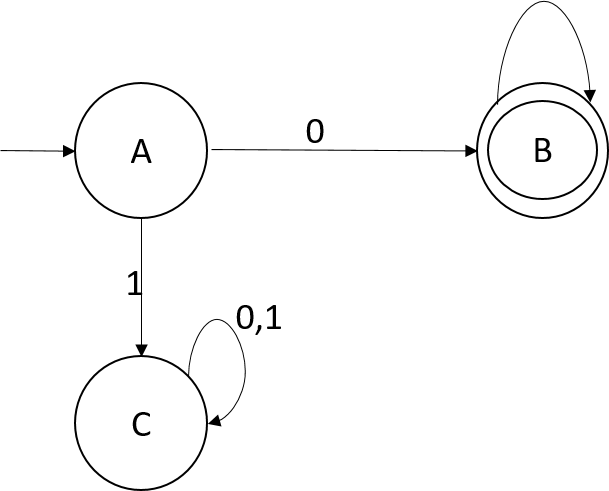
- 7Finite Autometa ExerciseConsider a DFA that accept sets of all string over {0,1} which start with 0.Theory of Computation

Previous Year QnS on TOC
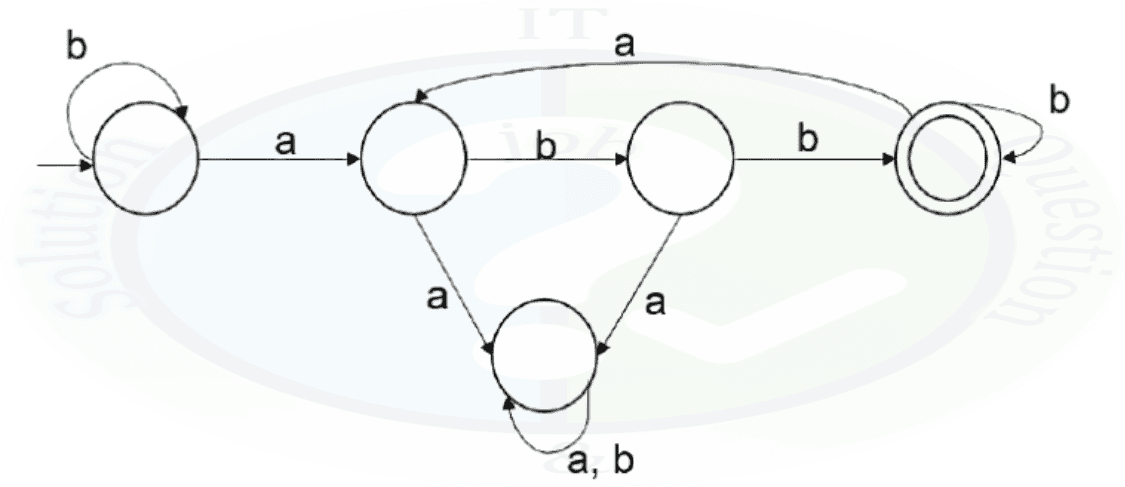
- ☆1Theory of ComputationConstruct a DFA of the following language. (W⊂ (a, b)* | every a in W is followed by at least two b's}CB, SO(IT), 22 | Senior Officer (IT)

- ☆2Theory of ComputationGive regular expressions that generate, The language {w|w contains at least two a's, or exactly two b's}.Janata, ASA, 21 | AME/ANE/AE
The language is:
{ w | w contains at least two a's, OR exactly two b's }Regular Expressions:
Strings with at least two a's:
(b|a)* a (b|a)* a (b|a)*Strings with exactly two b's:
a* b a* b a*Combined Regular Expression (Union):
((a|b)*a(a|b)*a(a|b)*) | (a*b a*b a*)
- ☆3Theory of ComputationCFGConsider the grammar:
E-E+E E* Eid
Show that the grammar is ambiguous for the string:
id + id * idTCombined Bank, SO(IT-24), 26 | Senior Officer (IT)Ambiguity of the Grammar
Given Grammar:
E → E + E
E → E * E
E → id
String:
id + id * id
A grammar is Ambiguous if the same string can have more than one Parse Tree (or more than one Leftmost/Rightmost Derivation).
Parse Tree 1: '+' evaluated first
            E
          / | \
         E  +  E
         |    /|\
        id   E * E
             |   |
            id  id
Expression: (id + id) * id
Parse Tree 2: '*' evaluated first
              E
            / | \
           E  *  E
         / | \    |
        E  +  E   id
        |     |
       id    id
Expression: id + (id * id)
Conclusion
Since the string id + id * id has two different Parse Trees, the grammar is Ambiguous.
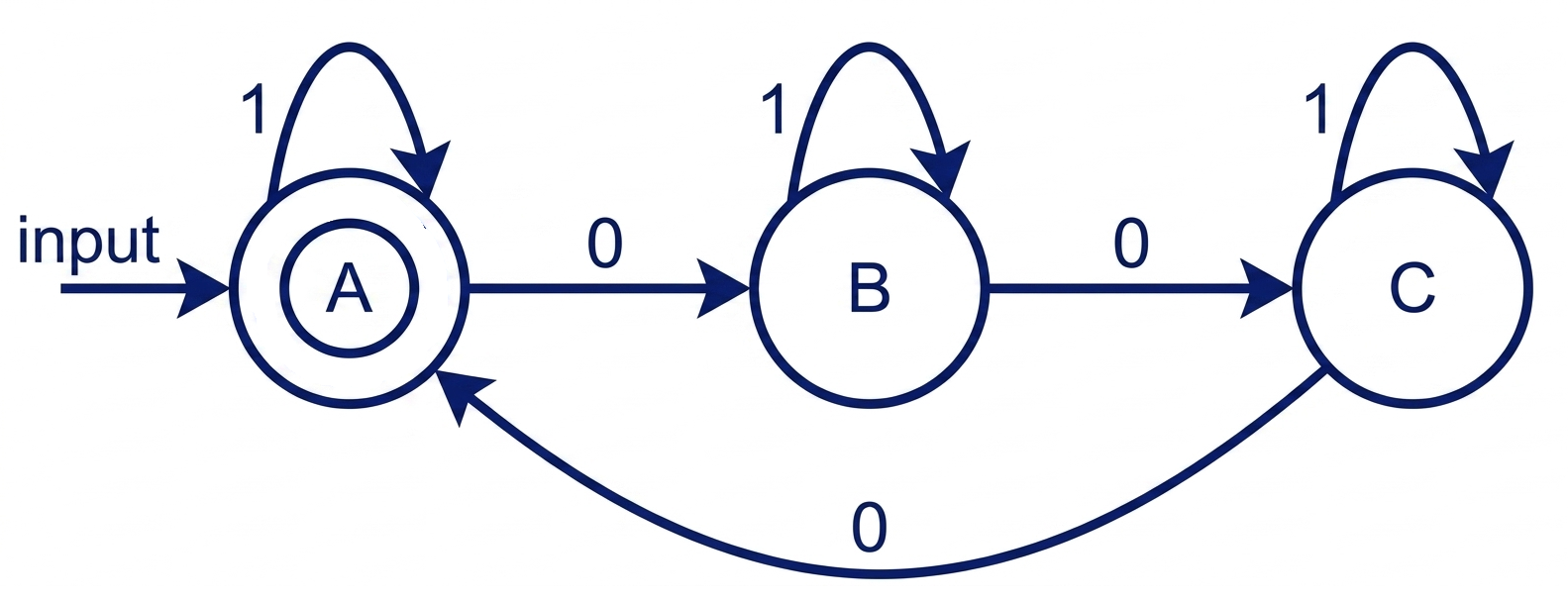
- ☆4Theory of ComputationDFAState diagram of DFA using binary strings having 0 with multiple of 3 on input {0,1}. Also showing regular expression.6 Bank & FI, AP, 21 | Assistant Programmer

Regular Expression
For binary strings over the alphabet Σ = {0,1} that contain a number of 0's which is a multiple of 3, the regular expression is:
1*(01*01*01*)*1*
Explanation
• 1* allows any number of 1's (including none) before, between, and after the zeros.
• 01*01*01* represents exactly three 0's, where each pair of 0's may be separated by any number of 1's.
• (01*01*01*)* repeats this group any number of times, ensuring the total number of 0's is always a multiple of 3.Examples
Accepted Strings:
ε
111
000
010010
101001010111
000111000Rejected Strings:
0
00
0000
10001