
Exam Module Subscription Required
You need an active Exam Module Subscription to access this content. Subscribe now to unlock the exam materials and continue your preparation.
Total Resources Available in System: R1 = 10, R2 = 5, R3 = 7Consider the following snapshot of a system with 5 processes (P0 to P4) and 3 resource types (R1, R2, R3):

Tasks:- Calculate the Current Need matrix for each process
- Find the initial Available Resource vector
- Is the system currently in a safe state? If yes, find the safe sequence.
Consider the following snapshot of a system with 5 processes (P0 to P4) and 3 resource types (R1, R2, R3):
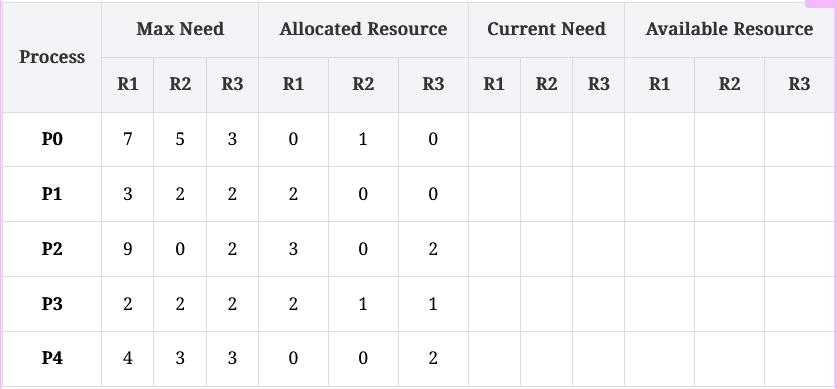
Tasks:
- Calculate the Current Need matrix for each process
- Find the initial Available Resource vector
- Is the system currently in a safe state? If yes, find the safe sequence.
- P0: (7, 5, 3) - (0, 1, 0) = (7, 4, 3)
- P1: (3, 2, 2) - (2, 0, 0) = (1, 2, 2)
- P2: (9, 0, 2) - (3, 0, 2) = (6, 0, 0)
- P3: (2, 2, 2) - (2, 1, 1) = (0, 1, 1)
- P4: (4, 3, 3) - (0, 0, 2) = (4, 3, 1)
First, sum up all currently allocated resources across processes:
- Total Allocated R1 = 0 + 2 + 3 + 2 + 0 = 7
- Total Allocated R2 = 1 + 0 + 0 + 1 + 0 = 2
- Total Allocated R3 = 0 + 0 + 2 + 1 + 2 = 5
Available = (10, 5, 7) - (7, 2, 5) = (3, 3, 2)
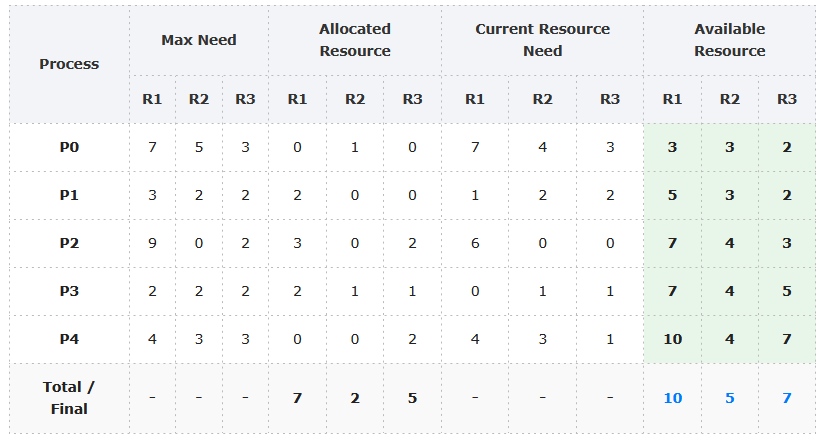 Step 3: Execution Trace (Safety Algorithm)
Check if Need(P1) ≤ Available → (1, 2, 2) ≤ (3, 3, 2) — True
New Available = Available + Allocated(P1) = (3, 3, 2) + (2, 0, 0) = (5, 3, 2)
Check if Need(P3) ≤ Available → (0, 1, 1) ≤ (5, 3, 2) — True
New Available = Available + Allocated(P3) = (5, 3, 2) + (2, 1, 1) = (7, 4, 3)
Check if Need(P4) ≤ Available → (4, 3, 1) ≤ (7, 4, 3) — True
New Available = Available + Allocated(P4) = (7, 4, 3) + (0, 0, 2) = (7, 4, 5)
Check if Need(P2) ≤ Available → (6, 0, 0) ≤ (7, 4, 5) — True
New Available = Available + Allocated(P2) = (7, 4, 5) + (3, 0, 2) = (10, 4, 7)
Check if Need(P0) ≤ Available → (7, 4, 3) ≤ (10, 4, 7) — True
New Available = Available + Allocated(P0) = (10, 4, 7) + (0, 1, 0) = (10, 5, 7)
Safe Sequence: < P1, P3, P4, P2, P0 >
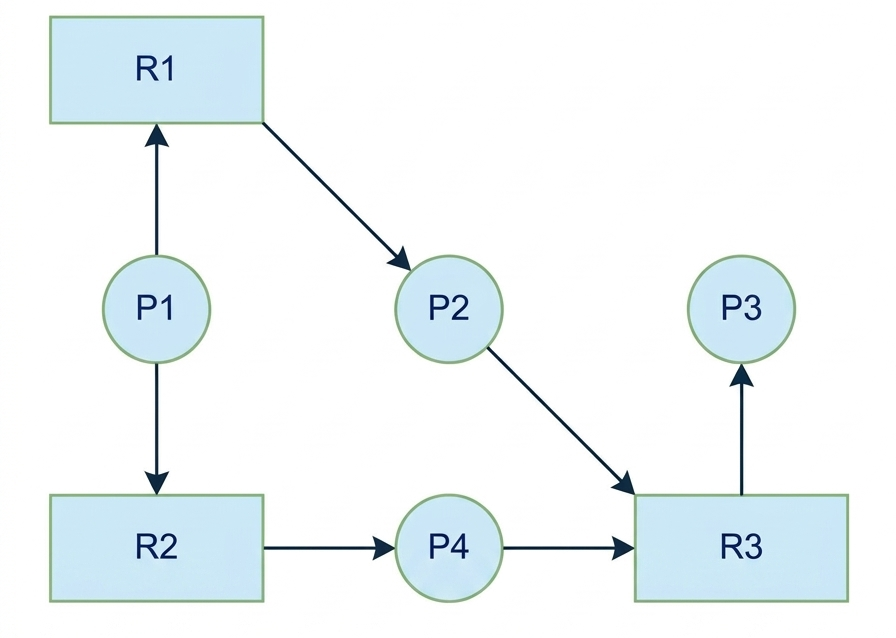
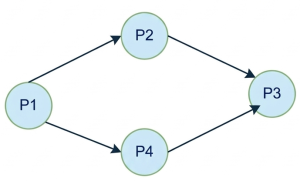
Consider a Resource Allocation Graph with 4 Processes P1, P2, P3, P4, and 4 Resources R1, R2, R3, R4. Find if there is a deadlock in the Graph using the Wait for Graph-based deadlock detection algorithm.

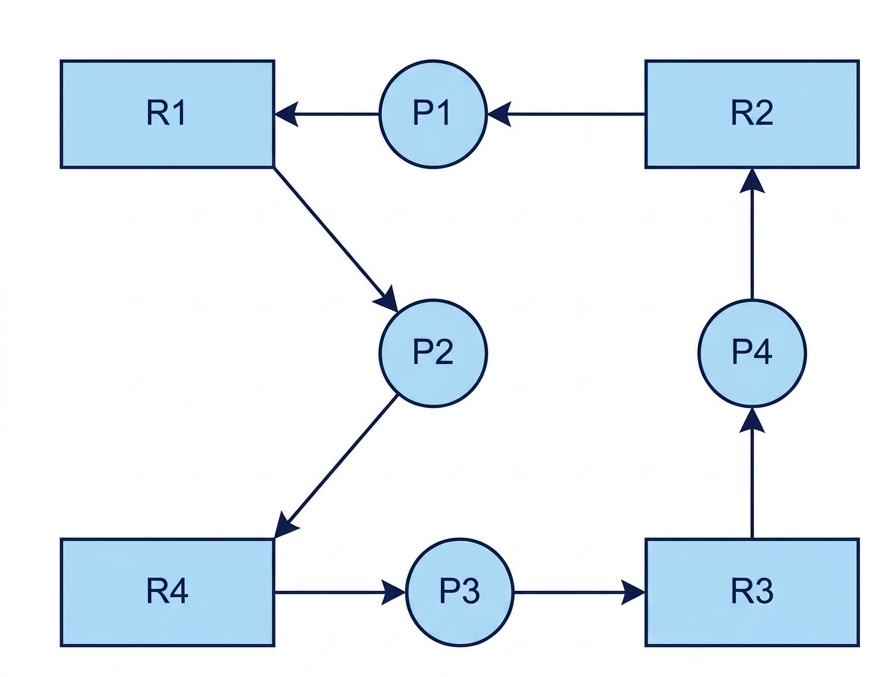
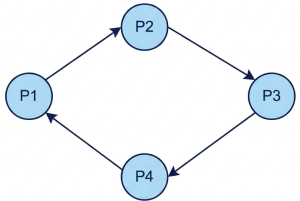
Resource Allocation Graph with 4 Processes P1, P2, P3, P4, and 3 Resources R1, R2, R3. Find if there is a deadlock in the Graph using the Wait for Graph-based deadlock detection algorithm.

Previous Job Question: Deadlock in Operating System
Previous Job Question: Deadlock in Operating System
- ☆1Operating SystemDeadlockWhat are the four necessary conditions for a deadlock to occur? Briefly explain "Circular Wait."Combined Bank, AE(IT)/AME, 26 | AME/ANE/AE
Four Necessary Conditions for Deadlock
- Mutual Exclusion: At least one resource must be held in a non-shareable mode.
- Hold and Wait: A process holds at least one resource and waits for others.
- No Preemption: Resources cannot be forcibly taken; must be released voluntarily.
- Circular Wait: A set of processes are waiting for each other in a circular chain.
Circular Wait (Explanation):
- In circular wait, each process is waiting for a resource held by another process.
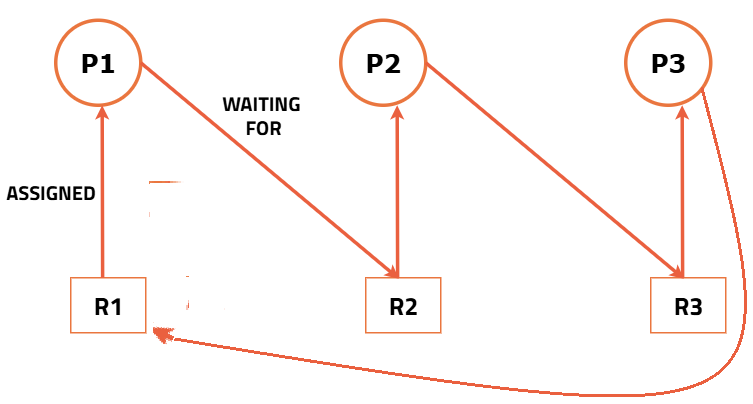
- This forms a cycle (e.g., P1 → P2 → P3 → P1).
- None of the processes can proceed, causing a deadlock.
Example:
- P1 holds R1 and waits for R2
- P2 holds R2 and waits for R3
- P3 holds R3 and waits for R1

- ☆2Operating SystemDeadlockWhat is Deadlock? Explain two situations where deadlock condition occurs.Janata, ASA, 21 | AME/ANE/AE
- ☆3Operating SystemDeadlockBriefly explain Circular Wait. In a Resource Allocation Graph (RAG), if a cycle exists, does it absolutely guarantee that a Deadlock has occurred? Explain briefly.CB, AME/AE(IT-23), 26 | AME/ANE/AE
Circular Wait
- Circular wait is one of the necessary conditions for deadlock.
- It occurs when a group of processes are waiting for resources in a circular chain.
- In this situation, each process holds at least one resource and waits for another resource held by the next process in the cycle.
Example:
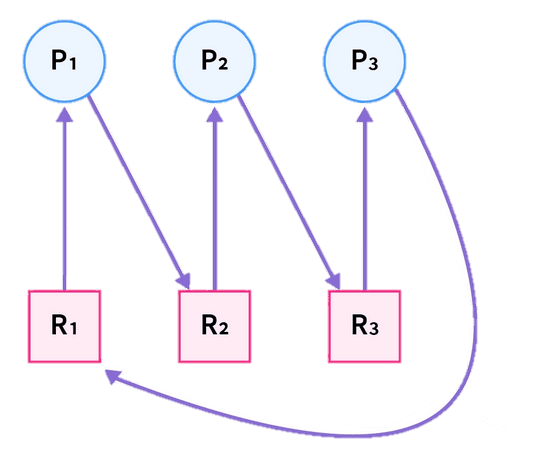
- Process P1 holds Resource R1 and waits for R2.
- Process P2 holds Resource R2 and waits for R3.
- Process P3 holds Resource R3 and waits for R1.
This creates a circular waiting condition.

Cycle in Resource Allocation Graph (RAG)
If a cycle exists in a Resource Allocation Graph, it does not always guarantee deadlock.
- If each resource type has only one instance, then a cycle definitely indicates deadlock.
- If resource types have multiple instances, then a cycle may exist without deadlock.
So, a cycle is:
- A necessary condition for deadlock
- But not always a sufficient condition
Deadlock Detection using Resource Allocation Graph
To detect deadlock using Resource Allocation Graph (RAG), we follow these steps −
- If RAG contains no cycles, then there is no deadlock in the system.
- If RAG is of single instance resources and it contains a cycle, then there is a deadlock in the system.
- If RAG is of multiple instance resources and it contains a cycle, then deadlock may or may not exist. To check for deadlock, we need convert multiple instance RAG to single instance RAG, by treating each instance of a resource as a separate resource type.

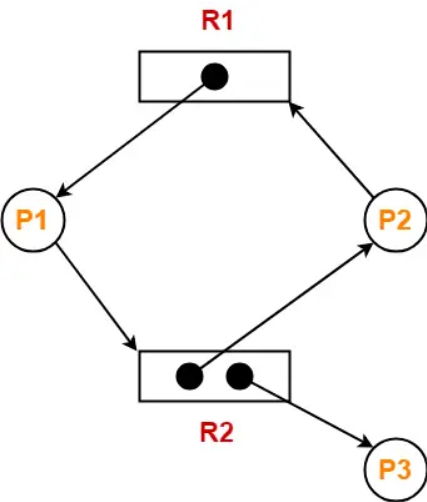
In the graph:
- Resource R1 has only one instance.
- Resource R2 has two instances.
- P1 is holding R1 and requesting R2.
- P2 is holding one instance of R2 and requesting R1.
- P3 is using another instance of R2.
A cycle exists in the graph: P1 → R2 → P2 → R1 → P1
But this graph does not indicate deadlock.
Reason:
Resource R2 has multiple instances. One instance of R2 is currently allocated to P3.
If P3 finishes its work and releases R2, then:
- P1 can obtain R2 and complete execution.
- After P1 completes, it releases R1.
- Then P2 can obtain R1 and continue execution.
Since the processes can still proceed and resources can eventually be released, the system is not permanently blocked.
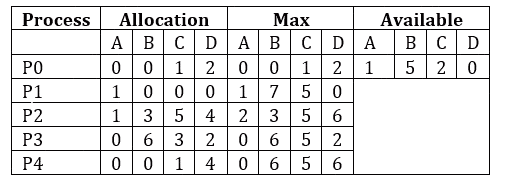
- ☆4Operating SystemDeadlockConsider the following snapshot of a system where maximum instance of A, B, C and D are 3, 14, 12 and 12.
 Answer the following Question using the Bankers algorithm,
a) Calculate the need matrix from the above table?
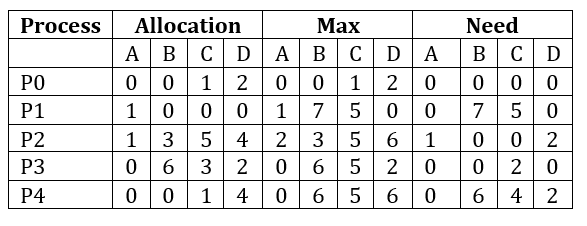
b) Is the system in the safe state? Find out the safe sequence if no, justify the reason.BB, AD(ICT), 25 | Bangladesh Banka) answer:The Need matrix is calculated as: Need = Max - Allocation For each process, we subtract the Allocation from the Max to get the Need Matrix.

b) answer:Step-by-step checking for our system:
- P0: Needs [0, 0, 0, 0] ≤ Available [1, 5, 2, 0] → yes, so finish P0.
- Update Available by adding P0's allocation: [1, 5, 2, 0] + [0, 0, 1, 2] = [1, 5, 3, 2]
- P1: Needs [0, 7, 5, 0] ≤ Available [1, 5, 3, 2] → no, cannot finish yet.
- P2: Needs [1, 0, 0, 2] ≤ Available [1, 5, 3, 2] → yes, finish P2.
- Update Available : [1, 5, 3, 2] + [1, 3, 5, 4] = [2, 8, 8, 6]
- P3: Needs [0, 0, 2, 0] ≤ Available [2, 8, 8, 6] → yes, finish P3.
- Update Available : [2, 8, 8, 6] + [0, 6, 3, 2] = [2, 14, 11, 8]
- P4: Needs [0, 6, 4, 2] ≤ Available [2, 14, 11, 8] → yes, finish P4.
- Update Available : [2, 14, 11, 8] + [0, 0, 1, 4] = [2, 14, 12, 12]
- P1 (rechecked): Needs [0, 7, 5, 0] ≤ Available [2, 14, 12, 12] → yes, finish P1.
- Update Available : [2, 14, 12, 12] + [1, 0, 0, 0] = [3, 14, 12, 12]
Since all processes can finish in this order, the system is in a safe state.
Safe sequence: <P0, P2, P3, P4, P1>
🎥 Video Solution: Deadlock Handling (Deadlock Avoidance - Banker's Algorithm) - ☆5Operating SystemDeadlockGive the necessary condition for deadlock occur. Is it possible to have deadlock involving only a single process ? Explain your answer?Combined Bank, O(IT), 24 | Officer (IT)
 Answer the following Question using the Bankers algorithm,
1 thought on “M3: Operating System (Deadlock in Operating System)”
Vai MCQ gulote marking system ta thakle vlo hoto.
1 star, 2 star, 3 star erkm,next time jate sohojei recape kora jai