Bangladesh Inland Water Transport Authority
Post: Assistant Engineer (CSE)
Exam Date: 24-02-2023, Exam Taker: BUET
Convert Subnet Mask to Binary: The subnet mask 255.255.255.240 can be written in binary as:
11111111.11111111.11111111.11110000
Determine the Number of Hosts: The number of host bits is 4, so we use the formula: 24 – 2 =14
Therefore, there are 14 valid hosts in this subnet.
Calculate the Network Address: Perform a bitwise AND between the IP address and subnet mask:
IP Address (192.168.1.50): 11000000.10101000.00000001.00110010
Subnet Mask (255.255.255.240): 11111111.11111111.11111111.11110000
The result is the network address in binary:
11000000.10101000.00000001.00110000
When converted back to decimal, the network address is: 192.168.1.48
Calculate the Broadcast Address: The broadcast address is obtained by setting all host bits to 1 in the network address:
- Network Address:
11000000.10101000.00000001.00110000 - Host bits set to 1:
11000000.10101000.00000001.00111111
The result is the broadcast address: 192.168.1.63
Determine the Valid Host Range: The valid host range is the IP addresses between the network address and the broadcast address, excluding those two addresses:
- The first valid host is 192.168.1.49 (Network Address + 1).
- The last valid host is 192.168.1.62 (Broadcast Address – 1).
- Network Address:
192.168.1.48 - Broadcast Address:
192.168.1.63 - Valid Host Range:
192.168.1.49to192.168.1.62 - Number of Hosts:
14
SELECT e.first name, d.dept_name FROM employees e JOIN department d ON e.dept_id = d.dept_id ORDER BY e.salary DESC LIMIT 1;
0
010
01010
#include <stdio.h>
int main() {
int rows;
printf("Enter number of rows: ");
scanf("%d", &rows);
int maxWidth = 2 * rows - 1;
for (int i = 0; i < rows; i++) {
int numbers = 2 * i + 1;
int spaces = (maxWidth - numbers) / 2;
// print leading spaces
for (int s = 0; s < spaces; s++) {
printf(" ");
}
// print 0 and 1 pattern
for (int j = 0; j < numbers; j++) {
printf("%d", j % 2);
}
printf("\n");
}
return 0;
}
Sample I/O:
Enter number of rows: 5
0
010
01010
0101010
010101010
=== Code Execution Successful ===
🔗 Run Online: Print Pattern
PEAS for Auto Taxi
Performance Measure: Safe driving, minimum travel time, fuel efficiency, passenger comfort, obey traffic rules.
Environment: Roads, traffic signals, pedestrians, other vehicles, weather conditions.
Actuators: Steering, accelerator, brake, horn, display system.
Sensors: Cameras, GPS, radar, lidar, speed sensors.
PEAS for Automatic Clinical Test
Performance Measure: Accurate diagnosis, fast test result, minimum error, patient safety.
Environment: Patient samples, laboratory conditions, medical database.
Actuators: Display screen, report printer, robotic arms.
Sensors: Blood sensors, chemical sensors, scanners, imaging devices.
Auto Taxi-এর জন্য PEAS
Performance Measure: নিরাপদ ড্রাইভিং, কম সময়ে গন্তব্যে পৌঁছানো, জ্বালানি সাশ্রয়, যাত্রী স্বাচ্ছন্দ্য, ট্রাফিক নিয়ম মেনে চলা।
Environment: রাস্তা, ট্রাফিক সিগন্যাল, পথচারী, অন্যান্য যানবাহন, আবহাওয়া।
Actuators: স্টিয়ারিং, এক্সেলারেটর, ব্রেক, হর্ন, ডিসপ্লে সিস্টেম।
Sensors: ক্যামেরা, GPS, রাডার, লিডার, স্পিড সেন্সর।
Automatic Clinical Test-এর জন্য PEAS
Performance Measure: সঠিক রোগ নির্ণয়, দ্রুত ফলাফল, কম ত্রুটি, রোগীর নিরাপত্তা।
Environment: রোগীর নমুনা, ল্যাবরেটরি পরিবেশ, মেডিক্যাল ডাটাবেস।
Actuators: ডিসপ্লে স্ক্রিন, রিপোর্ট প্রিন্টার, রোবোটিক বাহু।
Sensors: রক্ত সেন্সর, কেমিক্যাল সেন্সর, স্ক্যানার, ইমেজিং ডিভাইস।
Finding the Root of the Equation x² − 3 = 0 using Bisection Method
Let f(x) = x² − 3. We are given the interval [1, 2].
f(1) = −2 and f(2) = 1, so f(1)·f(2) < 0. Hence, a root exists in the interval [1, 2].
Iteration 1: a = 1, b = 2, c = (1 + 2)/2 = 1.5, f(c) = −0.75. Since f(c) and f(a) have the same sign, the new interval is [1.5, 2].
Iteration 2: a = 1.5, b = 2, c = 1.75, f(c) = 0.0625. Since f(c) and f(a) have opposite signs, the new interval is [1.5, 1.75].
Iteration 3: a = 1.5, b = 1.75, c = 1.625, f(c) = −0.359375. New interval is [1.625, 1.75].
Iteration 4: a = 1.625, b = 1.75, c = 1.6875, f(c) = −0.15234375. New interval is [1.6875, 1.75].
Conclusion: By continuing this process, the root converges to x = √3 ≈ 1.732.
Bisection Method ব্যবহার করে x² − 3 = 0 সমীকরণের Root নির্ণয়
ধরা যাক, f(x) = x² − 3 এবং দেওয়া interval হলো [1, 2]।
f(1) = −2 এবং f(2) = 1 হওয়ায় f(1)·f(2) < 0, অর্থাৎ interval-এর মধ্যে একটি root বিদ্যমান।
Iteration 1: a = 1, b = 2, c = 1.5, f(c) = −0.75। যেহেতু f(c) ও f(a)-এর sign একই, নতুন interval হবে [1.5, 2]।
Iteration 2: a = 1.5, b = 2, c = 1.75, f(c) = 0.0625। sign বিপরীত হওয়ায় নতুন interval হবে [1.5, 1.75]।
Iteration 3: a = 1.5, b = 1.75, c = 1.625, f(c) = −0.359375। নতুন interval হবে [1.625, 1.75]।
Iteration 4: a = 1.625, b = 1.75, c = 1.6875, f(c) = −0.15234375। নতুন interval হবে [1.6875, 1.75]।
উপসংহার: Iteration চালিয়ে গেলে root-এর মান √3 ≈ 1.732-এর দিকে ধীরে ধীরে পৌঁছে যায়।
A [8] = {11, 6, 3, 24, 46, 22, 7}
Merge Sort Example: Sorting Array [11, 6, 3, 24, 46, 22, 7]
Step 1: Initial Array
A = [11, 6, 3, 24, 46, 22, 7]
Step 2: Divide the Array
We divide the array into two halves:
A1 = [11, 6, 3, 24] and A2 = [46, 22, 7]
Step 3: Recursively Divide Each Half
For A1 = [11, 6, 3, 24], we divide it into:
A1.1 = [11, 6] and A1.2 = [3, 24]
For A1.1 = [11, 6], divide it into:
A1.1.1 = [11] and A1.1.2 = [6]
For A1.2 = [3, 24], divide it into:
A1.2.1 = [3] and A1.2.2 = [24]
For A2 = [46, 22, 7], we divide it into:
A2.1 = [46, 22] and A2.2 = [7]
For A2.1 = [46, 22], divide it into:
A2.1.1 = [46] and A2.1.2 = [22]
Step 4: Merge Subarrays
Now, we begin merging the subarrays:
Merge [11] and [6] → [6, 11]
Merge [3] and [24] → [3, 24]
Merge [46] and [22] → [22, 46]
Merge [22, 46] and [7] → [7, 22, 46]
Step 5: Final Merge
Finally, merge the two sorted halves:
[6, 11, 3, 24] and [7, 22, 46]
After merging, the sorted array is:
[3, 6, 7, 11, 22, 24, 46]
Time Complexity
Best Case Time Complexity: O(n log n)
Worst Case Time Complexity: O(n log n)
Decision Tree for Software Development Strategy
For the government project, the analyst considers three possible options: building the system from scratch, reusing existing components, or buying and modifying an available software product. A decision tree helps evaluate these options based on cost, time, risk, and requirement fulfillment.
Option 1: Build from Scratch
This option provides full control over system design and functionality and ensures all requirements are met. However, it requires high development cost, longer time, and higher risk.
Option 2: Reuse Existing Components
Reusing partial-experience components reduces development time and cost. The risk is moderate, but compatibility and integration issues may arise if components do not perfectly match requirements.
Option 3: Buy and Modify Software
Buying an existing software product and customizing it is usually the fastest and lowest-cost option. However, it may not fully satisfy all requirements and may create dependency on the vendor.
Conclusion:
The decision tree helps compare these alternatives systematically. For a government project where reliability and compliance are critical, reuse or buy-and-modify may be preferred if requirements are mostly satisfied; otherwise, building from scratch is the safest choice.
Software Development Strategy নির্ধারণে Decision Tree
সরকারি সংস্থার জন্য system তৈরির ক্ষেত্রে analyst তিনটি বিকল্প বিবেচনা করে: নতুন করে system তৈরি করা, বিদ্যমান component পুনঃব্যবহার করা, অথবা প্রস্তুত software কিনে সেটি পরিবর্তন করা। Decision tree এই বিকল্পগুলোকে cost, time, risk এবং requirement অনুযায়ী বিশ্লেষণ করতে সাহায্য করে।
Option 1: Build from Scratch
এই পদ্ধতিতে system-এর উপর সম্পূর্ণ নিয়ন্ত্রণ থাকে এবং সব requirement পূরণ করা যায়। তবে এতে বেশি সময়, বেশি খরচ এবং বেশি ঝুঁকি থাকে।
Option 2: Reuse Existing Components
বিদ্যমান component ব্যবহার করলে সময় ও খরচ কম লাগে। তবে component compatibility এবং integration সমস্যা হতে পারে।
Option 3: Buy and Modify Software
প্রস্তুত software কিনে পরিবর্তন করলে দ্রুত কাজ শেষ হয় এবং খরচ কম হয়। কিন্তু সব requirement পূরণ নাও হতে পারে এবং vendor-এর উপর নির্ভরতা তৈরি হয়।
উপসংহার:
Decision tree ব্যবহার করে analyst সহজেই সেরা বিকল্প নির্বাচন করতে পারে। সরকারি project-এর ক্ষেত্রে যদি requirement আংশিকভাবে পূরণ হয়, তাহলে reuse বা buy-and-modify উপযুক্ত; নাহলে build from scratch সবচেয়ে নিরাপদ সিদ্ধান্ত।
To design a 6-to-1 multiplexer (MUX) using 2-to-1 multiplexers, we can break it down into smaller parts. A 6-to-1 MUX has 6 data inputs, 1 output, and 3 selection bits (since 2^3 = 8 and we need 3 bits to select one of the 6 inputs). A 2-to-1 MUX has 2 inputs, 1 output, and 1 selection bit.
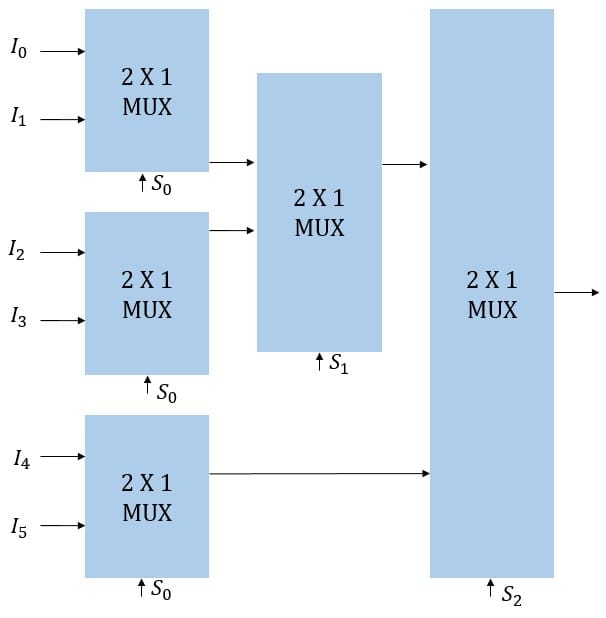
| S2 | S1 | S0 | Output Y |
|---|---|---|---|
| 0 | 0 | 0 | I0 |
| 0 | 0 | 1 | I1 |
| 0 | 1 | 0 | I2 |
| 0 | 1 | 1 | I3 |
| 1 | 0 | 0 | I4 |
| 1 | 0 | 1 | I5 |
| 1 | 1 | 0 | 0 |
| 1 | 0 | 1 | 0 |
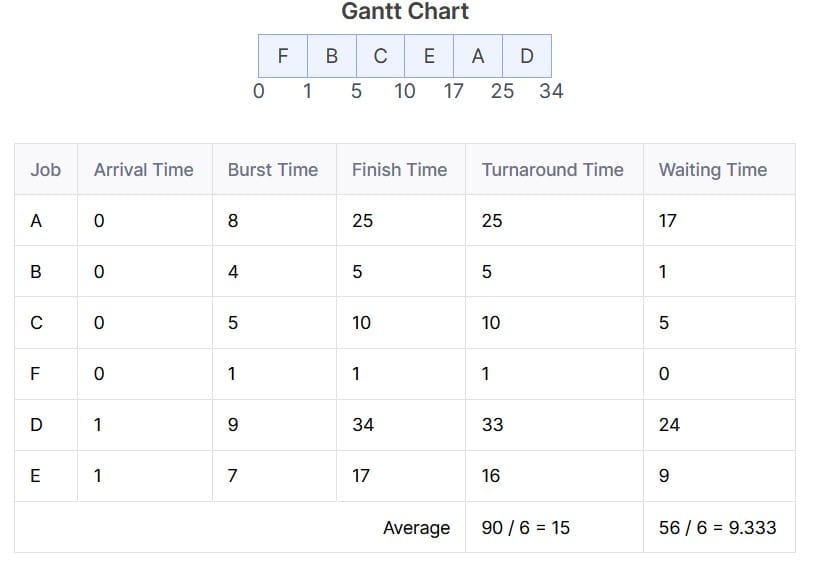
| Process | Arrival Time | Processing Time |
|---|---|---|
| A | 0 | 8 |
| B | 0 | 4 |
| C | 0 | 5 |
| D | 1 | 9 |
| E | 1 | 7 |
| F | 0 | 1 |
Find average turnaround time using shortest job first scheduling algorithm.