
Loading...
Maddhapara Granite Mining Company Limited

Post: Assistant Engineer
Exam Date: 20/05/2022, Exam Taker: BUET
1. Optical Fiber Working principle
What is Optical Fiber Cable?
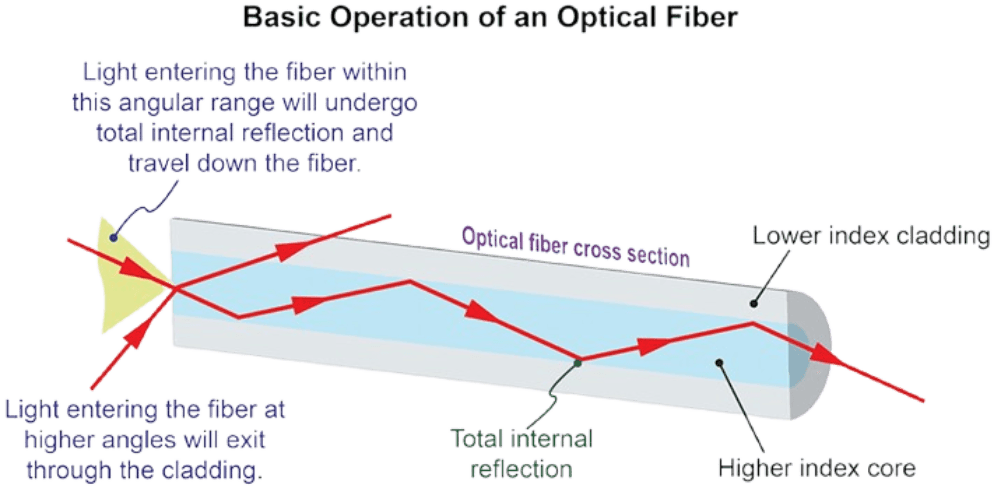
Optical fiber cable (also called fiber optic cable) is a modern communication medium that transmits data using light signals. It can carry digital and analog data such as internet, telephone, and television signals over long distances with very low signal loss (attenuation). It is preferred over traditional copper cables because of high speed, low signal loss, better security, cost efficiency, and low energy consumption.
Principle of Operation:
An optical fiber is a thin, cylindrical strand made of transparent glass or plastic. It has two main parts: a central core and an outer layer called cladding.The core and cladding have different refractive indices. When light enters the core at a specific angle, it reflects repeatedly inside the core instead of escaping into the cladding. This process is called Total Internal Reflection. Due to this principle, light signals travel long distances with very little loss, ensuring efficient and high-speed data transmission.

Optical Fiber Cable কী?
Optical fiber cable (বা fiber optic cable) হলো একটি আধুনিক communication মাধ্যম যা light signal ব্যবহার করে data প্রেরণ করে। এটি internet, telephone এবং television-এর মতো digital ও analog signal দীর্ঘ দূরত্বে খুব কম signal loss (attenuation) সহ পরিবহন করতে পারে। Traditional copper cable-এর তুলনায় এটি বেশি speed, কম signal loss, উন্নত security, cost efficiency এবং কম energy consumption প্রদান করে।

কার্যপ্রণালী (Principle of Operation):
Optical fiber হলো একটি স্বচ্ছ glass বা plastic দিয়ে তৈরি সরু ও নলাকার strand। এর দুটি প্রধান অংশ থাকে: কেন্দ্রীয় core এবং বাইরের স্তর cladding

Core এবং cladding-এর refractive index আলাদা হয়। নির্দিষ্ট কোণে light core-এ প্রবেশ করলে তা cladding-এ বের হয়ে না গিয়ে core-এর ভেতরে বারবার প্রতিফলিত হয়। এই প্রক্রিয়াকে Total Internal Reflection বলা হয়। এই নীতির কারণে light signal দীর্ঘ দূরত্বে খুব কম loss সহ ভ্রমণ করতে পারে এবং উচ্চগতির data transmission সম্ভব হয়।

2. Construct a Binary Search tree, then find post order, pre order traversal and delete a node.

In a Binary Search Tree (BST), each node can have up to two child nodes: a left child and a right child. The left child always holds a value that is less than its parent node, while the right child holds a value that is greater than its parent node. This property ensures that for any given node in the tree, all values in the left subtree are smaller, and all values in the right subtree are larger than the node’s value.

Input Set: [50, 30, 70, 20, 40, 60, 80]The BST constructed from these numbers will look like:
       50
      /  \
     30   70
    / \   / \
   20 40 60 80

Pre-order Traversal (Root, Left, Right)

In pre-order traversal, we visit the root first, then traverse the left subtree, and finally the right subtree.

For the above BST:[50, 30, 20, 40, 70, 60, 80]

Post-order Traversal (Left, Right, Root)

In post-order traversal, we traverse the left subtree first, then the right subtree, and visit the root last.

For above BST: [20, 40, 30, 60, 80, 70, 50]

Deleting a NodeLet’s delete the node with the value 30.Steps to delete a node in a BST:
  1. Find the node (30).
  2. If it has two children (as node 30 does), find the in-order successor (smallest node in the right subtree), which is 40.
  3. Replace the value of node 30 with 40 and delete the in-order successor node (40).
Modified BST after deletion:
       50
      /  \
     40   70
    /    / \
   20   60  80

3. Linux command- all hidden flies, remove a file, permission of a file, search for a string.

1. Show All Hidden Files

Use the following command to list all files, including hidden files:

ls -a

2. Remove a File

To delete a file, use the command below. Replace filename with the actual file name:

rm filename

3. Change File Permissions

To set permissions for a file, use this command. Replace filename with the file name:

chmod 777 filename

This command grants read, write, and execute permissions to all users.

4. Search for a String in Files

To search for a specific string within files, use the command below. Replace /path/to/directory/ with the directory path and pattern with the string to search for:

grep -rnw '/path/to/directory/' -e 'pattern'

Options:

  • -r: Makes the search recursive through all files in the directory.
  • -n: Displays the line numbers where the pattern is found.
  • -w: Matches whole words only.
4. Define Context switching in os and tlb.

Context Switching
Context switching is a process used by the Operating System (OS) to switch the CPU from one running process to another. During this operation, the OS saves the current state (such as program counter, registers, and process information) of the running process into the Process Control Block (PCB), and then loads the saved state of the next process.This mechanism allows multiple processes to share the CPU efficiently. It is essential for multitasking, as it enables the OS to allocate CPU time among different processes and create the illusion of parallel execution.

Translation Lookaside Buffer (TLB)
Translation Lookaside Buffer (TLB) is a special type of cache memory used in virtual memory management. It stores recent mappings of virtual addresses to physical addresses.

When the CPU needs to access memory, it first checks the TLB. If the address mapping is found (called TLB hit), memory access becomes faster. If not found (called TLB miss), the system searches the page table, which takes more time. The TLB is part of the Memory Management Unit (MMU) and helps improve overall memory access speed.

Context Switching
Context switching হলো একটি প্রক্রিয়া যেখানে Operating System (OS) CPU-কে একটি চলমান process থেকে অন্য process-এ পরিবর্তন করে। এই সময় OS চলমান process-এর বর্তমান state (যেমন program counter, registers, process information) Process Control Block (PCB)-এ সংরক্ষণ করে এবং পরবর্তী process-এর সংরক্ষিত state load করে।

এই পদ্ধতির মাধ্যমে একাধিক process একই CPU দক্ষভাবে ব্যবহার করতে পারে। Multitasking-এর জন্য এটি অত্যন্ত গুরুত্বপূর্ণ, কারণ এর মাধ্যমে OS বিভিন্ন process-কে নির্দিষ্ট সময়ের জন্য CPU বরাদ্দ দেয় এবং parallel execution-এর মতো অভিজ্ঞতা তৈরি করে।

Translation Lookaside Buffer (TLB)
Translation Lookaside Buffer (TLB) হলো virtual memory management-এ ব্যবহৃত একটি বিশেষ ধরনের cache memory। এটি virtual address থেকে physical address-এর সাম্প্রতিক mapping সংরক্ষণ করে।

CPU যখন memory access করতে চায়, তখন প্রথমে TLB পরীক্ষা করে। যদি প্রয়োজনীয় mapping পাওয়া যায় (TLB hit), তাহলে দ্রুত memory access করা যায়। যদি না পাওয়া যায় (TLB miss), তাহলে page table খুঁজতে হয়, যা বেশি সময় নেয়। TLB হলো Memory Management Unit (MMU)-এর অংশ এবং এটি memory access-এর গতি বৃদ্ধি করে।

You must subscribe & Login to view more.

Don’t have an account? Register

Or your subscription is under review by admin. Please message on WhatsApp / Telegram.

Leave a Comment

Latest Post
Field Based Job Question & Solution
Bank IT Job Solution

MCQ + Written from Bangladesh Bank, Sonali, Combined Bank IT recruitment.

BPSC IT Job Solution

BPSC Computer/IT cadre & non-cadre post Question papers with full solutions.

Gas Field IT Job Solution

Gas field like TGTDCL, BGDCL, JGTDSL, KGDCL, SGCL, RPGCL, GTCL etc. question solution

Power Sector IT Job Solution

Power sector such as NESCO, DESCO, DPDC, WZPDCL, BPDB, PGCB, BREB etc

Other IT Job Solution

Other Govt. Semi govt. organization like BCC, BTCL, CAAB, NSI etc.

NTRCA IT Job Solution (upcoming)

NTRCA ICT-related posts such as Assistant Teacher, Demonstrator, Lecturer.

IT MCQ Job Solution

Collected MCQ Job solution of BANK, BPSC, POWER SECTOR, GAS Field and Others.

Topic Based Q&S
WhatsApp Telegram Messenger