Loading...
6 Banks & Financial Institutions

Post: Assistant Programmer
Exam Date:2021
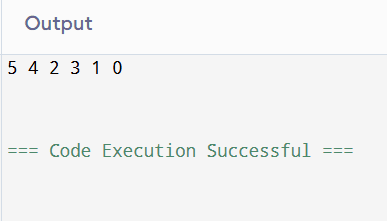
1. Topological sorting for Directed Acyclie Graph (DAG) is a linear ordering of vertices such that for every directed edge u v, vertex u comes before v in the ordering. Topological Sorting for a graph is not possible if the graph is not a DAG. Now write a C/C++ Program with the following input and Output.
Input: 5 2, 5 0, 4 0, 4 1, 2 3, 3 1
Output: 5 4 2 3 1 0

#include <bits/stdc++.h>
using namespace std;

// Function to perform DFS and topological sorting
void topologicalSortUtil(int v, vector<vector<int>> &adj, vector<bool> &visited, stack<int> &st) {
    // Mark the current node as visited
    visited[v] = true;

    // Recur for all adjacent vertices
    for (int i : adj[v]) {
        if (!visited[i])
            topologicalSortUtil(i, adj, visited, st);
    }

    // Push current vertex to stack which stores the result
    st.push(v);
}

vector<vector<int>> constructAdj(int V, vector<vector<int>> &edges) {
    vector<vector<int>> adj(V);

    for (auto it : edges) {
        adj[it[0]].push_back(it[1]);
    }

    return adj;
}

// Function to perform Topological Sort
vector<int> topologicalSort(int V, vector<vector<int>> &edges) {
    // Stack to store the result
    stack<int> st;

    vector<bool> visited(V, false);
    vector<vector<int>> adj = constructAdj(V, edges);

    // Call the recursive helper function for all vertices
    for (int i = 0; i < V; i++) {
        if (!visited[i])
            topologicalSortUtil(i, adj, visited, st);
    }

    vector<int> ans;

    // Append contents of stack
    while (!st.empty()) {
        ans.push_back(st.top());
        st.pop();
    }

    return ans;
}

int main() {
    int V = 6;
    vector<vector<int>> edges = {
        {2, 3}, {3, 1}, {4, 0}, {4, 1}, {5, 0}, {5, 2}
    };

    vector<int> ans = topologicalSort(V, edges);

    for (int node : ans) {
        cout << node << " ";
    }
    cout << endl;

    return 0;
}
Source:geeksforgeeks
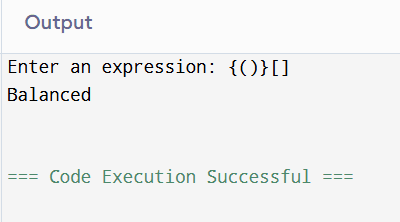
2. Write a C/C++ program to check Balanced parentheses in an Expression.
#include <bits/stdc++.h>
using namespace std;

// function to check if brackets are balanced
bool areBracketsBalanced(string expr)
{
    stack s;
    char x;

    // Traversing the Expression
    for (int i = 0; i < expr.length(); i++) 
    {
        if (expr[i] == '(' || expr[i] == '[' || expr[i] == '{') 
        {
            // Push the element in the stack
            s.push(expr[i]);
            continue;
        }

        // IF current current character is not opening
        // bracket, then it must be closing. So stack
        // cannot be empty at this point.
        if (s.empty())
            return false;

        switch (expr[i]) {
        case ')':
            // Store the top element in a
            x = s.top();
            s.pop();
            if (x == '{' || x == '[')
                return false;
            break;

        case '}':
            // Store the top element in b
            x = s.top();
            s.pop();
            if (x == '(' || x == '[')
                return false;
            break;

        case ']':
            // Store the top element in c
            x = s.top();
            s.pop();
            if (x == '(' || x == '{')
                return false;
            break;
        }
    }

    // Check Empty Stack
    return (s.empty());
}

// Driver code
int main()
{
    string expr;

    // Taking input from the user
    cout << "Enter an expression: "; cin >> expr;

    // Function call
    if (areBracketsBalanced(expr))
        cout << "Balanced\n";
    else
        cout << "Not Balanced\n";
    return 0;
}


Source : GeeksforGeeks

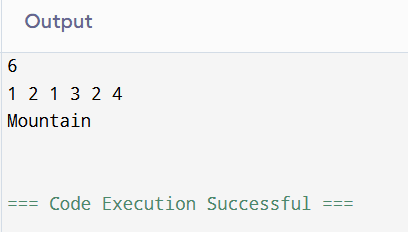
3. We are given an array of integers and a range, we need to find whether the subarray which falls in this range has values in the form of a mountain or not. All values of the subarray are said to be in the form of a mountain if either all values are increasing or decreasing or first increasing and then decreasing. Write a C/C++ Program that shows input is a Mountain sequence or Not Mountain sequence.

#include <bits/stdc++.h>
using namespace std;

#define ll long long

bool isMountain(vector<ll> a) {
    ll n = a.size();

    if (n < 3)
        return false;

    ll i = 1;

    // Increasing part
    while (i < n && a[i] > a[i - 1]) {
        i++;
    }

    // Peak cannot be first or last
    if (i == 1 || i == n)
        return false;

    // Decreasing part
    while (i < n && a[i] < a[i - 1]) {
        i++;
    }

    return i == n;
}

int main() {
    ll n;
    cin >> n;

    vector<ll> a(n);
    for (ll i = 0; i < n; i++) {
        cin >> a[i];
    }

    if (isMountain(a)) {
        cout << "Mountain" << endl;
    } else {
        cout << "Not Mountain" << endl;
    }

    return 0;
}
Source: Geeksforgeeks
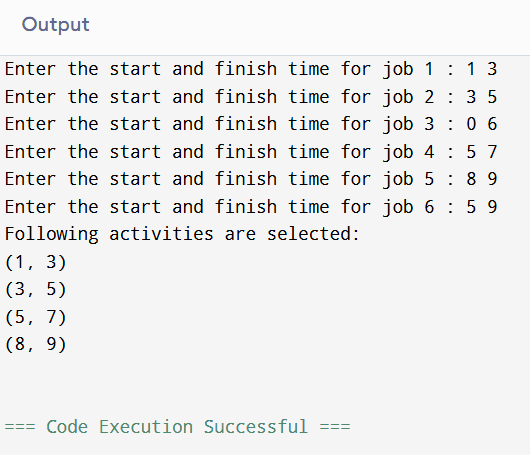
4. Given n jobs starting time n[] and duration d[], print maximum number of jobs that don't overlap between each other.

#include <bits/stdc++.h>
using namespace std;

#define N 6

// Define structure for Activity
struct Activity {
    int start, finish;
};

// Function to compare two activities
bool Sort_activity(Activity s1, Activity s2) {
    return (s1.finish < s2.finish); // Sort by finish time
}

// Function to print the maximum number of activities
void print_Max_Activities(Activity arr[], int n) {
    // Sort activities based on finish time
    sort(arr, arr + n, Sort_activity);

    cout << "Following activities are selected: \n";

    int i = 0;
    cout << "(" << arr[i].start << ", " << arr[i].finish << ")\n";

    // Select the next activity that starts after the last selected activity finishes
    for (int j = 1; j < n; j++) {
        if (arr[j].start >= arr[i].finish) {
            cout << "(" << arr[j].start << ", " << arr[j].finish << ")\n";
            i = j;
        }
    }
}

int main() {
    Activity arr[N];

    // Taking input from the user
    for (int i = 0; i < N; i++) {
        cout << "Enter the start and finish time for job " << i + 1 << " : ";
        cin >> arr[i].start >> arr[i].finish;
    }

    // Function call to print the selected activities
    print_Max_Activities(arr, N);

    return 0;
}
#include <iostream>
#include <string>
using namespace std;

// Bank Management System using Class & Inheritance in C++
/*
1. Saving Account
2. Current Account
3. Account Creation
4. Deposit
5. Withdraw
6. Balance
*/

class account {
private:
    string name;
    int accno;
    string atype;

public:
    void getAccountDetails() {
        cout << "\nEnter Customer Name : ";
        cin >> name;
        cout << "Enter Account Number : ";
        cin >> accno;
        cout << "Enter Account Type : ";
        cin >> atype;
    }

    void displayDetails() {
        cout << "\n\nCustomer Name : " << name;
        cout << "\nAccount Number : " << accno;
        cout << "\nAccount Type : " << atype;
    }
};

class current_account : public account {
private:
    float balance = 0;

public:
    void c_display() {
        cout << "\nBalance : " << balance;
    }

    void c_deposit() {
        float deposit;
        cout << "\nEnter amount to Deposit : ";
        cin >> deposit;
        balance = balance + deposit;
    }

    void c_withdraw() {
        float withdraw;
        cout << "\n\nBalance : " << balance;
        cout << "\nEnter amount to be withdraw : ";
        cin >> withdraw;

        if (balance >= withdraw && balance > 1000) {
            balance = balance - withdraw;
            cout << "\nBalance Amount After Withdraw: " << balance;
        } else {
            cout << "\nInsufficient Balance";
        }
    }
};

class saving_account : public account {
private:
    float sav_balance = 0;

public:
    void s_display() {
        cout << "\nBalance : " << sav_balance;
    }

    void s_deposit() {
        float deposit, interest;
        cout << "\nEnter amount to Deposit : ";
        cin >> deposit;
        sav_balance = sav_balance + deposit;
        interest = (sav_balance * 2) / 100;
        sav_balance = sav_balance + interest;
    }

    void s_withdraw() {
        float withdraw;
        cout << "\nBalance : " << sav_balance;
        cout << "\nEnter amount to be withdraw : ";
        cin >> withdraw;

        if (sav_balance >= withdraw && sav_balance > 500) {
            sav_balance = sav_balance - withdraw;
            cout << "\nBalance Amount After Withdraw: " << sav_balance;
        } else {
            cout << "\nInsufficient Balance";
        }
    }
};

int main() {
    current_account c1;
    saving_account s1;
    char type;
    int choice;

    cout << "\nEnter S for saving customer and C for current a/c customer : ";
    cin >> type;

    if (type == 's' || type == 'S') {
        s1.getAccountDetails();

        while (1) {
            cout << "\nChoose Your Choice" << endl;
            cout << "1) Deposit" << endl;
            cout << "2) Withdraw" << endl;
            cout << "3) Display Balance" << endl;
            cout << "4) Display with full Details" << endl;
            cout << "5) Exit" << endl;
            cout << "Enter Your choice: ";
            cin >> choice;

            switch (choice) {
                case 1:
                    s1.s_deposit();
                    break;
                case 2:
                    s1.s_withdraw();
                    break;
                case 3:
                    s1.s_display();
                    break;
                case 4:
                    s1.displayDetails();
                    s1.s_display();
                    break;
                case 5:
                    goto end;
                default:
                    cout << "\n\nEntered choice is invalid, TRY AGAIN";
            }
        }
    } 
    else if (type == 'c' || type == 'C') {
        c1.getAccountDetails();

        while (1) {
            cout << "\nChoose Your Choice" << endl;
            cout << "1) Deposit" << endl;
            cout << "2) Withdraw" << endl;
            cout << "3) Display Balance" << endl;
            cout << "4) Display with full Details" << endl;
            cout << "5) Exit" << endl;
            cout << "Enter Your choice: ";
            cin >> choice;

            switch (choice) {
                case 1:
                    c1.c_deposit();
                    break;
                case 2:
                    c1.c_withdraw();
                    break;
                case 3:
                    c1.c_display();
                    break;
                case 4:
                    c1.displayDetails();
                    c1.c_display();
                    break;
                case 5:
                    goto end;
                default:
                    cout << "\n\nEntered choice is invalid, TRY AGAIN";
            }
        }
    } 
    else {
        cout << "\nInvalid Account Selection";
    }

end:
    cout << "\nThank You for Banking with us..";
    return 0;
}
6. Write the definition of Inheritance, Polymorphism with coding example.

Inheritance:
Inheritance is an important concept of Object-Oriented Programming (OOP) where one class (child class) can acquire the properties and methods of another class (parent class). It helps in code reuse and creates a relationship between classes.

Example (C++):

#include <iostream>
using namespace std;

class Animal {
public:
    void eat() {
        cout << "Animal is eating" << endl;
    }
};

class Dog : public Animal {
public:
    void bark() {
        cout << "Dog is barking" << endl;
    }
};

int main() {
    Dog d;
    d.eat();   // inherited function
    d.bark();  // own function
}

In this example, the Dog class inherits the eat() function from the Animal class.

Polymorphism:
Polymorphism means “many forms”. It allows the same function name to perform different tasks depending on the situation. It improves flexibility and reusability in programs.

Example (Function Overloading in C++):

#include <iostream>
using namespace std;

class Math {
public:
    int add(int a, int b) {
        return a + b;
    }

    double add(double a, double b) {
        return a + b;
    }
};

int main() {
    Math m;
    cout << m.add(5, 3) << endl;
    cout << m.add(4.5, 2.3) << endl;
}

Here the function add() works in different ways depending on the data type of the arguments. This is an example of polymorphism.

Inheritance:
Inheritance হলো Object-Oriented Programming (OOP)-এর একটি গুরুত্বপূর্ণ ধারণা যেখানে একটি class (child class) অন্য একটি class (parent class)-এর properties এবং methods গ্রহণ করতে পারে। এটি code reuse করতে সাহায্য করে এবং class-এর মধ্যে relationship তৈরি করে।

Example (C++):

#include <iostream>
using namespace std;

class Animal {
public:
    void eat() {
        cout << "Animal is eating" << endl;
    }
};

class Dog : public Animal {
public:
    void bark() {
        cout << "Dog is barking" << endl;
    }
};

int main() {
    Dog d;
    d.eat();   // inherited function
    d.bark();  // own function
}

এখানে Dog class, Animal class-এর eat() function inherit করেছে।

Polymorphism:
Polymorphism অর্থ “many forms”। অর্থাৎ একই function নাম বিভিন্ন পরিস্থিতিতে ভিন্নভাবে কাজ করতে পারে। এটি program-এর flexibility এবং reusability বৃদ্ধি করে।

Example (Function Overloading in C++):

#include <iostream>
using namespace std;

class Math {
public:
    int add(int a, int b) {
        return a + b;
    }

    double add(double a, double b) {
        return a + b;
    }
};

int main() {
    Math m;
    cout << m.add(5, 3) << endl;
    cout << m.add(4.5, 2.3) << endl;
}

এখানে add() function একই নাম ব্যবহার করেও ভিন্ন data type-এর জন্য ভিন্নভাবে কাজ করছে। এটিই polymorphism

7. Write SQL command from the following tables.
Employee (ename, street, city)
Works (ename, cname, salary, joindate)
Company (cname, city)
Manages (ename, mname)

(a) Find name, street, city who work for First Corporation Bank and earn more than 30000
SELECT e.ename, e.street, e.city
FROM Employee e, Works w
WHERE e.ename = w.ename
  AND w.cname = 'First Corporation Bank'
  AND w.salary > 30000;
(b) Find name of all employees, who live in the same city and company for which they work.
SELECT e.ename
FROM Employee e, Works w, Company c
WHERE e.city = c.city
  AND w.cname = c.cname
  AND e.ename = w.ename
  AND e.city = w.city;
(c) Give all employees of First Century Bank 10 percent salary raise.
UPDATE Works
SET salary = salary + salary * 0.1
WHERE cname = 'First Century Bank';
(d) Find the company with payroll less than 100000.
SELECT cname
FROM Works
GROUP BY cname
HAVING SUM(salary) < 100000;
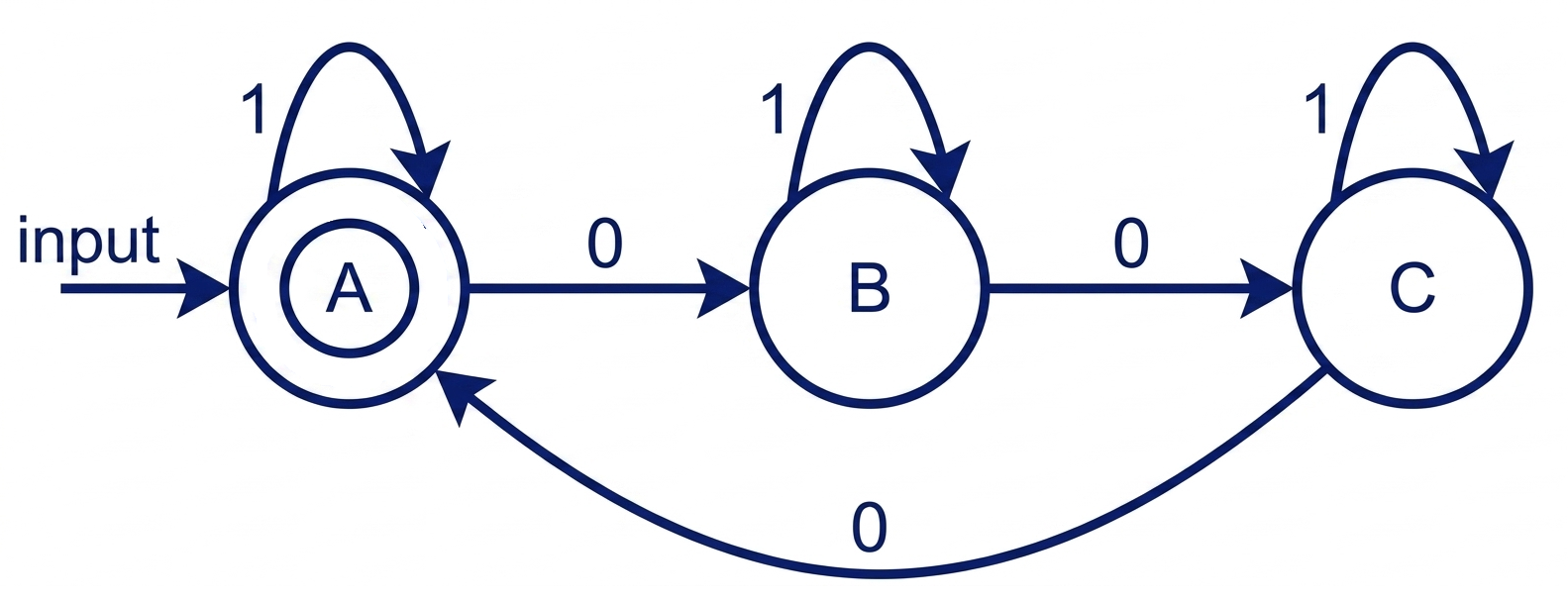
8. State diagram of DFA using binary strings having 0 with multiple of 3 on input {0,1}. Also showing regular expression
Transition Table:
StatesInput (0)Input (1)
—> A *BA
BCB
CAC
Regular Expression: (1* 0 1* 0 1* 0 1*)*

Leave a Comment

Latest Post
Field Based Job Question & Solution
Bank IT Job Solution

MCQ + Written from Bangladesh Bank, Sonali, Combined Bank IT recruitment.

BPSC IT Job Solution

BPSC Computer/IT cadre & non-cadre post Question papers with full solutions.

Gas Field IT Job Solution

Gas field like TGTDCL, BGDCL, JGTDSL, KGDCL, SGCL, RPGCL, GTCL etc. question solution

Power Sector IT Job Solution

Power sector such as NESCO, DESCO, DPDC, WZPDCL, BPDB, PGCB, BREB etc

Other IT Job Solution

Other Govt. Semi govt. organization like BCC, BTCL, CAAB, NSI etc.

NTRCA IT Job Solution (upcoming)

NTRCA ICT-related posts such as Assistant Teacher, Demonstrator, Lecturer.

IT MCQ Job Solution

Collected MCQ Job solution of BANK, BPSC, POWER SECTOR, GAS Field and Others.

Topic Based Q&S
WhatsApp Telegram Messenger