
Transport layer and Its Services
- 1Transport layer and its function
- 2Transport layer Protocol (TCP) Explanation
- 3TCP Header Format Explanation
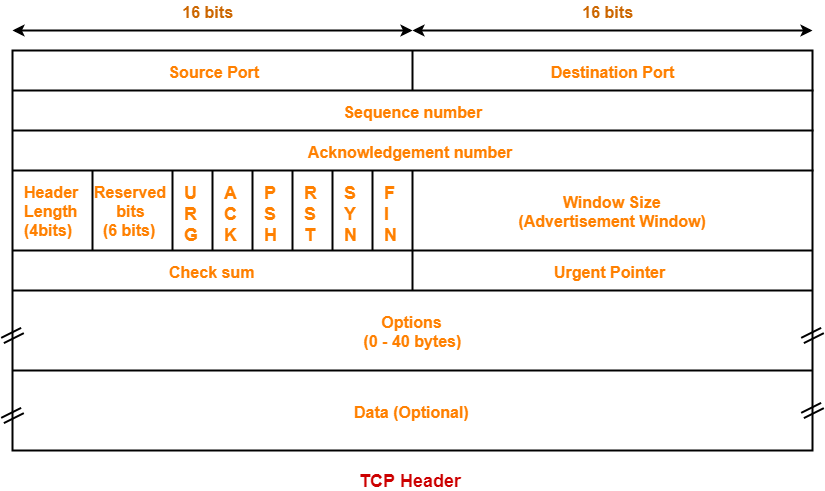
 TCP Header is attached to every TCP segment and contains control information required for reliable data transmission.
TCP Header Fields 1. Source Port — 16 bits
Identifies the port number of the sending application.
2. Destination Port — 16 bits
Identifies the port number of the receiving application.
3. Sequence Number — 32 bits
Identifies the sequence number of the first byte in the TCP segment.
4. Acknowledgment Number — 32 bits
Indicates the next byte expected from the other side. It is valid when the ACK flag is set.
5. Header Length / Data Offset — 4 bits
Indicates the length of the TCP header in 32-bit words.
Minimum TCP Header = 20 bytes
Maximum TCP Header = 60 bytes
6. Reserved — 6 bits
Reserved for future use.
7. Control Flags — 6 bits
The six traditional TCP control flags are:
URG — Urgent Pointer field is valid.
ACK — Acknowledgment Number is valid.
PSH — Push data immediately to the receiving application.
RST — Reset the connection.
SYN — Synchronize sequence numbers; used during connection establishment.
FIN — Finish/terminate the connection.
8. Window Size — 16 bits
Indicates the amount of data the receiver is willing to accept. It is used for Flow Control.
9. Checksum — 16 bits
Used for error detection of the TCP header and data.
10. Urgent Pointer — 16 bits
Points to urgent data when the URG flag is set.
11. Options — 0 to 40 bytes
Variable-length field used for additional TCP features, such as Maximum Segment Size (MSS).
12. Padding — Variable
Added to ensure that the TCP header ends on a 32-bit boundary.
TCP Header Format — Quick Revision- Source Port → 16 bits
- Destination Port → 16 bits
- Sequence Number → 32 bits
- Acknowledgment Number → 32 bits
- Header Length → 4 bits
- Reserved → 6 bits
- Control Flags → 6 bits
- Window Size → 16 bits
- Checksum → 16 bits
- Urgent Pointer → 16 bits
- Options → 0–40 bytes
- Padding → Variable
- Most Important for MCQ
- Source Port = 16 bits
- Destination Port = 16 bits
- Sequence Number = 32 bits
- Acknowledgment Number = 32 bits
- Header Length = 4 bits
- Reserved = 6 bits
- Flags = 6 bits
- Window Size = 16 bits
- Checksum = 16 bits
- Urgent Pointer = 16 bits
- Options = 0–40 bytes
- Minimum TCP Header = 20 bytes
- Maximum TCP Header = 60 bytes
- TCP Header Length is measured in = 32-bit words
- TCP Error Detection = Checksum
- TCP Flow Control = Window Size
- Connection Establishment = SYN
- Connection Termination = FIN
- 4Transport Layer Protocol (UDP) Explanation
 UDP stands for User Datagram Protocol.
UDP is a Transport Layer protocol. It is a connectionless, unreliable and lightweight transport protocol.
Important Characteristics of UDP 1. Connectionless
UDP does not establish a connection before data transmission. There is no connection setup before sending data.
2. Unreliable
UDP does not guarantee data delivery, ordering or retransmission of lost packets.
3. Fast and Lightweight
UDP has very little overhead compared to TCP, so data can be transmitted quickly.
4. Datagram-Oriented
UDP sends data as independent units called Datagrams.
5. No Flow Control
UDP does not provide flow control to regulate the sender's transmission rate according to the receiver's capacity.
6. No Congestion Control
UDP does not provide built-in congestion control.
7. Checksum
UDP uses a Checksum for error detection. The checksum covers the UDP header and data.
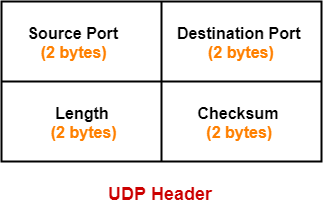
UDP Header Format The UDP header has a fixed size of 8 bytes.
1. Source Port — 16 bits
Identifies the port number of the sending application.
2. Destination Port — 16 bits
Identifies the port number of the receiving application.
3. Length — 16 bits
Specifies the total length of the UDP datagram, including the UDP Header + Data.
4. Checksum — 16 bits
Used for error detection of the UDP header and data.
UDP Header:- Source Port = 16 bits
- Destination Port = 16 bits
- Length = 16 bits
- Checksum = 16 bits
Advantages of UDP 1. Fast Data Transmission — Less overhead makes UDP faster than TCP.
2. Low Overhead — UDP has a small fixed header of only 8 bytes.
3. Suitable for Real-Time Applications — Useful for applications where speed is more important than perfect reliability.
4. Supports Broadcast and Multicast — UDP can be used for broadcast and multicast communication.
5. No Connection Setup — No three-way handshake is required before transmission.
Disadvantages of UDP 1. No Delivery Guarantee — UDP does not guarantee that the data will reach the destination.
2. No Retransmission — Lost datagrams are not automatically retransmitted by UDP.
3. No Sequencing — Datagrams may arrive out of order.
4. No Flow Control — UDP does not control the sender's transmission rate based on receiver capacity.
5. No Congestion Control — UDP does not provide built-in congestion control.
Applications of UDP 1. DNS (Domain Name System) — Commonly uses UDP for fast request-response communication.
2. DHCP (Dynamic Host Configuration Protocol) — Uses UDP for dynamic IP address assignment.
3. VoIP (Voice over IP) — Suitable for real-time voice communication.
4. Online Gaming — Low latency is more important than guaranteed delivery.
5. Video Streaming — Useful where continuous data delivery and low delay are important.
6. SNMP (Simple Network Management Protocol) — Uses UDP for network management.
7. TFTP (Trivial File Transfer Protocol) — Uses UDP for simple file transfer.
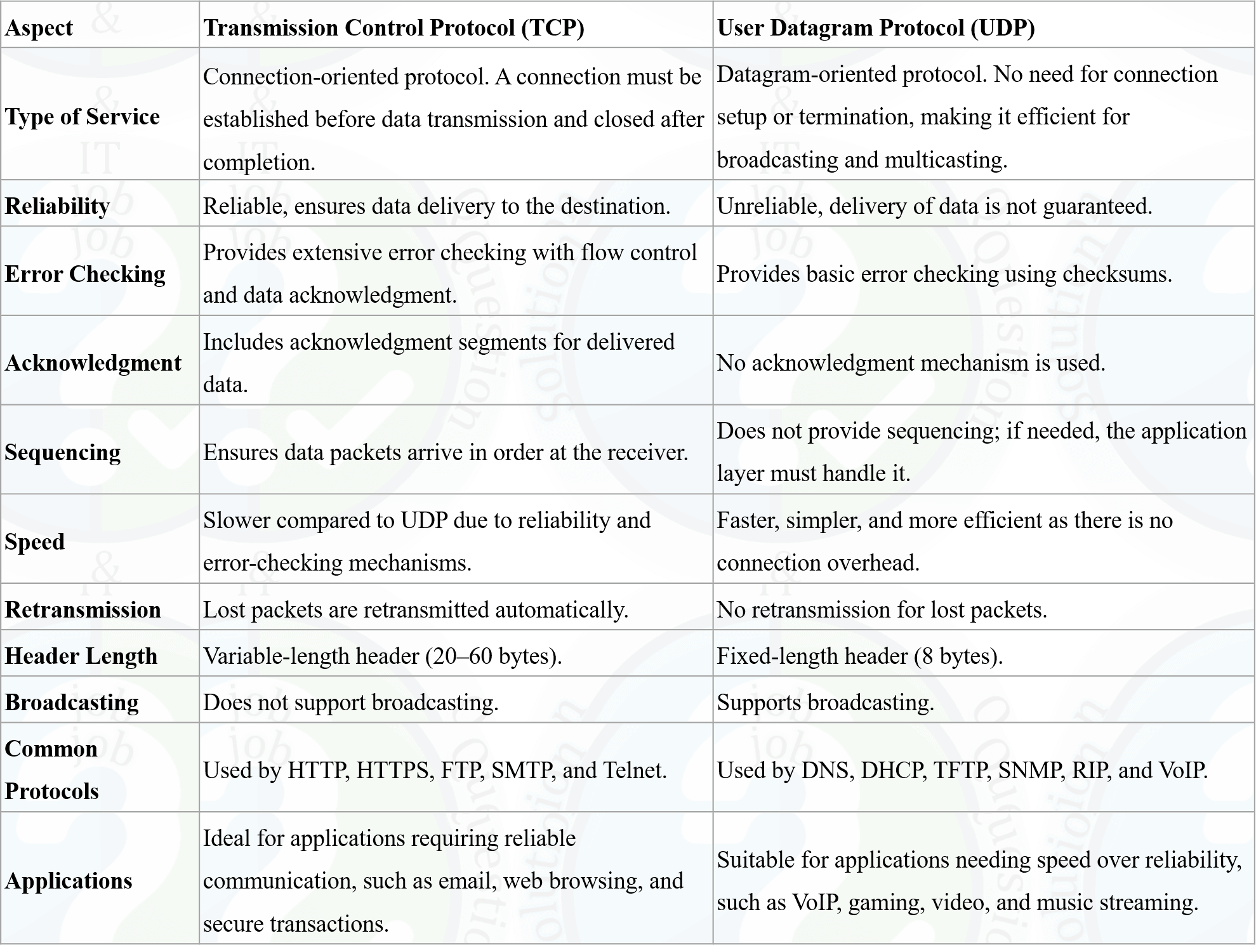
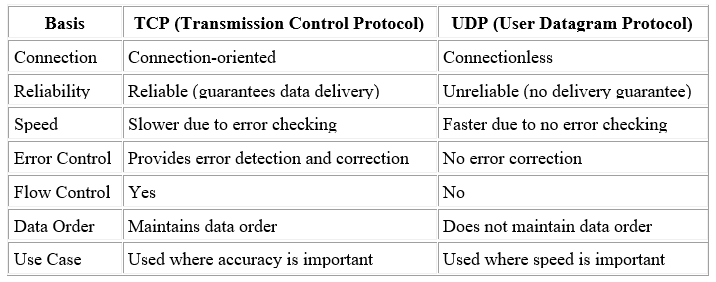
- 5TCP vs UDP

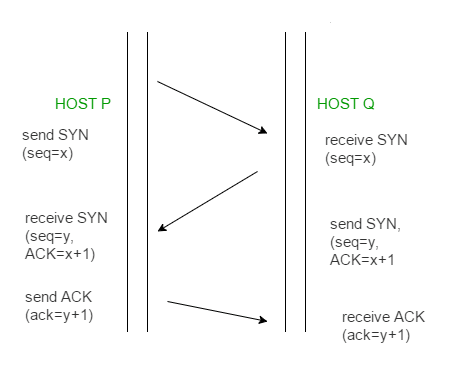
- 6TCP 3 Way Handshakhe (Connection Eshtablishment)TCP Connection Establishment — 3-Way Handshaking
 TCP is a connection-oriented protocol. Before data transmission, TCP establishes a reliable connection between the client and server using Three-Way Handshaking.
Steps of 3-Way Handshaking:- SYN — Client → Server
The client sends a SYN flag = 1 along with its Initial Sequence Number (ISN).
Example: Seq = X - SYN + ACK — Server → Client
The server sends SYN = 1 and ACK = 1.
It sends its own Initial Sequence Number and acknowledges the client's sequence number.
Example: Seq = Y, Ack = X + 1 - ACK — Client → Server
The client sends an ACK to acknowledge the server's sequence number.
Example: Ack = Y + 1
- SYN — Client → Server
- 7TCP Data Flow
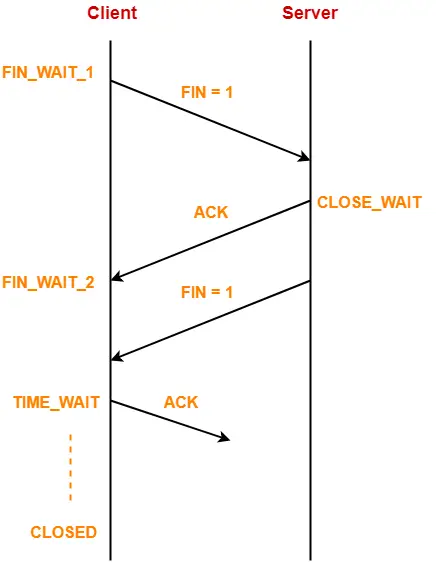
- 8TCP Connection Termination — 4-Way Handshaking
 TCP is a connection-oriented protocol. After the connection is established using Three-Way Handshaking and data transfer is completed, the TCP connection must be terminated properly.
TCP uses Four-Way Handshaking to terminate a connection gracefully and reliably.
Why Four-Way Handshaking?
TCP uses four packets during normal connection termination because communication is full-duplex. One side may finish sending data before the other side has finished sending its data.
Therefore, one side can close its sending direction while still receiving data from the other side.
Steps of TCP Connection Termination
1. FIN Packet
The host that wants to terminate the connection first sends a FIN (Finish) packet to the other host.
The FIN flag in the TCP header is set to 1.
It indicates that the sender has finished sending data and wants to close its side of the connection.
However, the sender may still be able to receive data from the other side.
2. ACK Packet
The receiving host receives the FIN packet and sends an ACK (Acknowledgment) back to the sender.
This acknowledgment confirms that the FIN request has been received.
At this point, the connection becomes half-closed. The host that sent the FIN cannot send more data, but it can still receive data from the other host.
3. FIN Packet from the Other Side
The other host may still have some data to send. It continues sending the remaining data.
After finishing its data transmission, it also sends a FIN packet to terminate its side of the connection.
The FIN flag is set to 1 in this packet as well.
4. Final ACK
The first host receives the second FIN packet and sends a final ACK back.
This acknowledgment confirms that the second host's FIN request has been received.
After this process, the TCP connection is finally closed.
TCP Four-Way Handshaking Sequence
Client/Host A → Server/Host B : FIN
Server/Host B → Client/Host A : ACK
Server/Host B → Client/Host A : FIN
Client/Host A → Server/Host B : ACK
FIN → ACK → FIN → ACK
Why Can the Second FIN Be Delayed?
When one host sends a FIN, it means that this host has finished sending data. It does not necessarily mean that the other host has finished sending its data.
For example, if the client finishes sending data first, it sends a FIN. The server acknowledges the FIN but may still have some data to send. Therefore, the server continues sending data and sends its own FIN only after completing its transmission.
TCP FIN Flag
The TCP header contains a FIN flag.
FIN = 1 indicates that the sender wants to terminate its sending side of the TCP connection.
Unlike the SYN flag, which is mainly used during connection establishment, the FIN flag is used during connection termination.
Graceful Connection Termination
TCP provides a graceful and reliable shutdown of the connection. Each side independently terminates its sending direction and acknowledges the termination request from the other side.
This ensures that pending data can be delivered before the connection is completely closed.
- 9TCP Congestion and ControlTCP Congestion Control
Congestion is a condition in a computer network where too much data is sent into the network, causing routers and network resources to become overloaded.
When congestion occurs, it can cause packet delay, packet loss, wastage of network resources, and reduced throughput and overall network performance.
TCP Congestion Control is a mechanism used by TCP at the Transport Layer to control the amount of data transmitted into the network and prevent network congestion.
Main Objectives:- Prevent network congestion.
- Reduce packet loss.
- Reduce packet delay.
- Improve network throughput.
- Maintain efficient communication between sender and receiver.

TCP Congestion Control Approaches
1. Slow Start Phase
The Slow Start phase is used by TCP to gradually increase the amount of data sent into the network at the beginning of communication.
In this phase, the Congestion Window (cwnd) grows exponentially. The amount of data is approximately doubled after receiving acknowledgements for each RTT (Round Trip Time).
Growth Pattern: 1 MSS → 2 MSS → 4 MSS → 8 MSS → 16 MSS
If the threshold value (ssthresh) is set to 8 MSS, TCP increases the congestion window rapidly until it reaches this threshold.
2. Congestion Avoidance Phase
After reaching the Slow Start Threshold (ssthresh), TCP enters the Congestion Avoidance phase.
In this phase, the congestion window does not continue to grow exponentially. Instead, it increases linearly by 1 MSS per RTT to probe safely for available bandwidth.
Example Transition: 1 → 2 → 4 → 8 → 16 (Slow Start) → 17 → 18 → 19 → 20 (Congestion Avoidance)
Why is Congestion Avoidance needed?
Suppose the receiver can accept 20 MSS of data, but the sender suddenly tries to send 32 MSS. Sending too much data rapidly can overflow router buffers. Therefore, after reaching the threshold, TCP increases the sending rate slowly.
3. Congestion Detection Phase
Congestion Detection occurs when TCP identifies signs of network congestion, such as packet loss, timeout, or duplicate acknowledgements.
When congestion is detected, TCP reduces the congestion window to decrease the load on the network. A common approach is to update the threshold to half of the current congestion window.
New Threshold (ssthresh) = Current Congestion Window / 2
Example: Ifcwndreaches 24 MSS and packet loss occurs:
ssthresh = 24 / 2 = 12 MSS
TCP sets the new threshold to 12 MSS and adjusts its congestion window accordingly.
Comparison SummaryFeature Slow Start Congestion Avoidance Growth Rate Exponential (2n) Linear (+1 per RTT) Purpose Rapidly probe for available capacity Safely approach link capacity to avoid congestion Sequence Example 1, 2, 4, 8, 16 MSS 16, 17, 18, 19, 20 MSS Condition Active when cwnd < ssthreshActive when cwnd ≥ ssthresh
 TCP Header is attached to every TCP segment and contains control information required for reliable data transmission.
 UDP stands for User Datagram Protocol.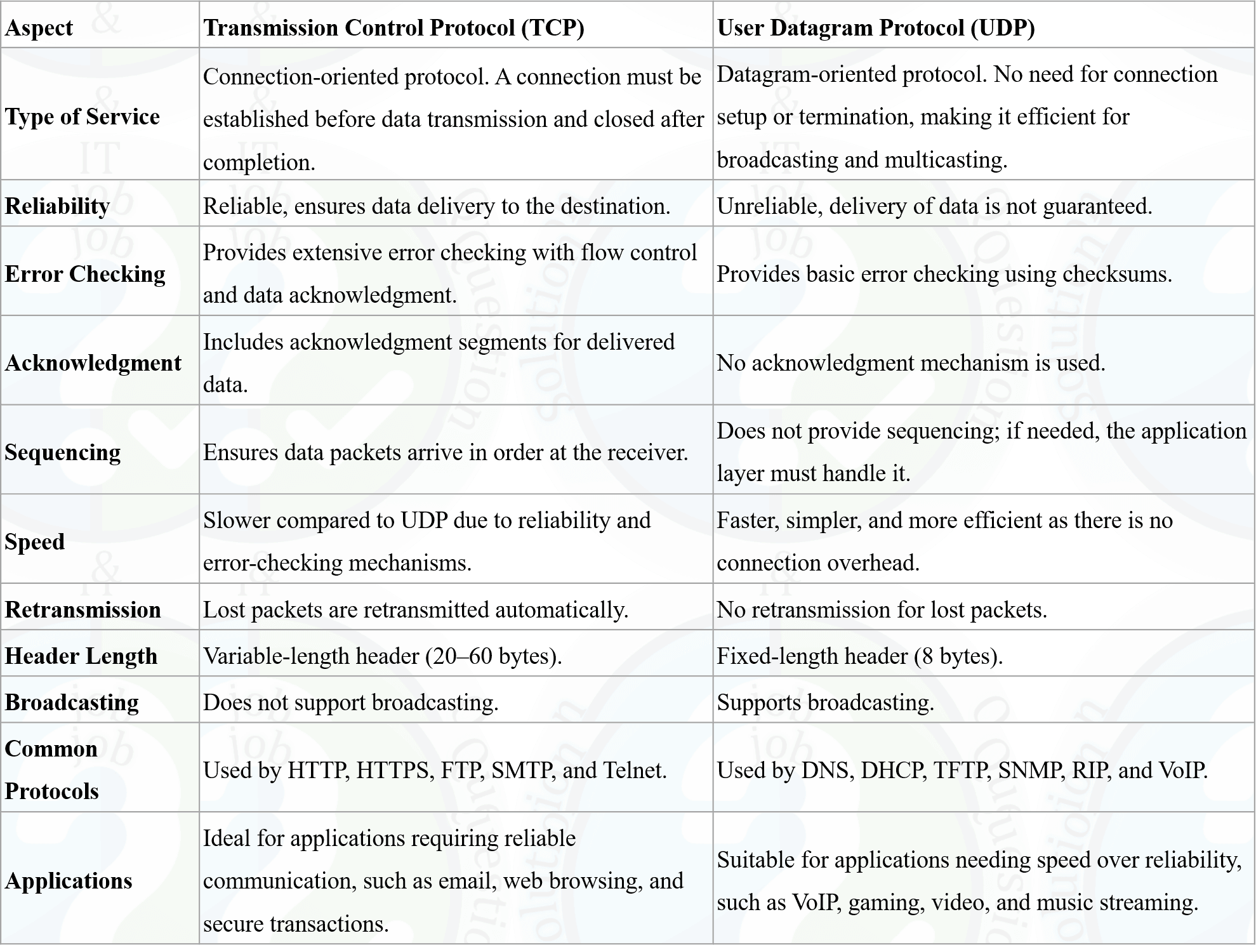
 TCP is a connection-oriented protocol. Before data transmission, TCP establishes a reliable connection between the client and server using Three-Way Handshaking.
 TCP is a connection-oriented protocol. After the connection is established using Three-Way Handshaking and data transfer is completed, the TCP connection must be terminated properly.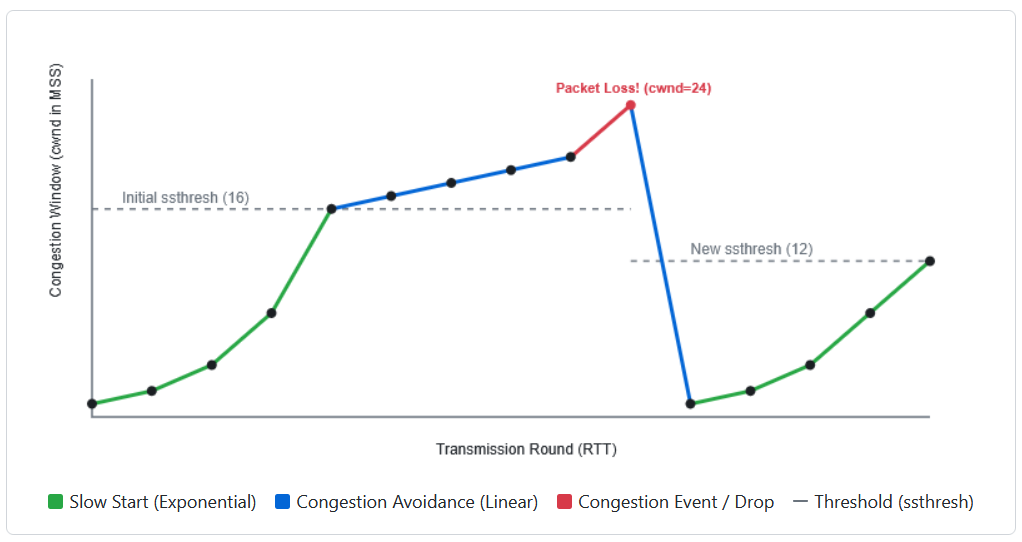
Previous Job Question: Trasnport Layer Functions and Protocol
Previous Job Question: Trasnport Layer Functions and Protocol
Topic Wise Question Bank
All Topics
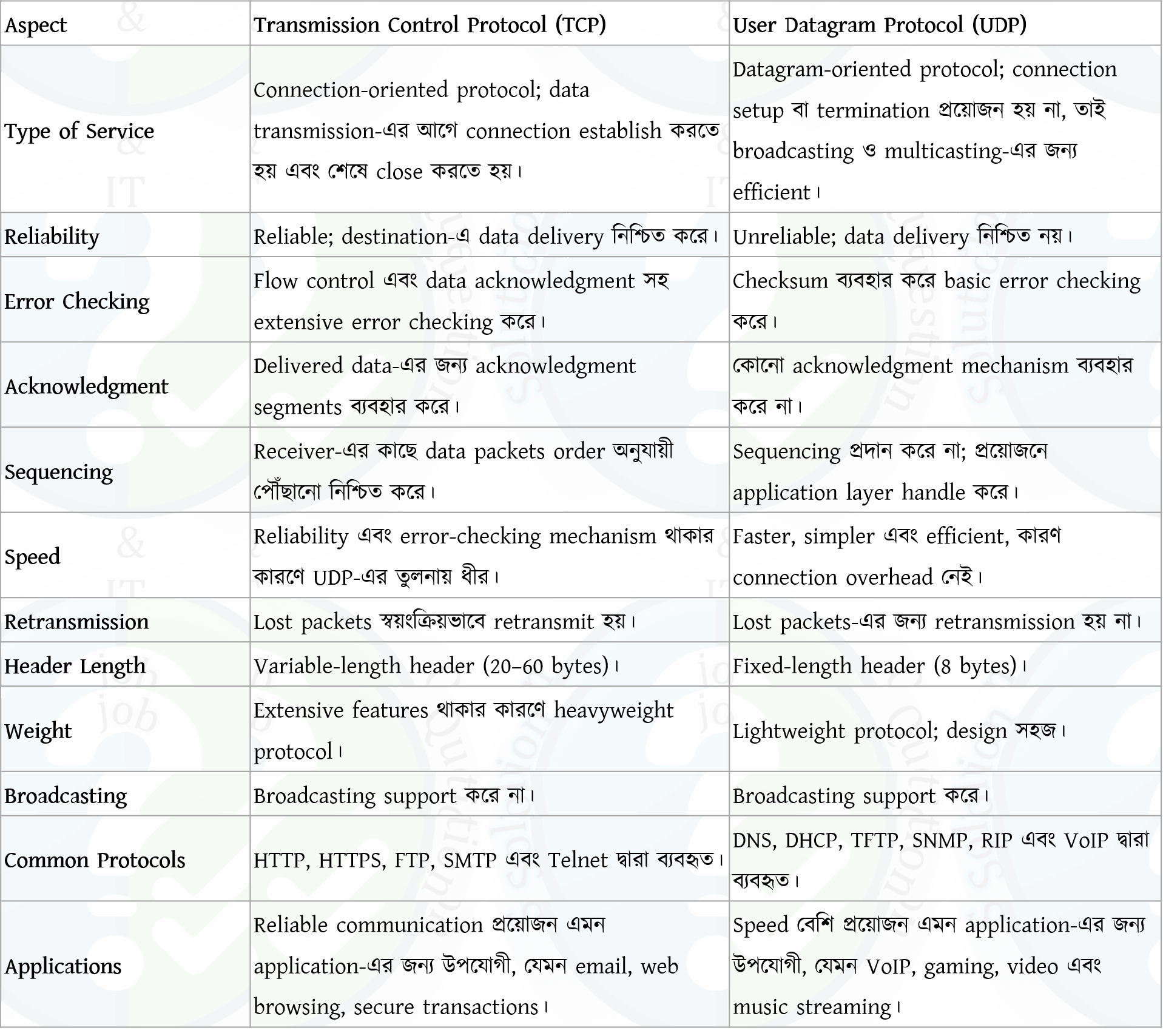
- ☆1Computer NetworkTransport Layer ProtocolCompare TCP and UDP in terms of connection, reliability, and speed. Give one real-life use case of UDP.Combined Bank, AP-23, 26 | Assistant Programmer
- ☆2Computer NetworkTransport Layer ProtocolThe primary function of the Transmission control Protocol (TCP) is to turn an unreliable network into a reliable network that is free from lost and duplicate packets. What are the functions performed by TCP to make a network more reliable?CB, O(IT), 20 | Officer (IT)
- ☆3Computer NetworkTransport Layer ProtocolWhy does the Domain Name System (DNS) primarily use UDP as its transport layer protocol instead of TCP? Describe the sequence of events that take place during the DNS name resolution process when a user enters www.companybd.com into a web browser and presses Enter.(10 Marks)Combined Bank, SO-IT, 25 | Senior Officer (IT)
- ☆4Computer NetworkTransport Layer ProtocolDifference between TCP and UDP, HTTP and HTTPs.SPCBL, SAME, 22 | AME/ANE/AE
Difference between HTTP and HTTPS
- Meaning: HTTP = HyperText Transfer Protocol, HTTPS = HyperText Transfer Protocol Secure.
- Security: HTTP is not encrypted, HTTPS is encrypted using SSL/TLS.
- Data Protection: HTTP data can be intercepted, HTTPS protects against eavesdropping and tampering.
- Port: HTTP uses port 80, HTTPS uses port 443.
- Certificate: HTTP does not require a certificate, HTTPS requires a digital certificate.
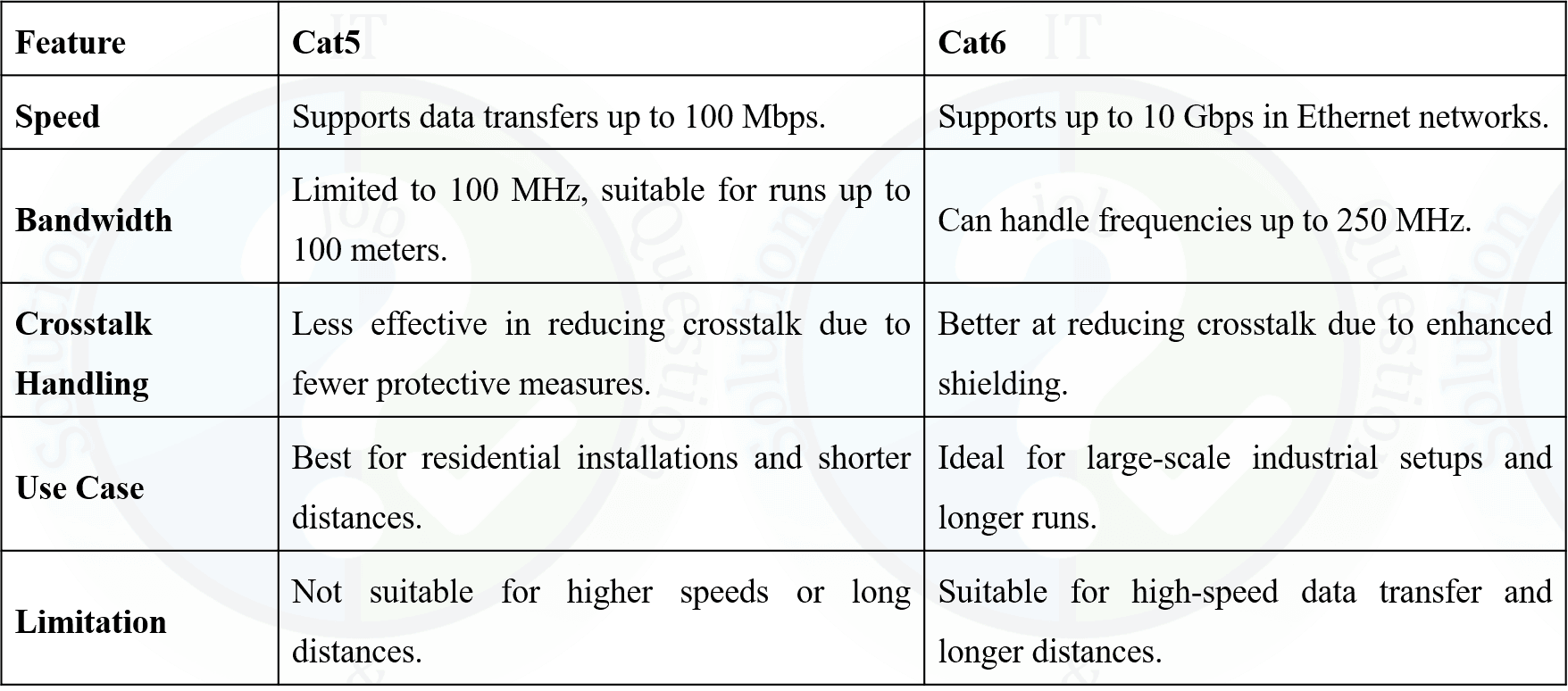
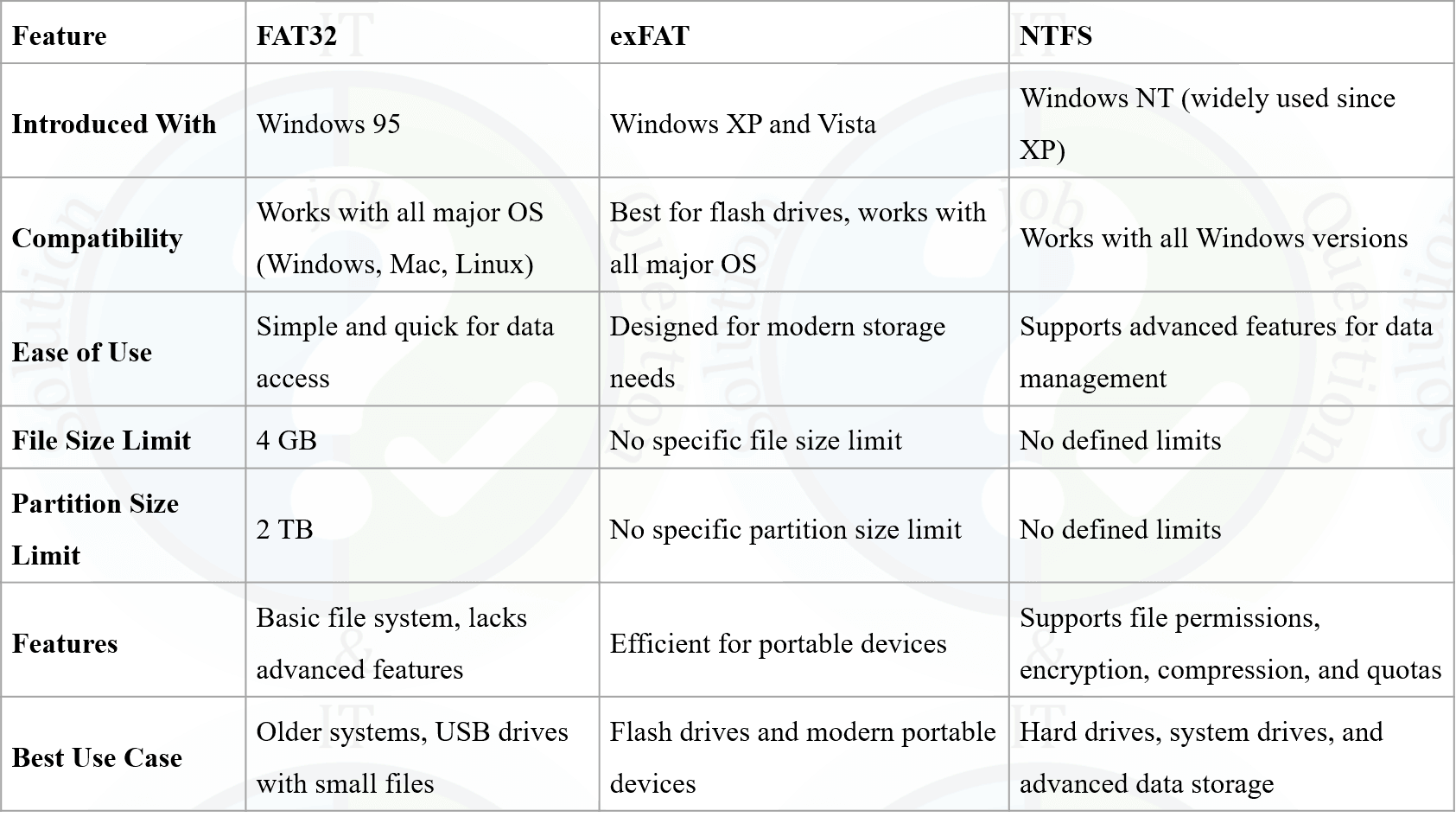
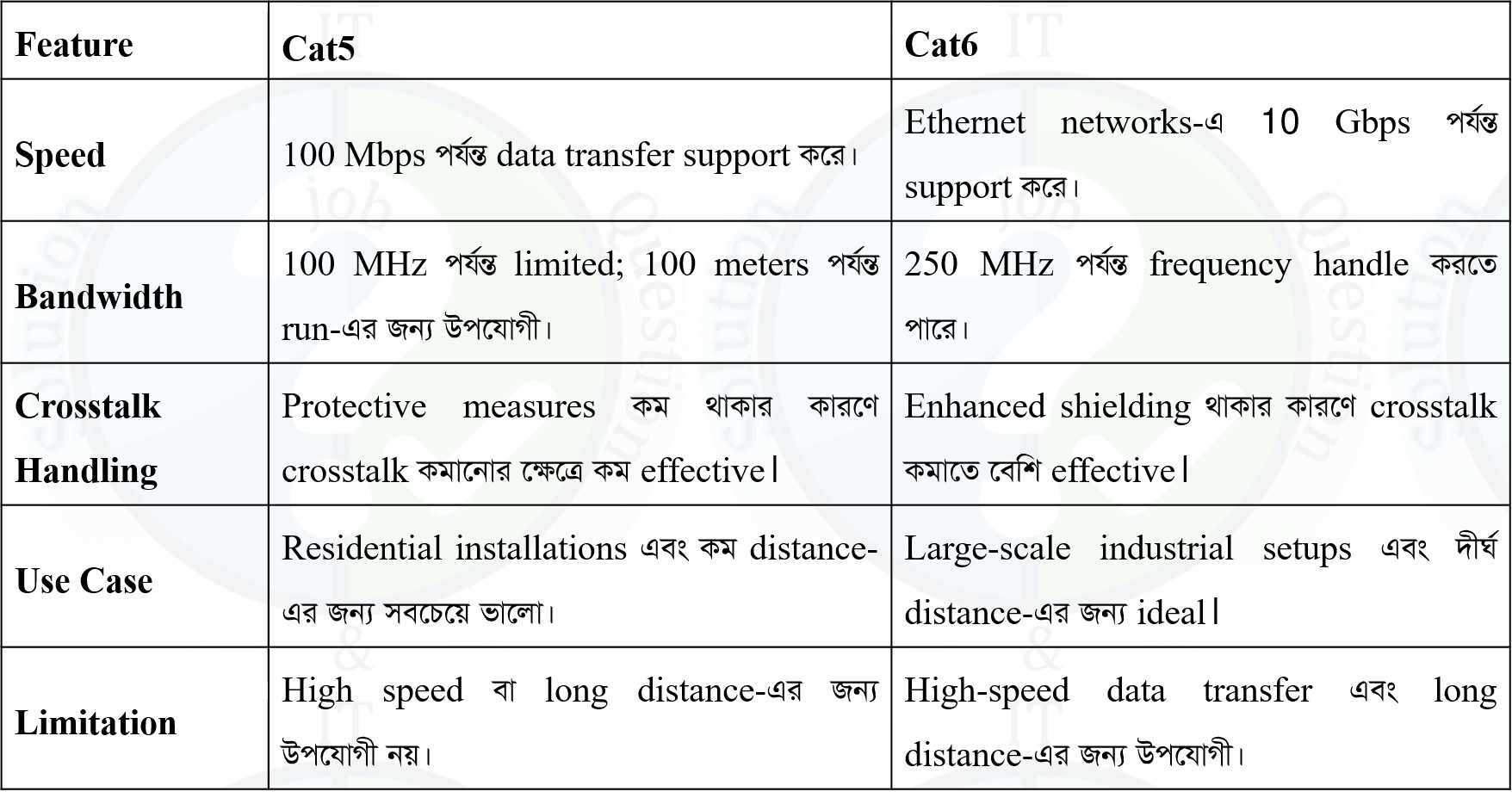
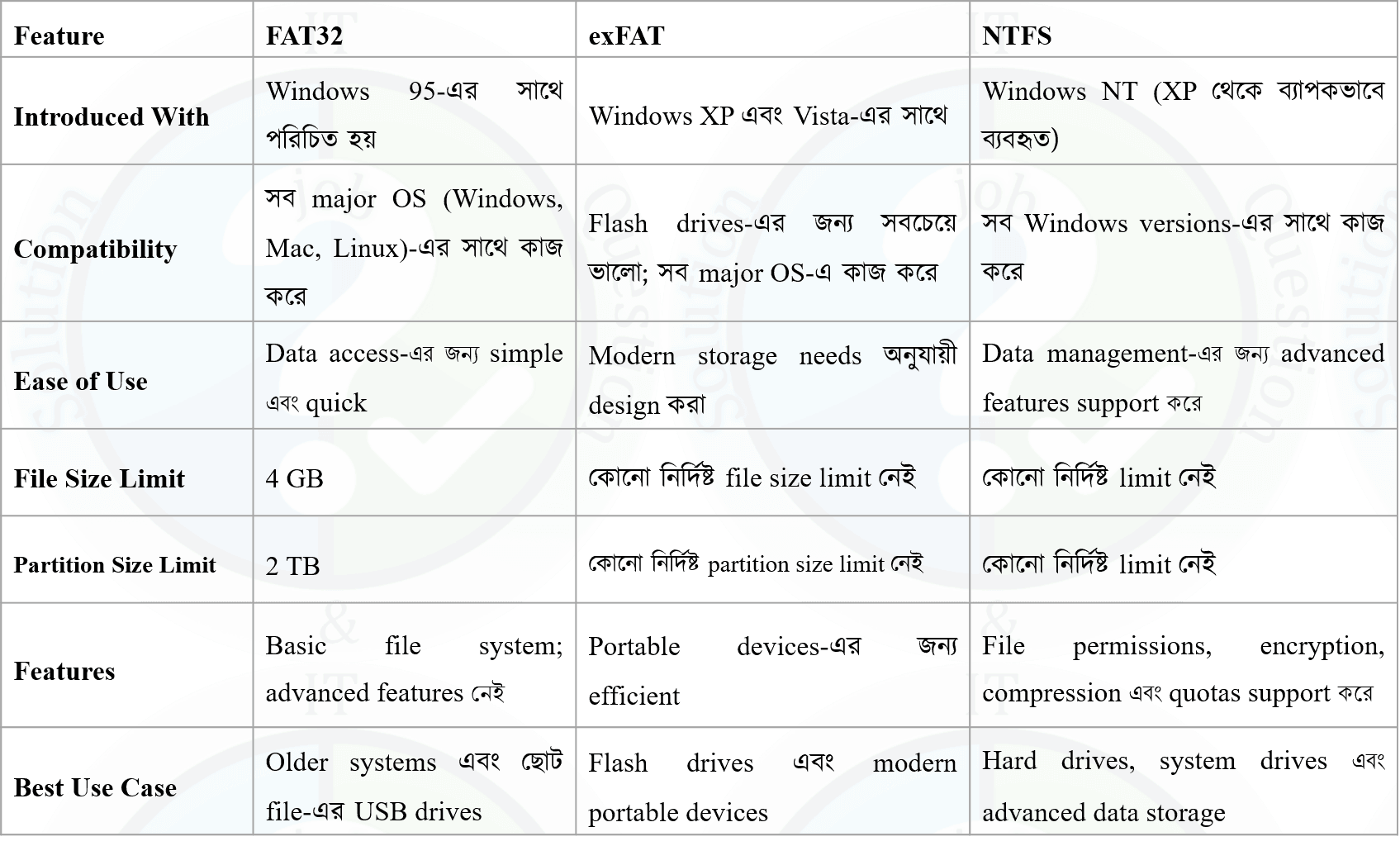
- ☆5Computer NetworkTransport Layer ProtocolDifference between TCP and UDP. Distinguish between Cat5 and Cat6. Difference among exFAT, FAT32 and NTFSCB, O(IT), 23 | Officer (IT)


- ☆6Computer NetworkTransport Layer ProtocolExplain Three-Way Handshaking in TCP Protocol.Sonali, O(it), 21 | Officer (IT)
The Three-Way Handshake in TCP (Transmission Control Protocol) is a process used to establish a reliable connection between a client and a server before data transmission begins.
Steps of the Three-Way Handshake
- SYN (Synchronize):
The client (Host P) generates a random sequence number (X) and sends a connection request to the server (Host Q) with the SYN flag, indicating that it wants to establish a connection. - SYN-ACK (Synchronize-Acknowledgment):
The server (Host Q) receives the request and responds by selecting its own random sequence number (Y). It sends back a packet containing the SYN flag and an ACK flag to acknowledge the client’s sequence number (X + 1). - ACK (Acknowledgment):
The client receives the server’s response and sends an acknowledgment packet with the ACK flag set, confirming the server’s sequence number (Y + 1). After this step, the connection is successfully established

- SYN (Synchronize):
- ☆7Computer NetworkTransport Layer ProtocolCompare TCP and UDP protocol with examples.Combined Bank, O(IT-22), 26 | Officer (IT)
 Examples of TCP:
Web browsing (HTTP/HTTPS), Email (SMTP), File transfer (FTP).
Examples of TCP:
Web browsing (HTTP/HTTPS), Email (SMTP), File transfer (FTP).
Examples of UDP: Video streaming, Online gaming, Voice calls (VoIP).
 Examples of TCP:
Web browsing (HTTP/HTTPS), Email (SMTP), File transfer (FTP).
Examples of TCP:
Web browsing (HTTP/HTTPS), Email (SMTP), File transfer (FTP).