
(i) Find no of students who can speak English only.
(ii) Find no of students who can speak French only.
(iii) Find no of students who can speak both.
Given:
Total = 100
English (E) = 72
French (F) = 43
Formula:
E + F − Both = Total
72 + 43 − Both = 100
115 − Both = 100
Both = 15
(i) English only:
= 72 − 15 = 57
(ii) French only:
= 43 − 15 = 28
(iii) Both:
= 15
Final Answer:
English only = 57
French only = 28
Both = 15
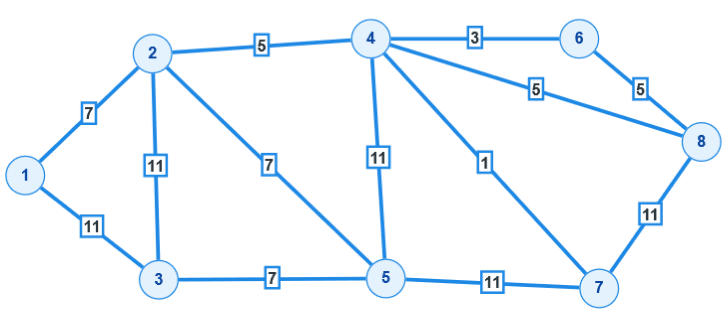
Assumption: source node = 1.
Dijkstra step by step
We keep two things: current shortest distance from node 1, and previous node used to reach it.
Initial table
d(1)=0, and all others = ∞
Previous = none
Step 1: pick node 1
Visited: {1}
From 1:
2 = 0 + 7 = 7
3 = 0 + 11 = 11
Now:
d(1)=0, d(2)=7, d(3)=11, d(4)=∞, d(5)=∞, d(6)=∞, d(7)=∞, d(8)=∞
Prev(2)=1, Prev(3)=1
Step 2: pick node 2 (smallest unvisited = 7)
Visited: {1,2}
From 2:
3 via 2 = 7+11 = 18, no improvement because 11 is smaller
4 via 2 = 7+5 = 12, update
5 via 2 = 7+7 = 14, update
Now:
d(1)=0, d(2)=7, d(3)=11, d(4)=12, d(5)=14, d(6)=∞, d(7)=∞, d(8)=∞
Prev(4)=2, Prev(5)=2
Step 3: pick node 3 (smallest unvisited = 11)
Visited: {1,2,3}
From 3:
5 via 3 = 11+7 = 18, no improvement because 14 is smaller
No change.
Step 4: pick node 4 (smallest unvisited = 12)
Visited: {1,2,3,4}
From 4:
5 via 4 = 12+11 = 23, no improvement
6 via 4 = 12+3 = 15, update
7 via 4 = 12+1 = 13, update
8 via 4 = 12+5 = 17, update
Now:
d(1)=0, d(2)=7, d(3)=11, d(4)=12, d(5)=14, d(6)=15, d(7)=13, d(8)=17
Prev(6)=4, Prev(7)=4, Prev(8)=4
Step 5: pick node 7 (smallest unvisited = 13)
Visited: {1,2,3,4,7}
From 7:
5 via 7 = 13+11 = 24, no improvement
8 via 7 = 13+11 = 24, no improvement
No change.
Step 6: pick node 5 (smallest unvisited = 14)
Visited: {1,2,3,4,7,5}
From 5:
No better path found.
Step 7: pick node 6 (smallest unvisited = 15)
Visited: {1,2,3,4,7,5,6}
From 6:
8 via 6 = 15+5 = 20, no improvement because 17 is smaller
No change.
Step 8: pick node 8 (smallest unvisited = 17)
Visited: {1,2,3,4,7,5,6,8}
Done.
Final shortest distances from node 1
Node 1 = 0
Node 2 = 7
Node 3 = 11
Node 4 = 12
Node 5 = 14
Node 6 = 15
Node 7 = 13
Node 8 = 17
Shortest paths
To 2: 1 → 2 (cost 7)
To 3: 1 → 3 (cost 11)
To 4: 1 → 2 → 4 (cost 12)
To 5: 1 → 2 → 5 (cost 14)
To 6: 1 → 2 → 4 → 6 (cost 15)
To 7: 1 → 2 → 4 → 7 (cost 13)
To 8: 1 → 2 → 4 → 8 (cost 17)
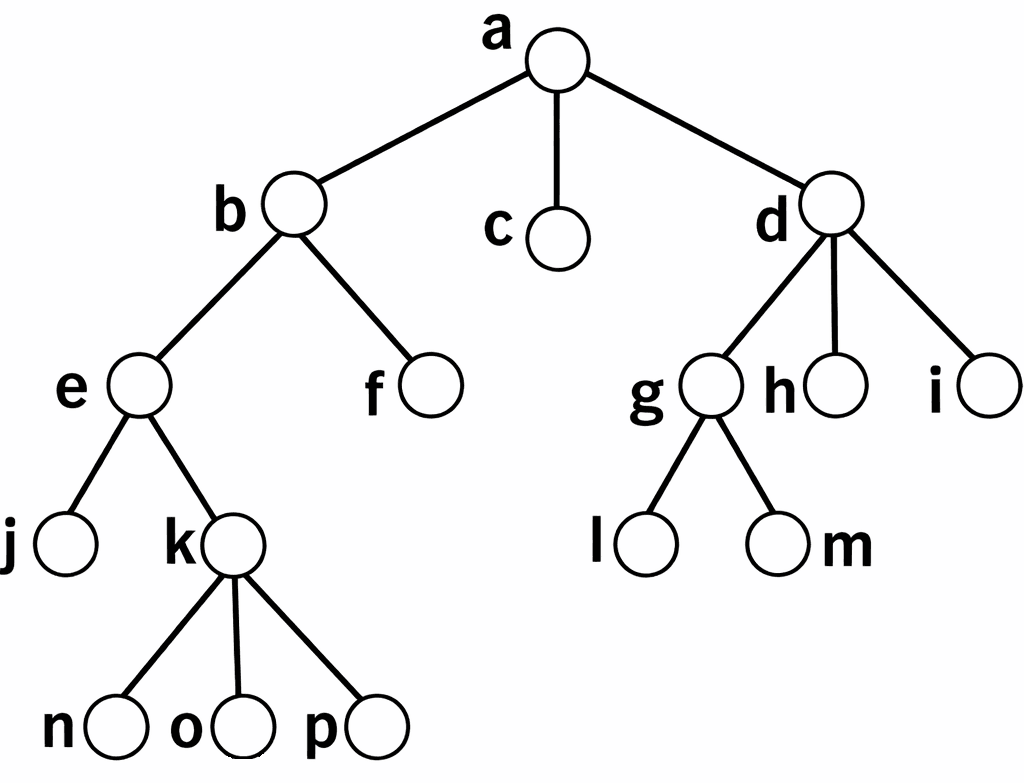
Preorder traversal (Root → Left → Right)
a → b → e → j → k → n → o → p → f → c → d → g → l → m → h → i
Postorder traversal (Left → Right → Root)
j → n → o → p → k → e → f → b → c → l → m → g → h → i → d → a
Decimal Conversion:
(651.124)8 = 6×82 + 5×81 + 1×80 + 1×8-1 + 2×8-2 + 4×8-3
= 384 + 40 + 1 + 0.125 + 0.03125 + 0.0078125
= (425.1640625)10
Hexadecimal Conversion:
Octal → Binary:
6 = 110, 5 = 101, 1 = 001
. → .
1 = 001, 2 = 010, 4 = 100
Binary = 110101001 . 001010100
Group into 4 bits:
0001 1010 1001 . 0010 1010 0000
Convert to Hex:
0001 = 1, 1010 = A, 1001 = 9
0010 = 2, 1010 = A, 0000 = 0
= (1A9.2A0)16
i. Find the range of valid host address?
ii. Find Network Address?
iii. Find Broadcast address?
Given:
IP Address = 102.168.1.50
Subnet Mask = 255.255.255.240
Step 1: Find subnet size
255.255.255.240 = /28
Block size = 256 – 240 = 16
Subnet ranges in last octet:
0–15, 16–31, 32–47, 48–63, 64–79, …
Since 50 lies in 48–63, this is the subnet.
i. Range of valid host addresses:
102.168.1.49 to 102.168.1.62
ii. Network Address:
102.168.1.48
iii. Broadcast Address:
102.168.1.63