
- 1Error Detection Error DetectionError Detection in Data Link LayerData Link LayerError Detection is the process of identifying whether the data received by a receiver has been corrupted during transmission. In a computer network, data may be changed or corrupted while traveling through a communication medium. Therefore, reliable communication requires mechanisms to detect and, when necessary, correct these errors.
Transmission Error: When data is transmitted from one network node to another, the data may be corrupted because of noise, interference, signal problems, or other transmission issues. The errors caused during data transmission are called Transmission Errors.
Error Control in OSI Model: Error control is mainly associated with the Data Link Layer and Transport Layer of the OSI model. These layers provide mechanisms for detecting and/or handling errors to support reliable data communication.
Types of Transmission Errors
There are mainly two types of transmission errors:- Bit Error
- Burst Error
Example:
Sender sends: 00000010
Receiver receives: 00001010
Here, only one bit has changed from 0 to 1. Therefore, this is a Bit Error.
2. Burst Error: A burst error occurs when two or more bits within a data unit are affected or corrupted during transmission.
The important point is that the burst length is measured from the first corrupted bit to the last corrupted bit, including all bits between them, whether every bit in between is actually corrupted or not.
For example, if the first corrupted bit occurs at position 3 and the last corrupted bit occurs at position 10, the burst length is 8 bits.
Error Detection: Error detection is the process by which the receiver determines whether the received data contains an error. The receiver normally does not have a copy of the original message, so additional information must be transmitted along with the original data.
To make error detection possible, the sender adds some extra bits to the original data. These extra bits are called Redundant Bits or Redundancy.
Basic Error Detection Process:
Original Data → Generator → Redundant Bits → Data + Redundancy → Transmission → Receiver → Checker → Accept / Reject
At the sender side, a generating function or algorithm calculates the redundant information from the original message. The redundant bits are then appended to the original data and transmitted to the receiver.
At the receiver side, a checking function or algorithm examines the received data and calculates or verifies the redundancy. The result is compared with the expected value.
If the check indicates that the data is correct, the receiver accepts the data. If an error is detected, the receiver rejects or discards the data and may request retransmission depending on the protocol.
Redundancy: Redundancy means adding extra information to the original data so that the receiver can detect or correct transmission errors.
For example, if the sender has a message, it passes the message through a generating algorithm. The algorithm produces redundant bits. These redundant bits are appended to the original message and the complete data is transmitted through the communication medium.
The receiver separates or processes the received information using a checking algorithm. If the calculated check matches the expected check, the data is considered valid. Otherwise, an error is detected.
Error Detection vs Error Correction
Error Detection: Error detection determines whether an error has occurred in the received data. It generally results in a simple decision: Accept if the data is valid or Reject if an error is detected.
Error Correction: Error correction attempts to recover the correct data after detecting an error. It is more complex than simple error detection.
There are two common approaches to error correction:- Retransmission: The receiver detects an error and requests the sender to retransmit the entire data unit.
- Error-Correcting Code: Additional redundancy allows the receiver to identify and automatically correct certain types of errors without retransmission.
Error Detection Techniques
There are four commonly discussed error detection techniques in data communication:- Vertical Redundancy Check (VRC)
- Longitudinal Redundancy Check (LRC)
- Checksum
- Cyclic Redundancy Check (CRC)
2. Longitudinal Redundancy Check (LRC): LRC organizes data into rows and columns and adds redundancy based on the bits in each column. It can detect certain errors that may not be detected by a simple parity check.
3. Checksum: In the checksum technique, the sender divides the data into fixed-size units and performs arithmetic operations on those units to generate a checksum value. The checksum is transmitted along with the data. The receiver performs a similar calculation and compares the result to determine whether an error has occurred.
4. Cyclic Redundancy Check (CRC): CRC is a powerful error detection technique based on binary polynomial division. The sender performs a calculation using a predefined generator polynomial and appends the resulting remainder to the data. The receiver performs a similar calculation to determine whether the received data has been corrupted.
CRC and Checksum are widely used error detection mechanisms in computer networks and communication protocols. CRC is particularly effective at detecting burst errors.
Error Detection হলো এমন একটি প্রক্রিয়া যার মাধ্যমে Receiver নির্ণয় করে যে Transmission-এর সময় প্রাপ্ত Data Corrupted হয়েছে কি না। Computer Network-এ Communication Medium-এর মধ্য দিয়ে Data যাওয়ার সময় Noise, Interference, Signal Problem বা অন্যান্য Transmission সমস্যার কারণে Data পরিবর্তিত বা Corrupted হতে পারে। তাই Reliable Communication-এর জন্য Error Detect এবং প্রয়োজন হলে Error Correct করার ব্যবস্থা প্রয়োজন।
Transmission Error: যখন Data একটি Network Node থেকে অন্য Network Node-এ পাঠানো হয়, তখন Noise, Interference, Signal Problem বা অন্যান্য Transmission সমস্যার কারণে Data Corrupted হতে পারে। Data Transmission-এর সময় সৃষ্ট এই ধরনের Error-কে Transmission Error বলা হয়।
Error Control in OSI Model: OSI Model-এর Data Link Layer এবং Transport Layer-এর সঙ্গে Error Control প্রধানত সম্পর্কিত। এই Layer-গুলো Reliable Data Communication নিশ্চিত করার জন্য Error Detection এবং প্রয়োজন অনুযায়ী Error Handling-এর ব্যবস্থা প্রদান করে।
Types of Transmission Errors
Transmission Error প্রধানত দুই ধরনের:
১. Bit Error
২. Burst Error
১. Bit Error: Transmission-এর সময় কোনো Data Unit-এর মাত্র একটি Bit পরিবর্তিত হলে তাকে Bit Error বলা হয়। একে Single-Bit Error-ও বলা হয়।
Example:
Sender sends: 00000010
Receiver receives: 00001010
এখানে শুধুমাত্র একটি Bit 0 থেকে 1 পরিবর্তিত হয়েছে। তাই এটি একটি Bit Error।
২. Burst Error: Transmission-এর সময় কোনো Data Unit-এর মধ্যে দুই বা ততোধিক Bit প্রভাবিত বা Corrupted হলে তাকে Burst Error বলা হয়।
Burst Length প্রথম Corrupted Bit থেকে শেষ Corrupted Bit পর্যন্ত গণনা করা হয়। মাঝখানের প্রতিটি Bit Corrupted না হলেও সেগুলো Burst Length-এর মধ্যে গণনা করা হয়।
উদাহরণস্বরূপ, যদি প্রথম Corrupted Bit-এর অবস্থান 3 এবং শেষ Corrupted Bit-এর অবস্থান 10 হয়, তাহলে Burst Length হবে 8 bits।
Error Detection: Error Detection হলো এমন একটি প্রক্রিয়া যার মাধ্যমে Receiver নির্ণয় করে যে প্রাপ্ত Data-তে কোনো Error রয়েছে কি না। সাধারণত Receiver-এর কাছে Original Message-এর একটি Copy থাকে না। তাই Error শনাক্ত করার জন্য Original Data-এর সঙ্গে অতিরিক্ত কিছু Information পাঠাতে হয়।
Error Detection সম্ভব করার জন্য Sender Original Data-এর সঙ্গে কিছু Extra Bits যুক্ত করে। এই Extra Bits-কে Redundant Bits বা Redundancy বলা হয়।
Basic Error Detection Process:
Original Data → Generator → Redundant Bits → Data + Redundancy → Transmission → Receiver → Checker → Accept / Reject
Sender Side-এ একটি Generating Function বা Algorithm Original Message থেকে Redundant Information তৈরি করে। এরপর Redundant Bits-কে Original Data-এর সঙ্গে যুক্ত করে Receiver-এর কাছে পাঠানো হয়।
Receiver Side-এ একটি Checking Function বা Algorithm প্রাপ্ত Data পরীক্ষা করে এবং Redundancy Calculate বা Verify করে। এরপর প্রাপ্ত Result-কে Expected Value-এর সঙ্গে Compare করা হয়।
যদি Check থেকে বোঝা যায় যে Data সঠিক, তাহলে Receiver Data Accept করে। যদি Error শনাক্ত হয়, তাহলে Receiver Data Reject বা Discard করতে পারে এবং Protocol অনুযায়ী Retransmission-এর জন্য Request করতে পারে।
Redundancy: Redundancy বলতে Original Data-এর সঙ্গে অতিরিক্ত Information যুক্ত করাকে বোঝায়, যাতে Receiver Transmission Error Detect বা Correct করতে পারে।
উদাহরণস্বরূপ, Sender-এর কাছে একটি Message থাকলে সেটিকে একটি Generating Algorithm-এর মাধ্যমে Process করা হয়। Algorithm থেকে Redundant Bits তৈরি হয়। এরপর এই Redundant Bits Original Message-এর সঙ্গে যুক্ত করে সম্পূর্ণ Data Communication Medium-এর মাধ্যমে পাঠানো হয়।
Receiver প্রাপ্ত Information-কে একটি Checking Algorithm-এর মাধ্যমে Process করে। Calculated Check যদি Expected Check-এর সঙ্গে মিলে যায়, তাহলে Data Valid হিসেবে বিবেচিত হয়। অন্যথায় Error শনাক্ত হয়।
Error Detection vs Error Correction
Error Detection: Error Detection নির্ণয় করে যে Received Data-তে কোনো Error ঘটেছে কি না। সাধারণত এর ফলাফল দুটি সিদ্ধান্তের মাধ্যমে প্রকাশ করা হয়: Data সঠিক হলে Accept এবং Error শনাক্ত হলে Reject।
Error Correction: Error Correction হলো Error শনাক্ত হওয়ার পর সঠিক Data পুনরুদ্ধার করার প্রক্রিয়া। এটি সাধারণ Error Detection-এর তুলনায় বেশি Complex।
Error Correction-এর দুটি সাধারণ পদ্ধতি:
১. Retransmission: Receiver Error শনাক্ত করে এবং Sender-এর কাছে সম্পূর্ণ Data Unit পুনরায় পাঠানোর জন্য Request করে।
২. Error-Correcting Code: অতিরিক্ত Redundancy ব্যবহার করে Receiver নির্দিষ্ট ধরনের Error শনাক্ত এবং স্বয়ংক্রিয়ভাবে Correct করতে পারে, ফলে Retransmission-এর প্রয়োজন হয় না।
Important: Error Detection এবং Error Correction উভয়ের জন্যই কোনো না কোনো ধরনের Redundancy প্রয়োজন। কারণ Received Data সঠিক কি না এবং কিছু ক্ষেত্রে Error কীভাবে Correct করতে হবে তা নির্ণয়ের জন্য Receiver-এর অতিরিক্ত Information প্রয়োজন হয়।
Error Detection Techniques
Data Communication-এ সাধারণত চারটি Error Detection Technique বেশি আলোচনা করা হয়:
১. Vertical Redundancy Check (VRC)
২. Longitudinal Redundancy Check (LRC)
৩. Checksum
৪. Cyclic Redundancy Check (CRC)
১. Vertical Redundancy Check (VRC): VRC হলো একটি Error Detection Technique যেখানে Data Bits-এর একটি Group-এর সঙ্গে একটি অতিরিক্ত Parity Bit যুক্ত করা হয়। নির্বাচিত Parity Scheme অনুযায়ী এই Parity Bit এমনভাবে নির্ধারণ করা হয় যাতে 1-এর সংখ্যা Even অথবা Odd হয়। VRC-কে সাধারণভাবে Parity Check বলা হয়।
২. Longitudinal Redundancy Check (LRC): LRC-তে Data-কে বিভিন্ন Row এবং Column-এ সাজানো হয় এবং প্রতিটি Column-এর Bits-এর ওপর ভিত্তি করে Redundancy যুক্ত করা হয়। এটি এমন কিছু Error শনাক্ত করতে পারে যা সাধারণ Parity Check দ্বারা শনাক্ত নাও হতে পারে।
৩. Checksum: Checksum Technique-এ Sender Data-কে নির্দিষ্ট আকারের কয়েকটি Unit-এ ভাগ করে সেই Unit-গুলোর ওপর Arithmetic Operation সম্পন্ন করে একটি Checksum Value তৈরি করে। Checksum-কে Data-এর সঙ্গে Receiver-এর কাছে পাঠানো হয়। Receiver একই ধরনের Calculation করে Result Compare করে এবং Error হয়েছে কি না তা নির্ণয় করে।
৪. Cyclic Redundancy Check (CRC): CRC হলো একটি শক্তিশালী Error Detection Technique, যা Binary Polynomial Division-এর ওপর ভিত্তি করে কাজ করে। Sender একটি নির্ধারিত Generator Polynomial ব্যবহার করে Calculation সম্পন্ন করে এবং প্রাপ্ত Remainder-কে Data-এর সঙ্গে যুক্ত করে। Receiver একই ধরনের Calculation করে Received Data Corrupted হয়েছে কি না তা নির্ণয় করে।
CRC and Checksum Computer Network এবং বিভিন্ন Communication Protocol-এ বহুল ব্যবহৃত Error Detection Mechanism। বিশেষ করে CRC বিভিন্ন ধরনের Burst Error শনাক্ত করার ক্ষেত্রে অত্যন্ত কার্যকর।
- 2Error Detection ParityExplain Parity Bit. How error is detected by Parity Biit?Data Link LayerParity Bit: A parity bit is an additional bit added to a data sequence to detect errors during data transmission. It is the simplest type of error-detecting code.
There are two types of parity: Even Parity and Odd Parity.
Even Parity: The parity bit is selected so that the total number of 1s in the transmitted code, including the parity bit, becomes even.
Example:
Data = 10101
Number of 1s = 3 (odd)
Therefore, parity bit = 1
Transmitted code = 101011
Total number of 1s = 4 (even)
Odd Parity: The parity bit is selected so that the total number of 1s in the transmitted code, including the parity bit, becomes odd.
Example:
Data = 10101
Number of 1s = 3 (odd)
Therefore, parity bit = 0
Transmitted code = 101010
Total number of 1s = 3 (odd)
Error Detection: At the receiver side, a parity checker checks the number of 1s in the received code. If the required parity is not maintained, an error is detected.
Example: Suppose even parity is used and the transmitted code is 101011. If one bit changes during transmission and the receiver gets 101001, the number of 1s becomes 3, which is odd. Therefore, the receiver detects an error.
Important Points:
• Parity can detect odd numbers of bit errors.
• Parity cannot detect an even number of bit errors.
• A parity bit can detect an error, but it cannot identify the exact location of the error.
• Therefore, a simple parity bit cannot correct the error.
Parity Bit: ডেটা ট্রান্সমিশনের সময় error শনাক্ত করার জন্য মূল ডেটার সাথে একটি অতিরিক্ত bit যোগ করা হয়, যাকে Parity Bit বলে। এটি একটি সহজ ধরনের error-detecting code.
Parity দুই ধরনের: Even Parity এবং Odd Parity।
Even Parity: Parity bit এমনভাবে নির্ধারণ করা হয় যাতে parity bit-সহ সম্পূর্ণ code-এ মোট 1-এর সংখ্যা জোড় হয়।
উদাহরণ:
Data = 10101
1-এর সংখ্যা = 3 (বিজোড়)
তাই parity bit = 1
Transmitted code = 101011
মোট 1-এর সংখ্যা = 4 (জোড়)
Odd Parity: Parity bit এমনভাবে নির্ধারণ করা হয় যাতে parity bit-সহ সম্পূর্ণ code-এ মোট 1-এর সংখ্যা বিজোড় হয়।
উদাহরণ:
Data = 10101
1-এর সংখ্যা = 3 (বিজোড়)
তাই parity bit = 0
Transmitted code = 101010
মোট 1-এর সংখ্যা = 3 (বিজোড়)
Error Detection: Receiver-এর parity checker প্রাপ্ত code-এ 1-এর সংখ্যা গণনা করে। নির্ধারিত parity বজায় না থাকলে receiver error শনাক্ত করতে পারে।
উদাহরণ: ধরা যাক, Even Parity ব্যবহার করা হয়েছে এবং transmitted code হলো 101011। Transmission-এর সময় একটি bit পরিবর্তিত হয়ে receiver 101001 পেল। এখানে 1-এর সংখ্যা 3, অর্থাৎ বিজোড়। তাই receiver বুঝতে পারে যে একটি error হয়েছে।
গুরুত্বপূর্ণ বিষয়:
• Parity দ্বারা বিজোড় সংখ্যক bit error শনাক্ত করা যায়।
• জোড় সংখ্যক bit error শনাক্ত করা যায় না।
• Parity bit error শনাক্ত করতে পারে, কিন্তু error-এর সঠিক অবস্থান নির্ণয় করতে পারে না।
• তাই simple parity bit দিয়ে error correct করা যায় না।
- 3Error Detection ChecksumError Detection Technique : ChecksumData Link LayerWhat is Checksum?
Checksum is an Error Detection Technique used in computer networks to detect whether data has been corrupted during transmission. At the sender side, the original data is divided into fixed-size blocks, the blocks are added together, and the One's Complement of the final sum is calculated as the checksum. The checksum is then appended to the original data and transmitted to the receiver.
How Checksum Works:- Divide the Data: Divide the original message into equal-sized blocks of n bits.
- Add the Blocks: Add all the blocks using binary addition.
- Wrap the Carry: If an extra carry is produced, add that carry back to the least significant bit of the result. This is called End-Around Carry.
- Find One's Complement: Invert every bit of the final sum. 0 becomes 1 and 1 becomes 0.
- Generate Checksum: The resulting value is the checksum.
- Append and Transmit: Append the checksum to the original data and send the complete information to the receiver.
- Receiver Verification: The receiver adds all received data blocks, including the checksum, using the same carry wrap-around method.
- Accept or Reject: If the final result contains all 1s, the data is considered error-free and accepted. Otherwise, an error is detected and the data is rejected.
Checksum কী?
Checksum হলো একটি Error Detection Technique, যা Computer Network-এ Data Transmission-এর সময় Data-এর কোনো অংশ Corrupted বা পরিবর্তিত হয়েছে কি না তা শনাক্ত করতে ব্যবহৃত হয়। Sender Side-এ মূল Data-কে নির্দিষ্ট আকারের কয়েকটি Block-এ ভাগ করা হয়। এরপর Block-গুলো Binary Addition-এর মাধ্যমে যোগ করা হয় এবং সর্বশেষ Sum-এর One's Complement নির্ণয় করা হয়। এই One's Complement-ই হলো Checksum। এরপর Checksum-কে Original Data-এর সঙ্গে যুক্ত করে Receiver-এর কাছে পাঠানো হয়।
Checksum কীভাবে কাজ করে:
১. Divide the Data:
Original Message-কে সমান আকারের n bits-এর কয়েকটি Block-এ ভাগ করা হয়।
২. Add the Blocks:
সবগুলো Data Block-কে Binary Addition পদ্ধতিতে যোগ করা হয়।
৩. Wrap the Carry:
Addition-এর ফলে অতিরিক্ত Carry তৈরি হলে সেই Carry-কে আবার Result-এর Least Significant Bit-এর সঙ্গে যোগ করা হয়। এই পদ্ধতিকে End-Around Carry বলা হয়।
৪. Find One's Complement:
Final Sum-এর প্রতিটি Bit-এর Complement নির্ণয় করা হয়। অর্থাৎ 0 হলে 1 এবং 1 হলে 0 করা হয়।
৫. Generate Checksum:
One's Complement থেকে পাওয়া Result-ই হলো Checksum।
৬. Append and Transmit:
Checksum-কে Original Data-এর সঙ্গে যুক্ত করে সম্পূর্ণ Data Receiver-এর কাছে পাঠানো হয়।
৭. Receiver Verification:
Receiver প্রাপ্ত সব Data Block এবং Checksum-কে একই Binary Addition পদ্ধতিতে যোগ করে এবং অতিরিক্ত Carry থাকলে End-Around Carry পদ্ধতিতে তা আবার যোগ করে।
৮. Accept or Reject:
Final Result-এ যদি সবগুলো Bit 1 হয়, তাহলে Data-কে সাধারণভাবে Error-Free হিসেবে গ্রহণ করা হয়। অন্যথায় Error শনাক্ত হয় এবং Data Reject করা হয়।
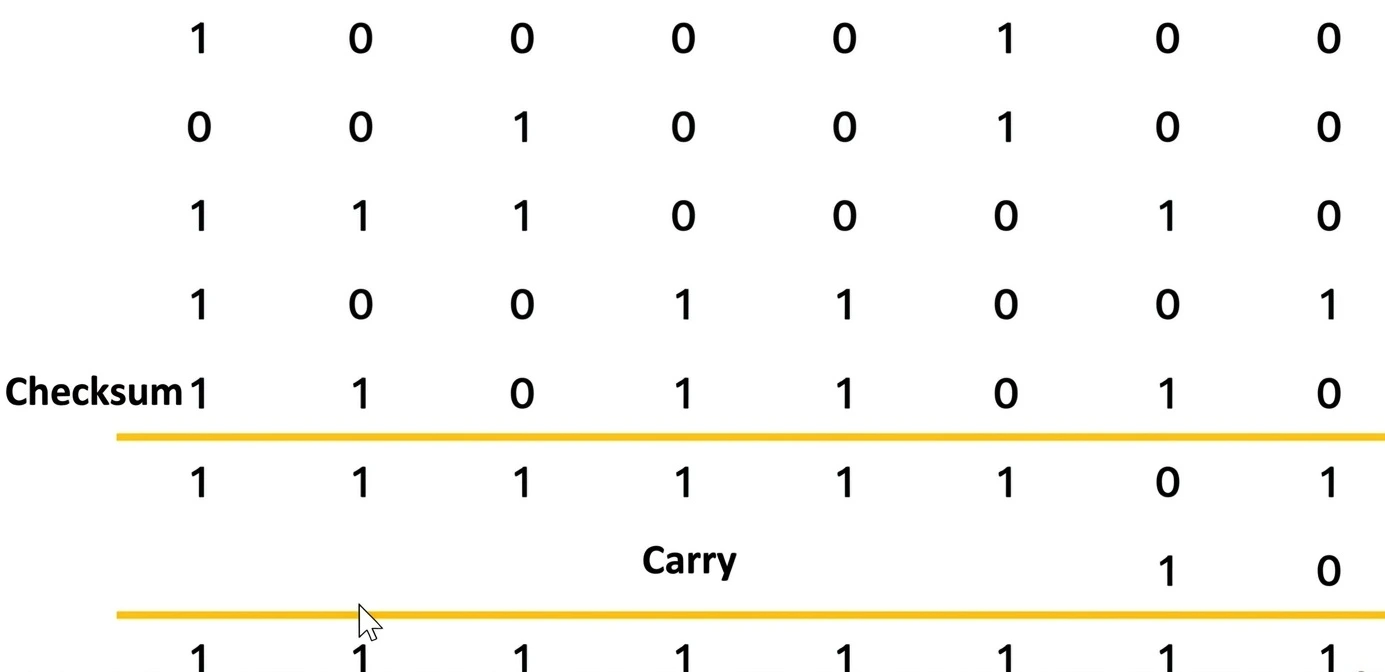
- 4Error Detection ChecksumExample & Performance of ChecksumData Link LayerExample: Suppose the original data is:
10011001111000100010010010000100
Assume the data is divided into four 8-bit blocks:
Step 1 — Add the Blocks:10011001 11100010 00100100 10000100
10011001
11100010
00100100
10000100
-----------------
00100011
+     10
---------------
00100101
The resulting 8-bit sum is: 00100101
Step 2 — One's Complement(invert): 00100101→ 11011010 (It is Checksum)
Step 3 — Transmitted Data:
The sender appends the checksum to the original data: 1101101010011001111000100010010010000100
Step 4 — Receiver Verification:
The receiver adds all four data blocks and the received checksum. If the final result is: 11111111
then the receiver assumes that no transmission error has been detected and accepts the data. otherwise rejected.

Performance of Checksum- Simple and easy to implement.
- Requires relatively little computational overhead.
- Can detect many single-bit, multiple-bit, and burst errors.
- Widely used in network and communication protocols.
- 5Error Detection CRCCRC and Step of CRCData Link LayerCRC (Cyclic Redundancy Check) is an error-detection technique used in the Data Link Layer to detect whether data has been corrupted during transmission.
Steps of CRC Process
Choose a Generator Polynomial — Sender and receiver agree on a binary divisor called the Generator.
Append Zeros — Add n-1 zeros to the original data, where n is the number of bits in the generator.
Binary Division — Divide the resulting bit sequence by the generator using XOR division.
Find Remainder — The remainder obtained from the division is called the CRC.
Create Codeword — Append the CRC remainder to the original data.
Transmit — Send the resulting data + CRC to the receiver.
Receiver Checks — Receiver divides the received codeword by the same generator.
Check Remainder:
Remainder = 0 → No error detected.
Remainder ≠ 0 → Error detected.
Shortcut:
Data → Append Zeros → XOR Division → CRC Remainder → Append CRC → Transmit → Divide → Check Remainder
CRC (Cyclic Redundancy Check) হলো একটি Error Detection Technique, যা Data Link Layer-এ Data Transmission-এর সময় Data Corrupted হয়েছে কি না তা শনাক্ত করতে ব্যবহৃত হয়।CRC Process-এর ধাপসমূহ
১. Choose a Generator Polynomial — Sender এবং Receiver একটি Binary Divisor-এর বিষয়ে সম্মত থাকে, যাকে Generator বলা হয়।
২. Append Zeros — Original Data-এর শেষে n-1টি Zero যোগ করা হয়, যেখানে n হলো Generator-এর Bit সংখ্যা।
৩. Binary Division — Zero যুক্ত Bit Sequence-কে Generator দিয়ে XOR Division করা হয়।
৪. Find Remainder — Division-এর মাধ্যমে প্রাপ্ত Remainder-কে CRC বলা হয়।
৫. Create Codeword — CRC Remainder-কে Original Data-এর শেষে যুক্ত করা হয়।
৬. Transmit — Data + CRC Receiver-এর কাছে পাঠানো হয়।
Receiver Checks — Receiver একই Generator ব্যবহার করে প্রাপ্ত Codeword-কে Divide করে।
Check Remainder:
Remainder = 0 → No error detected.
Remainder ≠ 0 → Error detected.
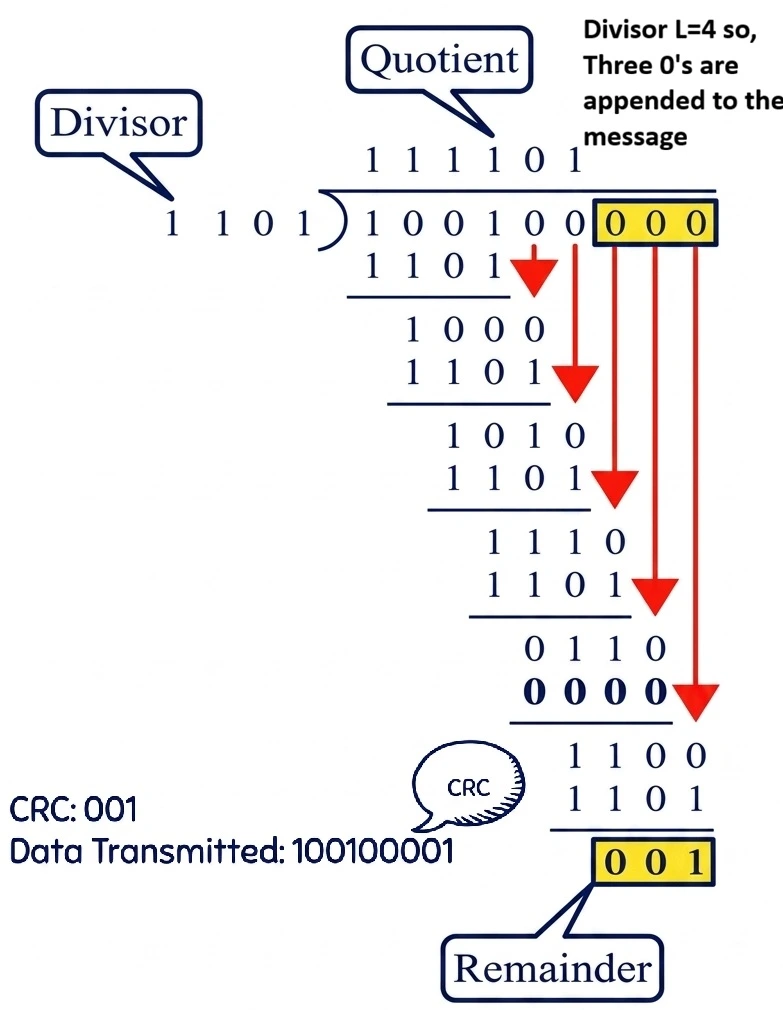
- 6Error Detection CRCFind the CRC for the data blocks 100100 with the divisor 1101?Data Link Layer

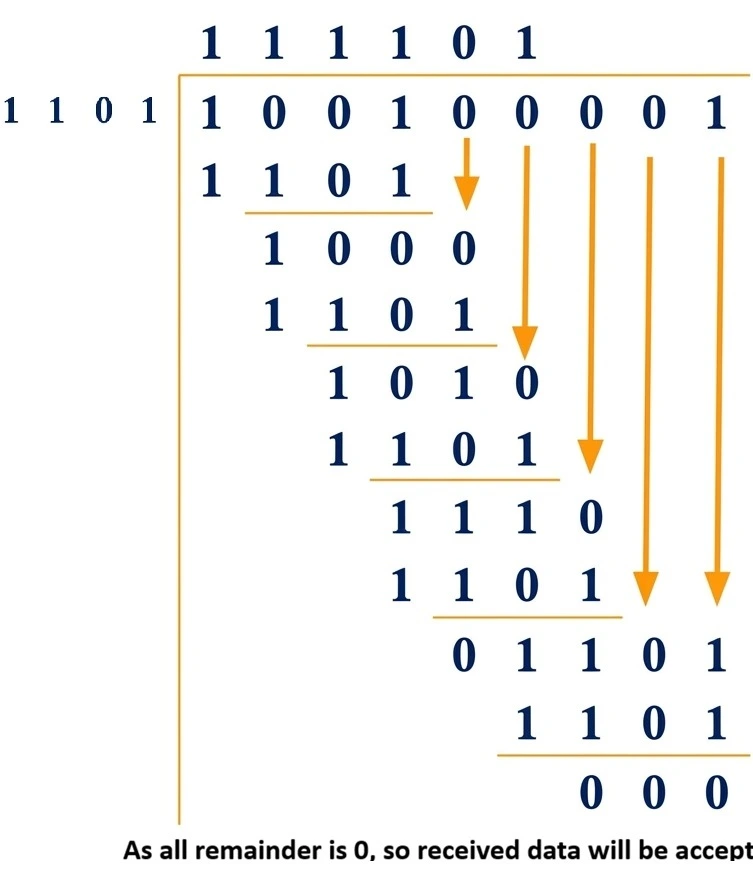
- 7Error Detection CRCReceiver received data 100100001 and the divisor is 1101 , Check the received Data will be accepted or not.Data Link Layer

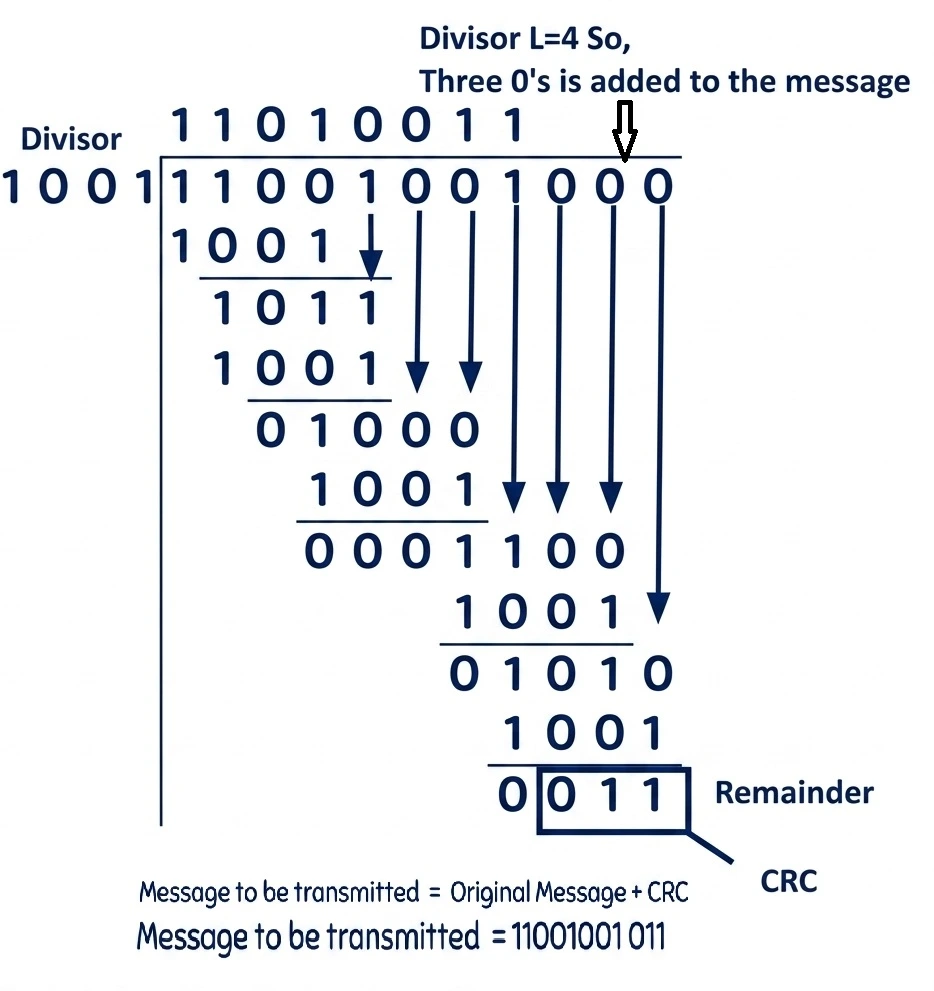
- 8Error Detection CRCThe message 11001001 is to be transmitted using CRC polynomial x3+1 to protect it from errors. Find the message that should be transmitted.Data Link Layer

Error Detection and Correction Code Example ( Hamming Code)
Given Data (m): 1011 → Length of data, $m = 4$
Formula: 2r ≥ m + r + 1
For r = 2: 22 ≥ 4 + 2 + 1 ⇒ 4 ≥ 7 (False)
For r = 3: 23 ≥ 4 + 3 + 1 ⇒ 8 ≥ 8 (True)
Selected r = 3. Total bits = $m + r = 4 + 3 = 7$ bits.
Place parity bits at positions that are powers of 2 (1, 2, 4):
| 7 | 6 | 5 | 4 | 3 | 2 | 1 |
|---|---|---|---|---|---|---|
| 1 | 0 | 1 | R3 | 1 | R2 | R1 |
Binary Position Table
| Position | R3 (4) | R2 (2) | R1 (1) |
|---|---|---|---|
| 0 | 0 | 0 | 0 |
| 1 (R1) | 0 | 0 | 1 |
| 2 (R2) | 0 | 1 | 0 |
| 3 | 0 | 1 | 1 |
| 4 (R3) | 1 | 0 | 0 |
| 5 | 1 | 0 | 1 |
| 6 | 1 | 1 | 0 |
| 7 | 1 | 1 | 1 |
Parity Bit Values
Bit Coverages:
- R1 covers positions (1, 3, 5, 7)
- R2 covers positions (2, 3, 6, 7)
- R3 covers positions (4, 5, 6, 7)
Even Parity Calculation:
R1 → (R1, Bit3, Bit5, Bit7) → (R1, 1, 1, 1) ⇒ R1 = 1 (to make count of 1s even)
R2 → (R2, Bit3, Bit6, Bit7) → (R2, 1, 0, 1) ⇒ R2 = 0 (already even)
R3 → (R3, Bit5, Bit6, Bit7) → (R3, 1, 0, 1) ⇒ R3 = 0 (already even)
Final Transmitted Hamming Code:
| 7 | 6 | 5 | 4 | 3 | 2 | 1 |
|---|---|---|---|---|---|---|
| 1 | 0 | 1 | 0 | 1 | 0 | 1 |
Transmitted Data: 1010101
Received Data: 1110101
| 7 | 6 | 5 | 4 | 3 | 2 | 1 |
|---|---|---|---|---|---|---|
| 1 | 1 | 1 | 0 | 1 | 0 | 1 |
Even Parity Check:
P1 (Positions 1, 3, 5, 7) → bits (1, 1, 1, 1) → Total 1s = 4 (Even) ⇒ 0
P2 (Positions 2, 3, 6, 7) → bits (0, 1, 1, 1) → Total 1s = 3 (Odd) ⇒ 1
P3 (Positions 4, 5, 6, 7) → bits (0, 1, 1, 1) → Total 1s = 3 (Odd) ⇒ 1
Error Location Calculation:
Syndrome Bits: (P3, P2, P1) = (1, 1, 0)2
Conclusion: Yes, there is an error! The error is located at Bit Position 6.
Correcting bit position 6 from 1 to 0 restores the original data: 1010101.