- 1Flow Control
- 2Stop-and-Wait Protocol
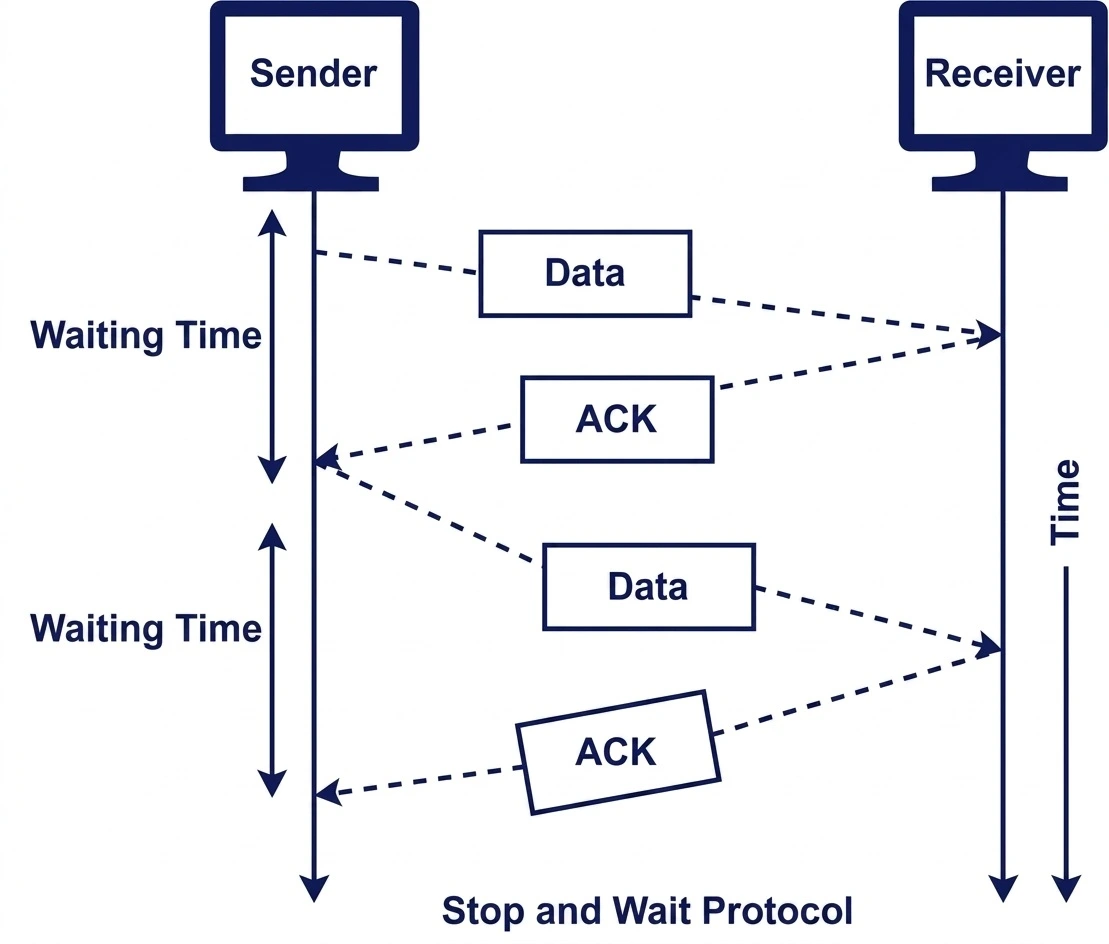
Stop-and-Wait Protocol is a Data Link Layer flow control protocol used for transmitting frames over a noiseless channel. It provides unidirectional data transmission with flow control but does not provide error control.
The basic idea is very simple: the sender sends only one frame at a time and waits for an acknowledgment (ACK) from the receiver before sending the next frame.

Working of Stop-and-Wait Protocol:
- The sender sends one data frame to the receiver.
- The sender waits for an acknowledgment before sending the next frame.
- The receiver receives and consumes the frame.
- After consuming the frame, the receiver sends an acknowledgment to the sender.
- After receiving the acknowledgment, the sender sends the next frame.
Example: Sender → Frame 1 → Receiver → ACK → Sender → Frame 2 → Receiver → ACK, and the process continues.
Advantages:
- Very simple and easy to implement.
- Provides basic flow control between sender and receiver.
- Prevents the sender from overwhelming a slow receiver.
Problems of Stop-and-Wait Protocol:
- Lost Data: If the data frame is lost, the receiver cannot send an acknowledgment, and the sender may wait indefinitely.
- Lost Acknowledgment: If the receiver's acknowledgment is lost, the sender does not know that the frame was successfully received and waits for the ACK.
- Delayed Data or Acknowledgment: If an ACK is delayed beyond the sender's waiting period, the sender may incorrectly interpret the delayed ACK as belonging to another frame.
Key Point: Stop-and-Wait is simple and reliable for flow control, but it is inefficient for large amounts of data because the sender must wait for an acknowledgment after every frame.
- 3Stop-and-Wait ARQ Protocol
Stop-and-Wait ARQ (Automatic Repeat reQuest) is a Data Link Layer protocol used for flow control and error control over noisy channels. It is an improved version of the simple Stop-and-Wait protocol.
In Stop-and-Wait ARQ, the sender sends one frame at a time and waits for an acknowledgment (ACK) before sending the next frame. It additionally uses a timer and sequence numbers to handle lost or delayed frames and acknowledgments.
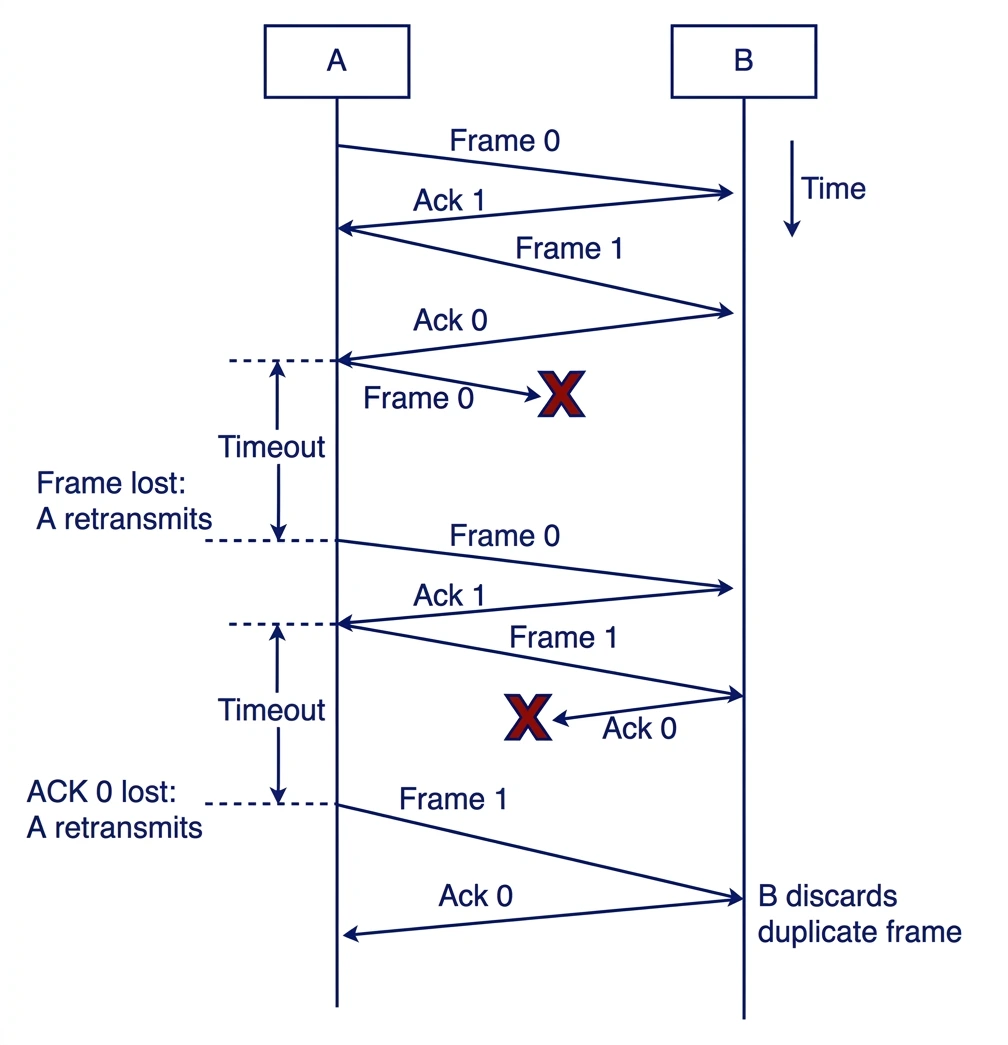
Working: After sending a frame, the sender starts a timer. If the ACK arrives before the timer expires, the sender sends the next frame. If the ACK does not arrive within the specified time, the sender assumes that the frame or ACK may have been lost and automatically retransmits the frame. This automatic retransmission is why it is called Automatic Repeat reQuest (ARQ).

Important Components:
- ACK: Confirms that the frame has been received successfully.
- Timer: Detects when an ACK has not arrived within the expected time.
- Sequence Number: Helps identify frames and detect duplicate frames caused by retransmission.
- Retransmission: The sender automatically sends the frame again when a timeout occurs.
Important Scenarios:
- ACK received before timeout: The frame and ACK are received successfully, so the sender sends the next frame.
- Frame lost: The receiver does not receive the frame and therefore does not send an ACK. After timeout, the sender retransmits the frame.
- ACK lost: The receiver receives the frame and sends an ACK, but the ACK is lost. After timeout, the sender retransmits the frame.
- Timeout occurs too soon: The frame and ACK are successfully delivered, but the ACK arrives after the timer expires. The sender retransmits the frame unnecessarily.
Difference from Simple Stop-and-Wait: Simple Stop-and-Wait mainly provides flow control and may wait indefinitely if a frame or ACK is lost. Stop-and-Wait ARQ adds a timer, sequence numbers, error detection and automatic retransmission, making it suitable for noisy channels.
Key Point: Stop-and-Wait ARQ = Stop-and-Wait + Timer + Sequence Number + Automatic Retransmission.
- 4Sliding Window Protocol
- 5Station A uses 32 byte packets to transmit message to Station B using a sliding window protocol. The round trip delay between A and B is 80 milliseconds and the bottleneck bandwidth on the path between A and B is 128 kbps. What is the optimal window size that A should use?
- 6The distance between two stations M and N is L kilometres. All frames are K bits long. The propagation time per kilometer is t seconds. Let R bits/second be the channel capacity. Assuming the processing delay is negligible, the minimum number of bits for the sequence number field in a frame for maximum utilization, when the sliding window protocol is used, is:
- 7If the bandwidth of a line is 1.5 Mbps, RTT is 45 ms, and packet size is 1 KB, find the link utilization in Stop-and-Wait protocol.
- 8A channel has a bit rate of 4 Kbps and one-way propagation delay of 20 ms. The channel uses Stop-and-Wait protocol. The transmission time of the acknowledgement frame is negligible. To get a channel efficiency of at least 50%, what should be the minimum frame size?
- 9What is the throughput achievable in Stop-and-Wait protocol for a maximum packet size of 1000 bytes and a network span of 10 km? Assume the speed of light in the cable is 70% of the speed of light in vacuum.
- 10If the packet size is 1 KB, propagation time is 15 ms, and channel bandwidth is 109 bits/sec, find the transmission time and sender utilization in Stop-and-Wait protocol.
- 11Consider a MAN with an average source and destination distance of 20 km and a one-way propagation delay of 100 μs. At what data rate does the round-trip delay equal the transmission delay for a 1 KB packet?
- 12Two hosts X and Y are connected by a direct link of rate 106 bits/sec. The distance between them is 10,000 km and the propagation speed is 2 × 10⁸ m/sec. Host X sends a file of 50,000 bytes as one large message to Y. Find the transmission delay and propagation delay.
- 13A sender uses Stop-and-Wait ARQ for reliable transmission. Frames are 1000 bytes and the sender transmission rate is 80 Kbps. The acknowledgement size is 100 bytes and the receiver transmission rate is 8 Kbps. The one-way propagation delay is 100 ms. Assuming no frame is lost, find the sender throughput in bytes/sec.
Flow Control and Its Protocol