- 1What is Network Topology and its types.
- 2Bus Topology
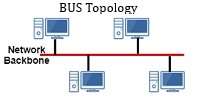
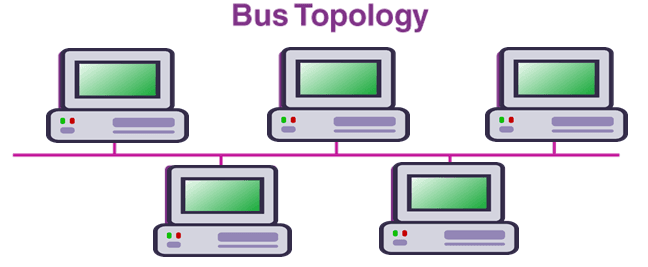
In Bus Topology, all devices are connected to a single central cable called the Backbone.
Each node is connected to the backbone using a Drop Cable.
When a device sends data, it travels along the backbone and is broadcast to all devices. Only the intended recipient accepts the data; others ignore it.

Advantages of Bus Topology:
- Simple to install and requires less hardware.
- Failure of one device does not affect other devices.
- Easy to troubleshoot due to simple structure.
Disadvantages of Bus Topology:
- If the backbone cable fails, the entire network stops working.
- Data collision occurs when multiple devices send data at the same time, reducing speed.
- As more devices are added, network performance decreases due to shared backbone traffic.
- 3Ring Topology
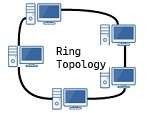
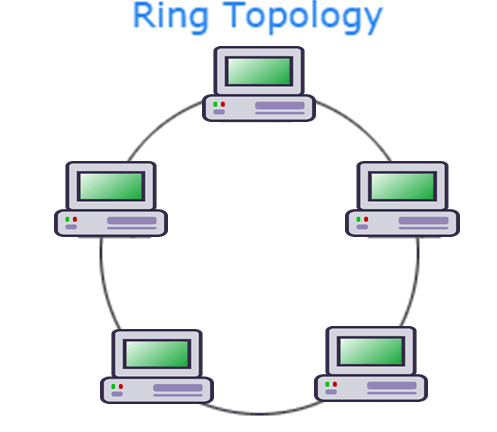
In Ring Topology, each device is connected to exactly two other devices, forming a circular structure. This creates a closed loop for data transmission.
Data moves in one direction from one device to another until it reaches the destination.

Working Principle of Ring Topology:
- Data transmission occurs using a special signal called a Token, which is why it is also called Token Ring.
- A Token is a special data packet that circulates through the network and controls permission to send data.
- Only the device holding the token can transmit data.
- The token moves sequentially from one device to another.
- When a device wants to send data, it captures the token, attaches the data, and transmits it.
- After successful transmission, the token is released and passed to the next device. Since only one device sends data at a time, collisions do not occur.
Advantages of Ring Topology:
- No data collision due to token-based transmission.
- Each device gets equal opportunity to send data.
Disadvantages of Ring Topology:
- Data travels in only one direction, even if the destination is nearby in the opposite direction.
- Failure of one node or link can disrupt the entire network.
- Performance decreases as network traffic increases.
- Data passes through multiple nodes, increasing security risks.
- 4Star Topology
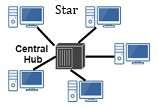
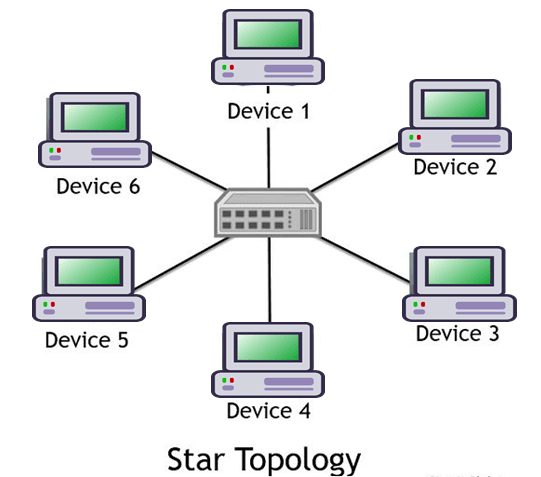
In Star Topology, all devices are connected to a central Hub or Switch, which acts as a mediator for data transmission. All network traffic passes through this central device.
This topology is widely used in modern networks because it is easy to set up and scalable.

Advantages of Star Topology:
- Easy to design and implement.
- Centralized administration is possible since all devices connect to a hub or switch.
- Adding new devices is simple.
- Failure of one device does not affect other devices.
Disadvantages of Star Topology:
- If the hub or switch fails, the entire network stops working.
- Overload on the hub or switch can reduce network performance.
- Requires more hardware (hub/switch), increasing cost.
- 5Tree Topology
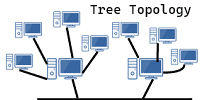
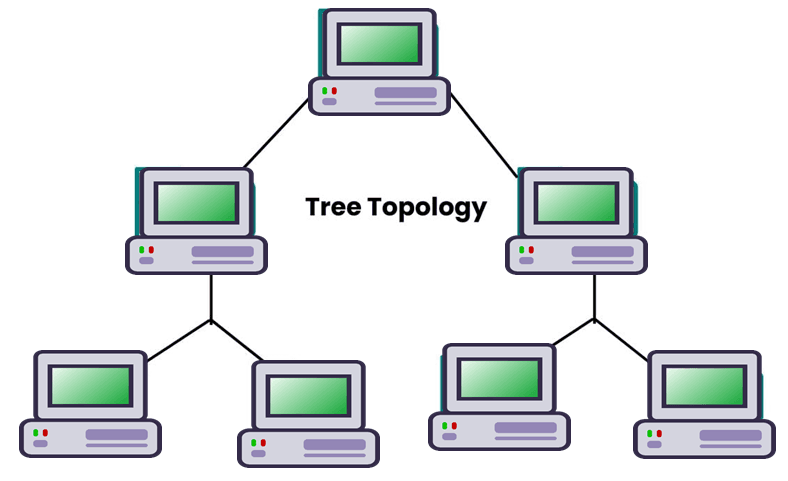
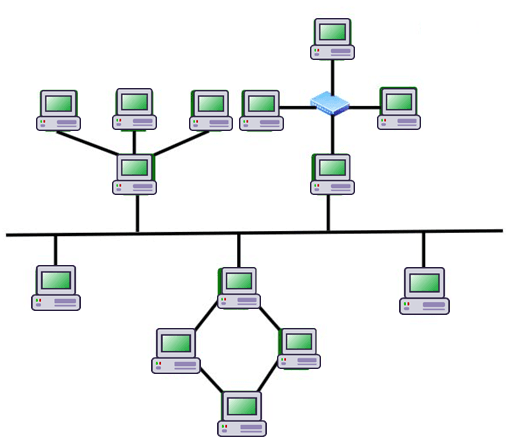
In Tree Topology, characteristics of both Bus and Star topologies are combined. Devices are organized in a hierarchical structure with multiple branches connected to a central root node.
It is commonly used in large networks such as WAN (Wide Area Network).

Advantages of Tree Topology:
- The network can easily expand by adding new nodes or branches.
- Easy to detect and troubleshoot problems.
- Large networks can be divided into smaller segments for better management.
Disadvantages of Tree Topology:
- If the main cable (root node) fails, the entire network is affected.
- Requires more cables and hardware, increasing installation cost.
- 6Mesh Topology
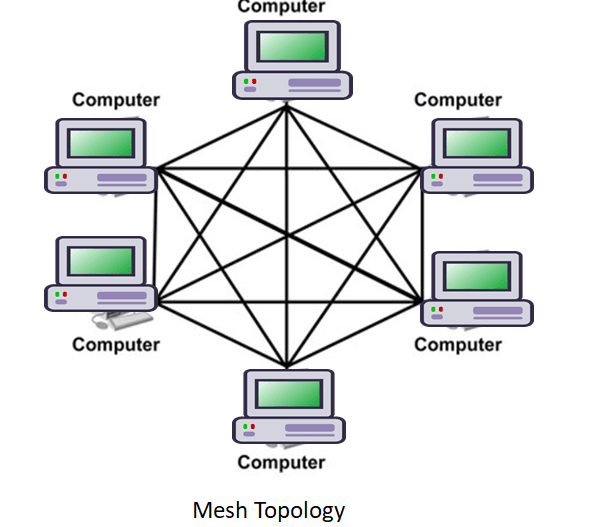
In Mesh Topology, devices are interconnected through multiple paths. Each device is either directly connected to every other device (Full Mesh) or connected to only some devices (Partial Mesh).
Mesh topology is suitable for large-scale networks where reliability and redundancy are important.

Advantages of Mesh Topology:
- Fault Tolerance: Multiple paths allow continuous communication even if one link fails.
- High Security: Direct point-to-point connections provide better security.
- Fast Communication: Data can travel through the shortest path, increasing speed.
Disadvantages of Mesh Topology:
- Requires a large amount of wiring and hardware, making it expensive.
- Difficult to configure and manage.
- Not practical for very large networks due to complexity and cost.
- 7Hybrid Topology
Hybrid Topology is a combination of two or more different topologies designed to meet specific organizational needs. For example, a network may combine Star and Bus topologies.
Hybrid networks are highly customizable and scalable.

Advantages of Hybrid Topology:
1. Flexibility: Can be customized according to organizational requirements.
2. Fault Tolerance: If one part of the network fails, the remaining parts may continue to function.
3. Scalability: New devices can be added without affecting the existing network structure.
Disadvantages of Hybrid Topology:
1. Complex Design: Designing and managing a hybrid network is complex.
2. Expensive: Requires more hardware, cabling, and installation cost.
- 8Networking DeviceNetworking Devices(Hub, Bridge, Switch, Router, Modem, Repeater, and Gateway) (One Shot)
- 9Networking DeviceNetwork Interface Card (NIC)
- 10Networking DeviceReapeter
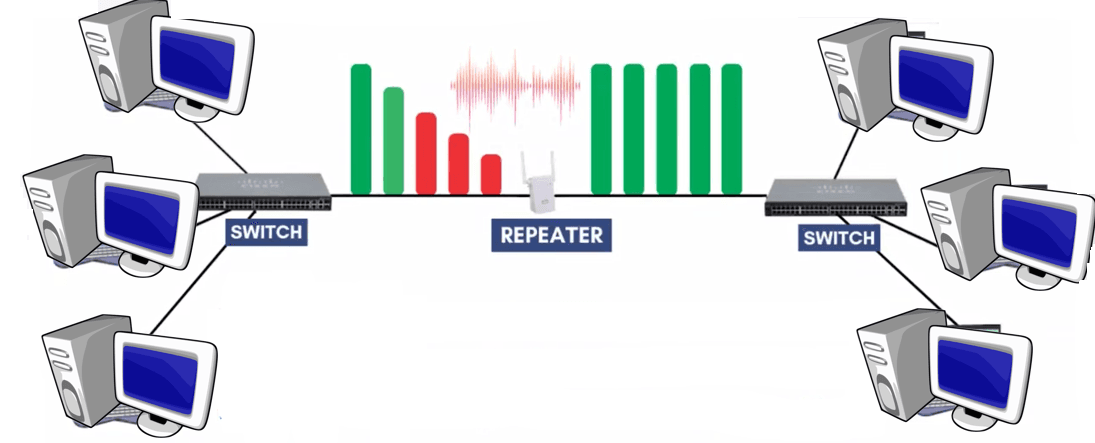
A Repeater is a network device that receives a weak network signal, regenerates it, and retransmits it to extend the communication distance.
When a network signal travels through transmission media such as Ethernet Cable or wireless media, its strength gradually decreases as the distance increases. This phenomenon is known as Signal Attenuation.
A repeater receives the weakened signal and regenerates it before forwarding it to the next segment or device. Therefore, it helps maintain the quality of the signal over a longer distance.
A traditional repeater operates at the Physical Layer (Layer 1) of the OSI Model. It does not examine the destination address or make routing decisions.
Advantages: It extends network coverage, helps overcome signal attenuation, and allows devices to communicate over greater distances.
Example: A Wi-Fi repeater can receive a weak Wi-Fi signal and retransmit it to provide network coverage in an area that is farther from the main router.

- 11Networking DeviceHub
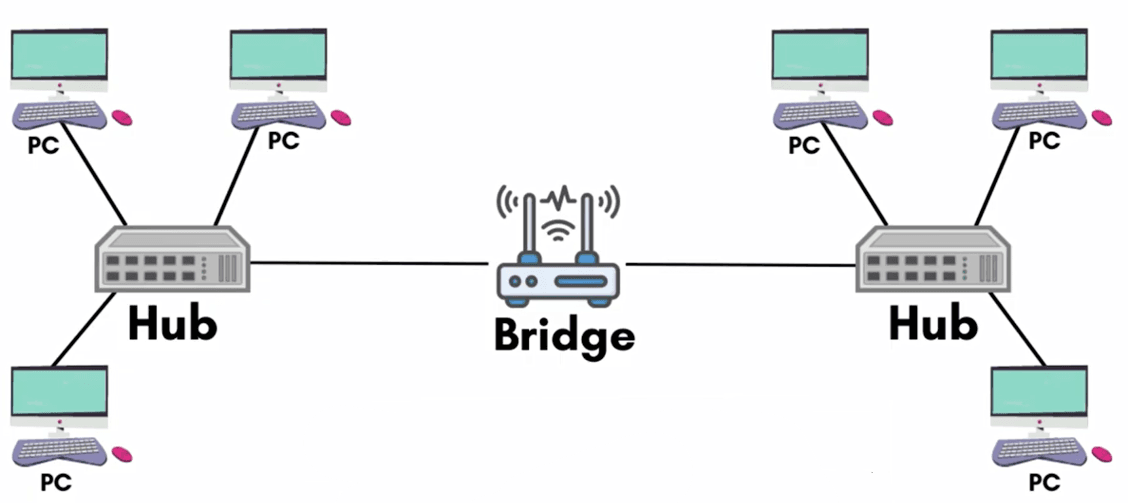
A Hub is a basic networking device used to connect multiple devices in a Local Area Network (LAN).
A hub operates at the Physical Layer (Layer 1) of the OSI Model. It does not examine MAC addresses or make decisions about where to forward data.
When a hub receives a signal from one device, it repeats the signal to all other connected ports. Therefore, it cannot send data only to the intended destination device.
Because all connected devices share the same collision domain and bandwidth, network performance decreases as the number of connected devices increases. Collisions can also occur when multiple devices transmit at the same time.
Traditional Ethernet hubs operate in Half-Duplex mode, meaning a device can either send or receive data at a time, but it cannot perform both simultaneously.

Types of Hub:
1. Passive Hub:
- Provides a physical connection between network devices.
- Does not amplify or regenerate the incoming signal.
- Generally does not require an external power supply.
- Suitable for short-distance connections.
2. Active Hub:
- Receives the incoming signal and regenerates or strengthens it before retransmitting it.
- Requires a power source.
- Works similarly to a repeater.
- Can help extend the network's transmission distance.
3. Intelligent Hub:
- Provides additional network management and monitoring features.
- Can monitor network traffic and the status of ports.
- May support management protocols such as SNMP and use a MIB (Management Information Base) for network management information.
- Helps administrators monitor and troubleshoot network problems.
Advantages of Hub:
- Simple to install and configure.
- Less expensive than many managed networking devices.
- Can connect multiple Ethernet devices in a small network.
- Broadcasting behavior can sometimes be useful for basic network troubleshooting.
Disadvantages of Hub:
- Broadcasts incoming data to all connected ports.
- Creates a single collision domain.
- Shares available bandwidth among connected devices.
- Supports only Half-Duplex communication.
- Provides no intelligent traffic filtering or MAC-address-based forwarding.
- Generally offers lower performance and security than a modern Switch.
- 12Networking DeviceBridge
A Bridge is a networking device that connects two or more network segments and allows them to communicate with each other.
A traditional bridge operates at the Data Link Layer (Layer 2) of the OSI Model. It uses MAC Addresses to make forwarding and filtering decisions.
The main purpose of a bridge is to divide a large LAN into smaller network segments, reduce unnecessary traffic, and improve network performance.

How Bridge Works:
- The bridge receives a data frame and examines its Source MAC Address and Destination MAC Address.
- It learns the location of devices by recording Source MAC Addresses in its MAC Address Table.
- If the destination device is on the same segment from which the frame came, the bridge filters the frame and does not forward it to the other segment.
- If the destination device is on another segment, the bridge forwards the frame to the appropriate segment.
- If the destination MAC address is unknown, the bridge generally floods the frame to the other segments, except the segment from which the frame was received.
- This filtering and forwarding process reduces unnecessary traffic between network segments.
Key Characteristics of Bridge:
- Operates at Layer 2 (Data Link Layer).
- Uses MAC Addresses.
- Maintains a MAC Address Table.
- Can perform Frame Filtering and Frame Forwarding.
- Separates Collision Domains.
- Does not normally separate Broadcast Domains.
Note: A modern Network Switch performs the basic functions of a multi-port bridge and is commonly considered a multi-port bridge.
- 13Networking DeviceSwitch
- 14Networking DeviceRouter
A Router is a networking device that connects two or more different networks and forwards data packets between them.
A traditional router operates at the Network Layer (Layer 3) of the OSI Model. It uses IP Addresses to identify source and destination networks and determine where packets should be forwarded.
A router uses a Routing Table to select an appropriate or best available path for forwarding packets toward their destination. The routing table contains information about available networks, next-hop addresses, interfaces, and routing metrics.

How Router Works:
- The router receives a data packet from an incoming interface.
- It examines the packet's Destination IP Address.
- It checks the Routing Table to determine the best matching route.
- It forwards the packet through the appropriate outgoing interface toward the destination network.
- If no suitable route is available, the router may discard the packet or use a default route if one is configured.
Advantages of Router:
- Connects different networks and enables communication between them.
- Uses routing information to select an appropriate path for data packets.
- Separates Broadcast Domains, helping control broadcast traffic between networks.
- Can provide security features such as Access Control Lists (ACLs), firewall functions, and traffic filtering depending on the router.
- Supports large and scalable networks.
Disadvantages of Router:
- Configuration and management can require technical knowledge.
- High-performance routers can be expensive.
- Packet processing and complex configurations can affect performance if the router is overloaded or underpowered.
- A poorly configured or unsecured router can become a security risk.
- If a critical router fails and there is no backup path, communication between the affected networks may be interrupted.
Key Exam Points:
- OSI Layer: Network Layer (Layer 3).
- Address Used: IP Address.
- Table Used: Routing Table.
- Data Unit: Packet.
- Main Function: Routing and forwarding packets between different networks.
- Broadcast Domain: A router separates Broadcast Domains.
- 15Networking DeviceBrouter
- 16Networking DeviceAccess point
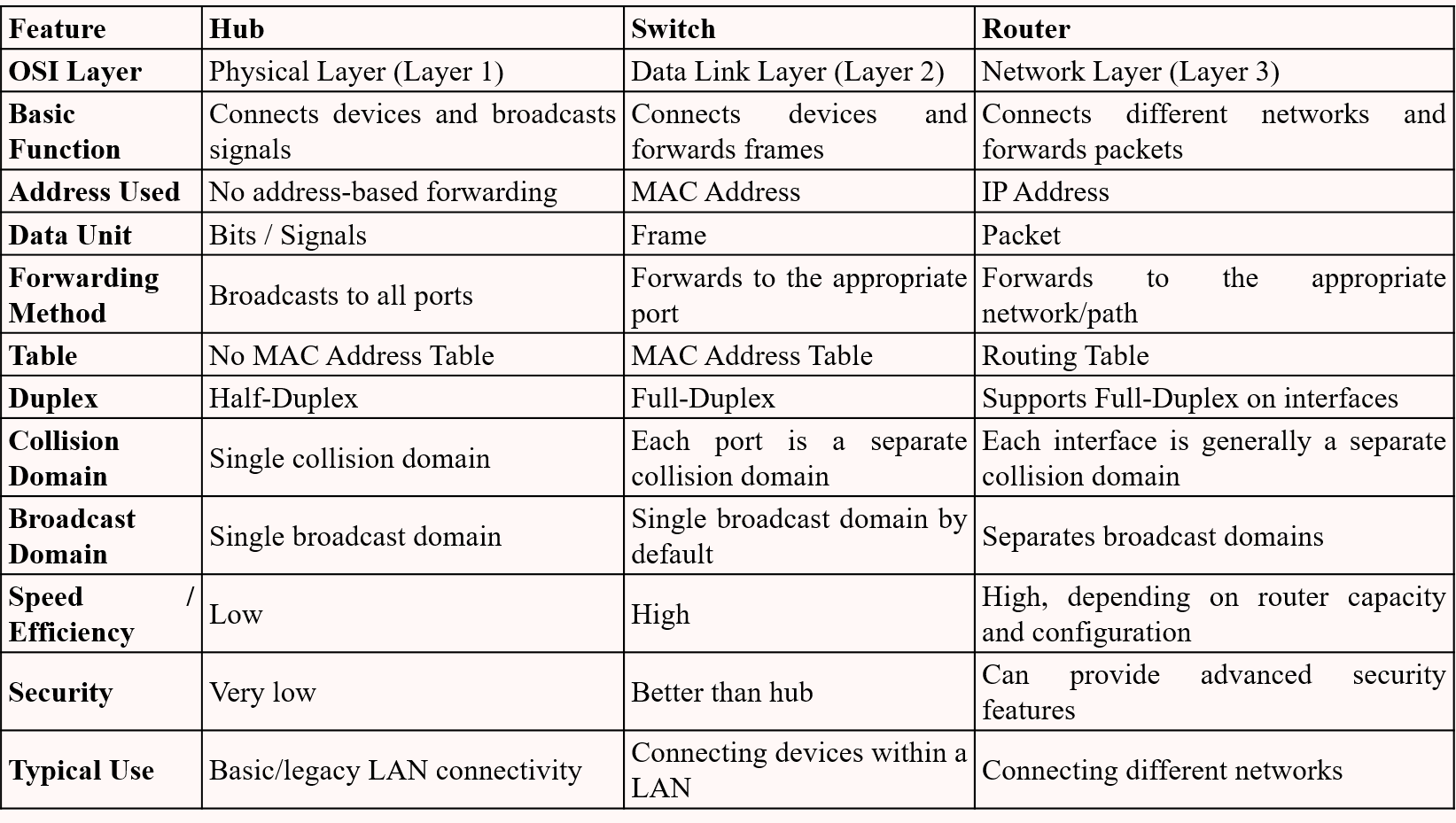
- 17Networking DeviceHub vs Switch vs Router

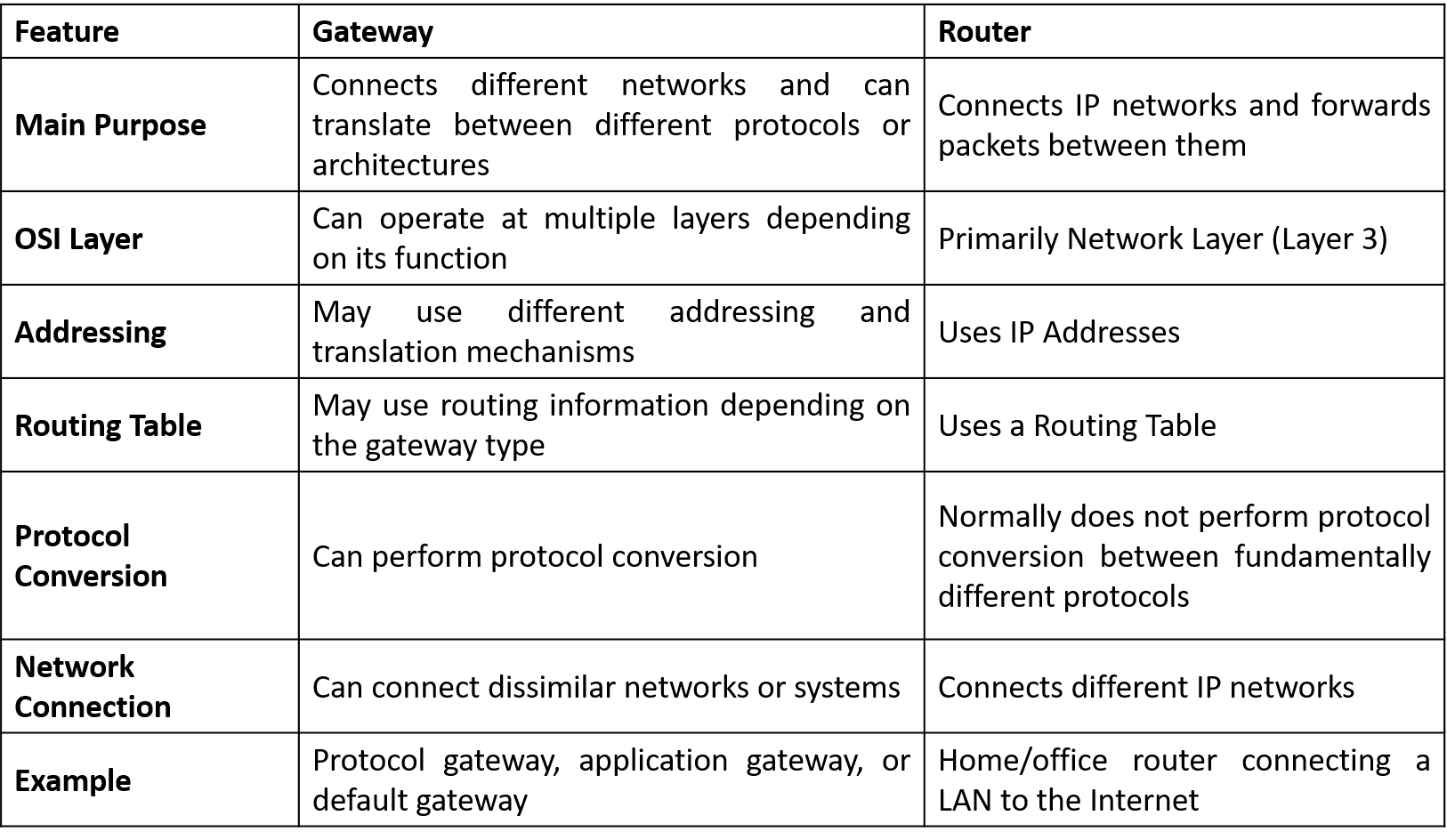
- 18Networking DeviceRouter vs Gateway

- 19Networking DeviceNetwork Security Device (Firewall & it types)
- 20Networking DeviceTraditional Firewall vs Next generation firewall

Previous Job Question: Network Topology & Devices
Previous Job Question: Network Topology & Devices
- ☆1Computer NetworkNetwork Topology & DevicesDescribe the functions of a Switch and a Router and explain two key differences between these networking devices.
- ☆2Computer NetworkNetwork Topology & DevicesBriefly describe the following network devices: Repeater, Hub, Bridge, Switch and Router.
- ☆3Computer NetworkNetwork Topology & DevicesWhat is network topology? Explain the different network topologies.
- ☆4Computer NetworkNetwork Topology & DevicesWrite connection type?
i. Router to Router
ii. Router to switch
iii. Computer to computer
iv. Hub to Switch - ☆5Computer NetworkNetwork Topology & DevicesDifference among Switch, Bridge and Router.
- ☆6Computer NetworkNetwork Topology & DevicesWhat is Topology in data communication? What are differences between Bus, Ring, Tree and Star topology? Purpose of IEEE 802.11 committee. 10
Network Topology
Network topology refers to the physical or logical arrangement of computers, devices, and communication links in a network that determines how data is transmitted.
Example: Computers connected through a central switch in an office network follow Star topology.
1. Bus Topology
Working: In bus topology, all devices are connected to a single backbone cable. When a device sends data, it travels along the cable and reaches all devices, but only the intended receiver accepts it.

Advantage: Low installation cost and simple structure.
2. Ring Topology
Working: In ring topology, devices are connected in a circular manner. Data moves in one direction from one device to the next until it reaches the destination.

Advantage: No data collision occurs.
3. Star Topology
Working: In star topology, all devices are connected to a central hub or switch. Data sent by a device first goes to the hub, which then forwards it to the destination device.

Advantage: Easy to manage and troubleshoot.
4. Tree Topology
Working: Tree topology uses a hierarchical structure where multiple star networks are connected to a main backbone cable, and data flows from parent nodes to child nodes.

Advantage: Suitable for large and expandable networks.
3. Purpose of IEEE 802.11 Committee
The IEEE 802.11 committee is responsible for developing standards for Wireless Local Area Networks (WLAN).
- Defines Wi-Fi communication standards
- Ensures interoperability between wireless devices
- Improves wireless speed, security, and reliability
- ☆7Computer NetworkNetwork Topology & DevicesA network administrator is replacing a hub-based LAN with a switch-based LAN. Explain the differences between half-duplex and full-duplex communication and discuss how the change affects network performance.[assume]
- ☆8Computer NetworkNetwork Topology & DevicesWhat is Network Topology? Distinguish between Bus, Ring, Tree and Star topology. Discuss how the Bus topology works.
Network Topology
Network topology refers to the physical or logical arrangement of computers, devices, and communication links in a network that determines how data is transmitted.
Example: Computers connected through a central switch in an office network follow Star topology.
1. Bus Topology
Working: In bus topology, all devices are connected to a single backbone cable. When a device sends data, it travels along the cable and reaches all devices, but only the intended receiver accepts it.
Advantage: Low installation cost and simple structure.
2. Ring Topology
Working: In ring topology, devices are connected in a circular manner. Data moves in one direction from one device to the next until it reaches the destination.
Advantage: No data collision occurs.
3. Star Topology
Working: In star topology, all devices are connected to a central hub or switch. Data sent by a device first goes to the hub, which then forwards it to the destination device.
Advantage: Easy to manage and troubleshoot.
4. Tree Topology
Working: Tree topology uses a hierarchical structure where multiple star networks are connected to a main backbone cable, and data flows from parent nodes to child nodes.
Advantage: Suitable for large and expandable networks.