
Ministry of Food
Post: Network/Website Manager
Exam Date: 30-11-2022, Subject: CSE, Exam Taker: BPSC
1 (a) Name and define the components of data communication system with necessary diagram. 6 marks
- Message: The message is the actual information that needs to be transmitted. It may include text, audio, video, images, or a combination of these.
- Sender: The sender is the device that originates and sends the message, such as a computer, smartphone, or other transmitting device.
- Receiver: The receiver is the destination device that receives and interprets the transmitted message.
- Transmission Medium: This is the physical path or channel through which data travels from sender to receiver. It can be wired (fiber optic, coaxial cable) or wireless (radio waves, infrared).
- Protocol: A protocol is a set of rules that governs data communication. It defines data format, transmission methods, error detection, and correction.
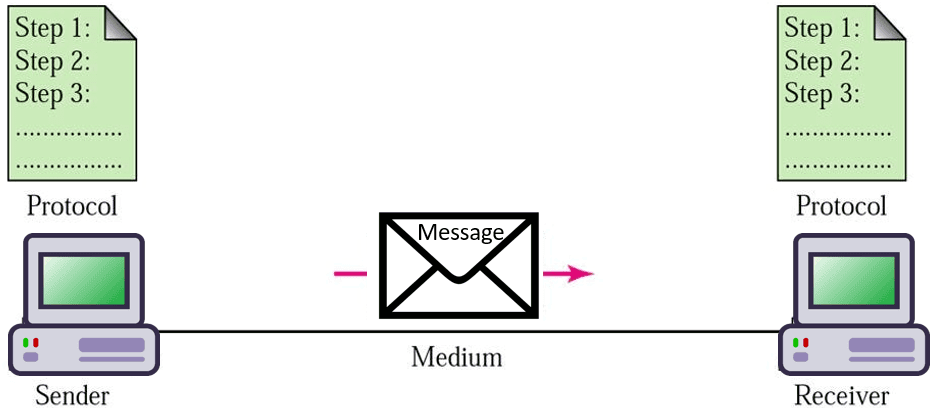
- Message: Message হলো আসল তথ্য যা প্রেরণ করা হয়। এটি text, audio, video, image অথবা এগুলোর সমন্বয় হতে পারে।
- Sender: Sender হলো সেই device যেটি message তৈরি করে এবং পাঠায়, যেমন computer, smartphone ইত্যাদি।
- Receiver: Receiver হলো সেই device যেটি পাঠানো message গ্রহণ করে এবং বুঝতে পারে।
- Transmission Medium: Transmission medium হলো সেই পথ যার মাধ্যমে message sender থেকে receiver-এর কাছে পৌঁছায়। এটি wired (fiber optic, coaxial cable) অথবা wireless (radio wave, infrared) হতে পারে।
- Protocol: Protocol হলো নিয়মের একটি সেট যা data কীভাবে পাঠানো ও গ্রহণ করা হবে তা নির্ধারণ করে। এটি data format, error checking এবং correction নিয়ন্ত্রণ করে।

1 (b) What do you mean by transmission speed and Bandwidth? 4 marks
Transmission Speed
Transmission Speed refers to the actual rate at which data is transmitted from one device to another over a network. It indicates how fast data is being sent or received at a given moment.
Unit: bits per second (bps), Mbps, Gbps.
Bandwidth
Bandwidth refers to the maximum data-carrying capacity of a communication channel. It represents the maximum amount of data that can be transmitted over a network in a given period of time.
Unit: Hertz (Hz) or bits per second (bps).
Note: Bandwidth defines the capacity of the channel, while transmission speed shows how much of that capacity is actually being used.
Transmission Speed
Transmission Speed হলো network-এর মাধ্যমে এক device থেকে অন্য device-এ data কত দ্রুত পাঠানো বা গ্রহণ করা হচ্ছে তার পরিমাপ। এটি data transfer-এর বাস্তব গতি নির্দেশ করে।
Unit: bits per second (bps), Mbps, Gbps।
Bandwidth
Bandwidth হলো একটি communication channel সর্বোচ্চ কত পরিমাণ data বহন করতে পারে তার ক্ষমতা। এটি network-এর maximum data-carrying capacity নির্দেশ করে।
Unit: Hertz (Hz) অথবা bits per second (bps)।
Note: Bandwidth channel-এর capacity নির্দেশ করে, আর transmission speed দেখায় সেই capacity-এর কতটুকু ব্যবহার হচ্ছে।
2 (a) Write some outstanding characteristics of E-commerce. 4 marks
Outstanding Characteristics of E-commerce
- Global Reach: E-commerce enables businesses to reach customers worldwide without geographical limitations.
- 24×7 Availability: Online stores operate round the clock, allowing customers to shop anytime.
- Convenience: Customers can buy products and services from anywhere using internet-enabled devices.
- Cost Effectiveness: Reduces operational costs such as physical stores, staff, and inventory management.
- Personalization: Offers personalized recommendations based on customer behavior and preferences.
- Fast Transactions: Electronic payment systems enable quick and secure transactions.
- Easy Information Access: Customers can easily compare products, prices, and reviews.
E-commerce-এর উল্লেখযোগ্য বৈশিষ্ট্যসমূহ
- Global Reach: E-commerce-এর মাধ্যমে ব্যবসা বিশ্বব্যাপী customer-এর কাছে পৌঁছাতে পারে।
- 24×7 Availability: Online store সবসময় খোলা থাকে, যেকোনো সময় কেনাকাটা করা যায়।
- Convenience: Internet-enabled device ব্যবহার করে যেকোনো স্থান থেকে কেনাকাটা করা যায়।
- Cost Effectiveness: Physical store, staff এবং inventory cost কমে যায়।
- Personalization: Customer-এর behavior অনুযায়ী personalized product suggestion দেওয়া যায়।
- Fast Transactions: Electronic payment system ব্যবহার করে দ্রুত ও নিরাপদ লেনদেন সম্ভব।
- Easy Information Access: Product, price এবং review সহজে তুলনা করা যায়।
2 (b) Briefly explain different payment systems used in E-commerce. 6 marks
- Credit Card: Allows customers to pay online using card details; widely used and supports instant payment.
- Debit Card: Amount is directly deducted from the customer’s bank account during purchase.
- Net Banking: Enables direct transfer of money from the customer’s bank account to the merchant.
- Digital Wallet: Stores money electronically and allows fast payments (e.g., PayPal, Google Pay).
- Mobile Payment: Uses mobile apps or SMS-based systems for payment.
- Cash on Delivery (COD): Customers pay in cash when the product is delivered.
- Credit Card: Card details ব্যবহার করে online payment করা হয় এবং তাৎক্ষণিক লেনদেন সম্ভব।
- Debit Card: Customer-এর bank account থেকে সরাসরি টাকা কেটে নেওয়া হয়।
- Net Banking: Bank account থেকে সরাসরি merchant-এর account-এ টাকা পাঠানো হয়।
- Digital Wallet: Electronic money store করে দ্রুত payment করা যায় (যেমন PayPal, Google Pay)।
- Mobile Payment: Mobile app বা SMS-এর মাধ্যমে payment সম্পন্ন করা হয়।
- Cash on Delivery (COD): Product delivery-এর সময় নগদ অর্থ প্রদান করা হয়।
3 (a) Can you call one constructor from another if a class has multiple constructors in Java? Briefly explain. 3 marks
- The this() call must be the first statement inside the constructor.
- It helps reduce code duplication by reusing initialization code.
- Only one constructor can be called using this() at a time.
class Sample {
Sample() {
this(10);
}
Sample(int x) {
System.out.println(x);
}
}
- this() সবসময় constructor-এর প্রথম statement হতে হবে।
- Initialization code reuse করার জন্য এটি ব্যবহার করা হয়।
- এক সময়ে শুধুমাত্র একটি constructor কল করা যায়।
class Sample {
Sample() {
this(10);
}
Sample(int x) {
System.out.println(x);
}
}
3 (b) What is the difference between "compile time" and "run time" polymorphism. 2 marks
Difference between Compile Time and Run Time Polymorphism
Compile Time Polymorphism
Compile time polymorphism is achieved when the method call is resolved at compile time. It is also known as static polymorphism and is implemented using method overloading.
- Decision is made during compilation.
- Methods have the same name but different parameters.
- Faster execution.
Run Time Polymorphism
Run time polymorphism occurs when the method call is resolved at runtime. It is also called dynamic polymorphism and is implemented using method overriding.
- Decision is made during program execution.
- Uses inheritance and dynamic binding.
- More flexible but slightly slower.
Compile Time এবং Run Time Polymorphism-এর পার্থক্য
Compile Time Polymorphism
Compile time polymorphism তখন ঘটে যখন method call compile সময়েই নির্ধারিত হয়। একে static polymorphism বলা হয় এবং এটি method overloading দ্বারা বাস্তবায়িত হয়।
- Compile সময়েই সিদ্ধান্ত নেওয়া হয়।
- Method-এর নাম একই কিন্তু parameter ভিন্ন হয়।
- Execution তুলনামূলকভাবে দ্রুত।
Run Time Polymorphism
Run time polymorphism তখন ঘটে যখন method call program চলার সময় নির্ধারিত হয়। একে dynamic polymorphism বলা হয় এবং এটি method overriding দ্বারা বাস্তবায়িত হয়।
- Program execution-এর সময় সিদ্ধান্ত নেওয়া হয়।
- Inheritance এবং dynamic binding ব্যবহার করে।
- বেশি flexible হলেও কিছুটা ধীর।
3 (c) Write a Java program to find the frequency of a character in a string. 5 marks
import java.util.Scanner;
public class CharacterFrequency {public static void main(String[] args) {
// Creating Scanner object for user input
Scanner scanner = new Scanner(System.in);
// Taking string input
System.out.print("Enter a string: ");
String str = scanner.nextLine();
// Taking character input
System.out.print("Enter the character to find frequency: ");
char ch = scanner.next().charAt(0);
// Variable to store frequency count
int count = 0;
// Loop through the string to count occurrences of the character
for (int i = 0; i < str.length(); i++)
{
if (str.charAt(i) == ch) {
count++;
}
}
// Displaying the result
System.out.println("Frequency of '" + ch + "' in the string: " + count);
// Closing scanner
scanner.close();
}
}
4 (a) State the importance of information in modern science. 4 marks
- Foundation of Research: Information is essential for scientific research, analysis, and discovery.
- Decision Making: Accurate information helps scientists make informed decisions and predictions.
- Technological Advancement: Modern technologies like AI, biotechnology, and space science depend on vast amounts of data and information.
- Knowledge Sharing: Information enables collaboration and sharing of scientific knowledge globally.
- Problem Solving: Scientific information helps in solving complex real-world problems such as climate change and medical research.
- Research-এর ভিত্তি: Scientific research, analysis এবং discovery-এর জন্য information অত্যন্ত গুরুত্বপূর্ণ।
- Decision Making: সঠিক information বিজ্ঞানীদের সঠিক সিদ্ধান্ত ও পূর্বাভাস দিতে সাহায্য করে।
- Technological Advancement: AI, biotechnology এবং space science-এর মতো আধুনিক প্রযুক্তি information-এর উপর নির্ভরশীল।
- Knowledge Sharing: Information বিশ্বব্যাপী scientific knowledge আদান-প্রদান সহজ করে।
- Problem Solving: Climate change, medical research-এর মতো জটিল সমস্যা সমাধানে information গুরুত্বপূর্ণ ভূমিকা রাখে।
4 (b) What is the information system? Briefly describe various types of information system. 5 marks
Information System (IS):
An Information System is a combination of people, hardware, software, data, and procedures that work together to collect, process, store, and distribute information to support decision-making and control in an organization.
Types of Information System:
1. Transaction Processing System (TPS):
TPS records and processes daily routine transactions of an organization.
Example: Sales entry, ATM transactions, payroll system.
2. Management Information System (MIS):
MIS uses data from TPS to generate reports for middle-level management to help in planning and controlling.
Example: Monthly sales report, performance report.
3. Decision Support System (DSS):
DSS helps managers make semi-structured or complex decisions using analytical models and data analysis tools.
Example: Investment analysis system, budgeting system.
4. Executive Information System (EIS):
EIS provides summarized and strategic information to top-level executives for decision-making.
Example: Company performance dashboard.
5. Office Automation System (OAS):
OAS supports office activities and improves communication and productivity.
Example: Email system, word processing, video conferencing.
Conclusion (Exam Point):Information Systems help organizations operate efficiently, improve decision-making, and gain competitive advantage.
Information System (IS):
Information System হলো people, hardware, software, data এবং procedures-এর সমন্বয়ে গঠিত একটি system, যা information সংগ্রহ, প্রক্রিয়াকরণ, সংরক্ষণ এবং বিতরণ করে organization-এর decision-making এবং control সমর্থন করে।
Information System-এর বিভিন্ন প্রকারভেদ:
১. Transaction Processing System (TPS):
TPS organization-এর দৈনন্দিন transaction record ও process করে।
উদাহরণ: Sales entry, ATM transaction, payroll system।
২. Management Information System (MIS):
MIS, TPS থেকে data নিয়ে report তৈরি করে, যা middle-level management planning ও control-এর জন্য ব্যবহার করে।
উদাহরণ: Monthly sales report, performance report।
৩. Decision Support System (DSS):
DSS analytical model ও data analysis tool ব্যবহার করে complex বা semi-structured decision নিতে সহায়তা করে।
উদাহরণ: Investment analysis system, budgeting system।
৪. Executive Information System (EIS):
EIS top-level management-কে summarized ও strategic information প্রদান করে।
উদাহরণ: Company performance dashboard।
৫. Office Automation System (OAS):
OAS office-এর communication ও productivity বৃদ্ধি করে।
উদাহরণ: Email system, word processing, video conferencing।
উপসংহার (Exam Point):Information System organization-কে দক্ষভাবে পরিচালনা, উন্নত decision-making এবং competitive advantage অর্জনে সহায়তা করে।
